
Results

BLOOD AND BURNING.
London: Victor Gollancz Ltd, 1979. Octavo, boards. First British (and first hardcover) edition. This edition prints six of the eleven stories printed in the 1978 Berkley paperback. [Reference: Anatomy of Wonder (1987) 3-75].
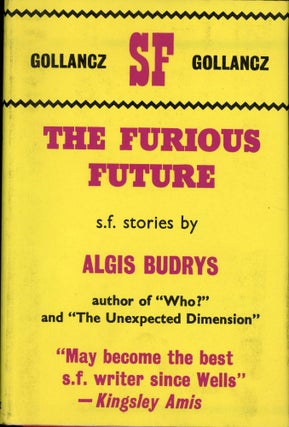
THE FURIOUS FUTURE.
London: Victor Gollancz, Ltd, 1964. Octavo, boards. First British (and first hardcover edition). Collects nine stories. Issued earlier in the U.S. as BUDRYS' INFERNO (1963). [Reference: Anatomy of Wonder (1987) 3-76].
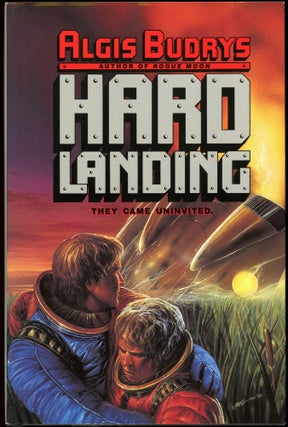
HARD LANDING.
[New York]: Warner Books, [1994]. Octavo, boards. First hardcover edition. Issued by the Science Fiction Book Club. Nebula Award nominee. Thirty years after an alien ship crash lands on earth, the four humanoid survivors have blended into American life. But after the death of one in which an autopsy reveals his true nature and the discovery of the original alien ship, an investigation begins.
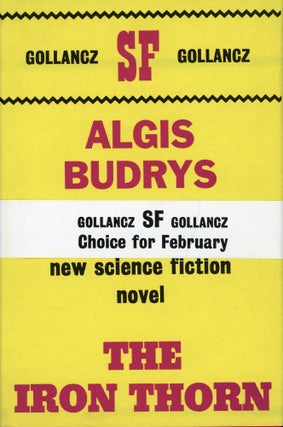
THE IRON THORN.
London: Victor Gollancz, Ltd, 1968. Octavo, boards. First British (and first hardcover edition). Issued earlier in the U.S. as a paperback original, THE AMSIRS AND THE IRON THORN (1967).

ROGUE MOON.
Norwalk, CT: The Easton Press, [1988]. Octavo, illustrations by A. C. Farley, full leather, a.e.g. Later edition. New introduction by Willis E. McNelly. "A matter transmitter is used to send men to the Moon. There they encounter a terrifying alien 'maze.' This powerful psychological thriller deals with the human urge to transcend death. A minor SF classic." - Pringle, The Ultimate Guide to Science Fiction, second edition, p. 310. " ... now widely regarded as an SF classic. A good deal has been written about the highly integrated symbolic structure of this story, whose perfectly competent surface narration deals with a hard-SF solution to the problem of an alien labyrinth, discovered on the Moon, which kills anyone who tries to pass through it without obeying various arbitrary and incomprehensible rules. At one level, the novel's description of attempts to thread the labyrinth from Earth via matter transmission (which is also matter duplication) makes for excellent traditional SF; at another, it is a sustained rite de passage, a doppelganger conundrum about the mind-body split, a death-paean. There is no doubt that Budrys intends that both levels of reading should register, however any interpretation might run; in this novel the two levels interact fruitfully." - SFE (online). 1961 Hugo nominee. Collector's notes laid in. Part of the Easton Press "Masterpieces of Science Fiction" series. [Reference: Anatomy of Wonder (2004) II-181. Pringle, Science Fiction: The 100 Best Novels 32. Survey of Science Fiction Literature IV, pp. 1821-26].
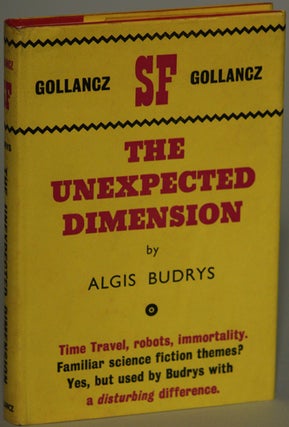
THE UNEXPECTED DIMENSION.
London: Victor Gollancz Ltd, 1962. Octavo, boards. First British and first hardcover edition. First published in the U.S. as a paperback. Collects the title story and six others. "A thoughtful collection..." Anatomy of Wonder (1995) 3-39.
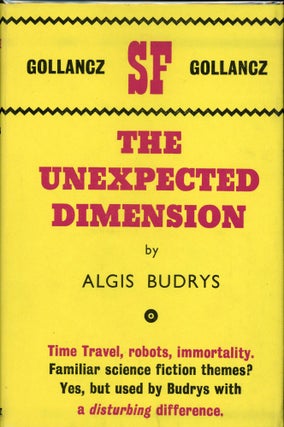
THE UNEXPECTED DIMENSION.
London: Victor Gollancz Ltd, 1962. Octavo, boards. First British (and first hardcover edition). First published in the U.S. as a paperback. Collects the title story and six others. "A thoughtful collection..." Anatomy of Wonder (1995) 3-39. [Reference: Anatomy of Wonder (2004) II-182].
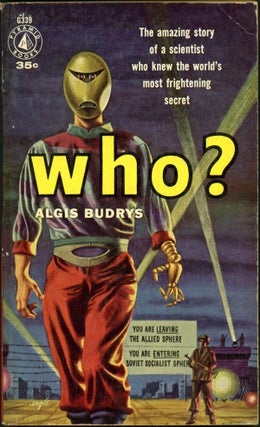
WHO?
New York: Pyramid Books, [1958]. Small octavo, pictorial wrappers. First edition. Pyramid Books G339. "An American scientist is badly injured in an explosion, then "repaired" by Soviet doctors and returned to the USA. The problem is that he is now virtually a cyborg and no one can be sure of his identity. A clever cold-war thriller which established this young writer's reputation." - Pringle, The Ultimate Guide to Science Fiction, second edition (1995), p. 419. "A strong indictment of the idiocies dignified at that time (and to a great extent still today) as 'security,' but a parable also of estrangement and alienation more generally." - Anatomy of Wonder (2004) II-183. "Perhaps as fine a study of dehumanization and alienation as SF will ever produce." - Gene Wolfe. 1959 Hugo nominee. Filmed in 1973 with Elliott Gould and Trevor Howard, it is faithful to the concept of the novel. Retitled for the video release as Roboman, apparently to cash in on the Robocop craze. [Reference: Survey of Science Fiction Literature V, pp. 2474-77].