
Results

DRACULA'S GUEST AND OTHER WEIRD STORIES.
London: George Routledge & Sons, Ltd., [1914]. Octavo. pp. [1-8] 1-200, original decorated red cloth, front panel with author, title and decorations stamped in blind, spine panel stamped in gold and blind. First edition, first printing. Posthumous collection of nine stories. "Dracula's Guest" is a previously unpublished episode from an early draft of DRACULA. [Reference: Barron (ed), Horror Literature 3-187. Bleiler, The Guide to Supernatural Fiction #1551. Dalby 22a].
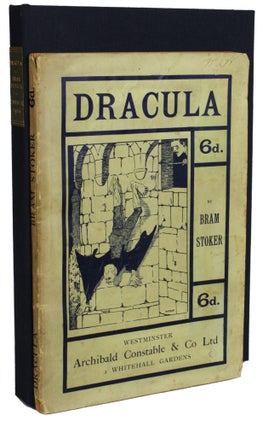
DRACULA.
Westminster: Archibald Constable and Company, 1901. Octavo, pp. [1-11] 12-138 [139-144: ads], original pictorial gray-green wrappers printed in black. First printing of the revised text. Most copies of DRACULA take their text from the first edition of 1897 (or the first American edition of 1899, or a 1912 edition that corrected some typographical errors in the first edition). However, in 1901, another significantly different edition appeared, a paperback with a slightly abridged text, revised by Stoker himself at the request of the publisher. Stoker cut about 15% of the text, mainly from descriptions and conversations, in order to make the action scenes stand out a bit more. The paperback edition of 1901 is very rare. Some think this version reads better than the original edition.

DRACULA.
Westminster: Archibald Constable and Company, 1897. Octavo, pp. [i-vii] viii-ix [x] [0] 2-390 [390: blank] [392: ad for The Shoulder of Shasta on page (392)] [note: dedication leaf is tipped in and not part of gathering (A)], original mustard cloth, front, spine, and rear panels stamped in red. First edition, second (or third) printing. Bibliographically, a complex book: this copy is part of the second printing (or third printing) which printed an advertisement for Stoker's THE SHOULDER OF SHASTA on page [392] -- this page is blank in all first printing copies. According to Dalby 10c, this is the "third issue of [the] first edition," but it is a later printing, not a later issue. The most famous and influential of all vampire novels. "Although it is based in part on the crude VARNEY, THE VAMPIRE and the superior 'Carmilla' by LeFanu, DRACULA remains the definitive treatment of the classical vampire, a work of great imagination and conviction. While it is generally conceded that it has technical weaknesses -- wooden characters, sentimental writing, needless complexity -- its virtues overweigh its flaws and it is one of the great classics of supernatural fiction." - Bleiler, The Guide to Supernatural Fiction 0546. [Reference: Ashley, Who's Who in Horror and Fantasy Fiction, pp. 167-68. Barron (ed), Horror Literature 3-186. Bleiler (ed), Supernatural Fiction Writers: Fantasy and Horror, pp. 375-81. Cawthorn and Moorcock: Fantasy: The 100 Best Books 19. Jones and Newman (eds), Horror: 100 Best Books 21. Sullivan (ed), The Penguin Encyclopedia of Horror and the Supernatural, pp. 404-06. Survey of Modern Fantasy Literature I, pp. 404-09. Tymn (ed), Horror Literature 3-234. In 333. Bleiler (1978), p. 187. Reginald 13726. Dalby 10c].

DRACULA.
New York: Doubleday & McClure Co., 1899. Octavo, pp. [1-2] [i-vi] vii-ix [x] 1-378 [379-380: blank] [note: last leaf is a blank], original pictorial beige cloth, front panel stamped in tan, blue and gold, spine panel stamped in blue, fore and bottom edges untrimmed. First U.S. edition. The most famous and influential of all vampire novels. "Although it is based in part on the crude VARNEY, THE VAMPIRE and the superior "Carmilla" by LeFanu, DRACULA remains the definitive treatment of the classical vampire, a work of great imagination and conviction. While it is generally conceded that it has technical weaknesses – wooden characters, sentimental writing, needless complexity – its virtues overweigh its flaws and it is one of the great classics of supernatural fiction." - Bleiler, The Guide to Supernatural Fiction 1546. [Reference: Ashley, Who's Who in Horror and Fantasy Fiction, pp. 167-68. Barron (ed), Horror Literature 3-186. Bleiler (ed), Supernatural Fiction Writers: Fantasy and Horror, pp. 375-81. Cawthorn and Moorcock: Fantasy: The 100 Best Books 19. Jones and Newman (eds), Horror: 100 Best Books 21. Sullivan (ed), The Penguin Encyclopedia of Horror and the Supernatural, pp. 404-06. Survey of Modern Fantasy Literature I, pp. 404-09. Tymn (ed), Horror Literature 3-234. In 333. Bleiler (1978), p. 187. Reginald 13726. Dalby 10b].

DRACULA: THE RARE TEXT OF 1901.
White Rock, British Columbia: Transylvania Press, 1994. Octavo, cloth. First hardcover edition of this text. Limited to 500 copies. Most reprints of DRACULA take their text from the first edition of 1897 (or the first American edition of 1899, or a 1912 edition that corrected some typographical errors in the first edition). However, in 1901, another significantly different edition appeared, a paperback with a slightly abridged text, revised by Stoker himself at the request of the publisher. Stoker cut about 15% of the text, mainly from descriptions and conversations, in order to make the action scenes stand out a bit more. The paperback edition of 1901 is rare, and the publishers of this edition have made a reprint of it (with correction of typographical errors) in order to give readers and scholars a chance to have access to this interesting version of a classic work. Some think it reads better than the original edition.

THE LAIR OF THE WHITE WORM ...
London: W. Foulsham & Co. Ltd., n.d., [1925]. Octavo, pp. [1-8] 9-190 [191-192: ads], original purple cloth, front and spine panels stamped in gold. Second edition, abridged. This edition was heavily abridged and partly rewritten. "The Freudian, bloodcurdling LAIR OF THE WHITE WORM features a monstrous worm secreted for thousands of years in a bottomless well and able to metamorphose into a woman. It has several parallels to DRACULA (with Sir Nathaniel de Salis assuming the Van Helsing role) and contains some of Stoker's most graphic and grisly moments of horror." - Sullivan (ed), The Penguin Encyclopedia of Horror and the Supernatural, p. 406. [Reference: Ashley, Who's Who in Horror and Fantasy Fiction, pp. 167-68. Barron (ed), Horror Literature 3-190. Bleiler, The Guide to Supernatural Fiction 1550. Locke, A Spectrum of Fantasy, p. 207. Tymn (ed), Horror Literature 3-236. In 333. Bleiler (1978), p. 187. Reginald 13731. Dalby 21c].
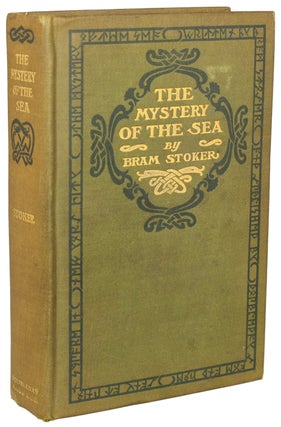
THE MYSTERY OF THE SEA: A NOVEL ...
New York: Doubleday, Page & Co., 1902. Octavo, pp. [i-vi] vii [viii] [1-2] 3-498 [499-500: blank] [note: last leaf is a blank], original decorated olive green cloth, front and spine panels stamped in gold and black, rear panel stamped in black. First edition, first printing. Presentation copy with signed inscription by Stoker dated 22 March 1902, a week prior to publication date (29 March 1902) on front free endpaper: "My dear Elizabeth (Newbery?) / with love & greetings / Bram Stoker / 22.3.02." The Doubleday, Page edition preceded the British Heinemann edition by several months. Ingenious romantic adventure novel "set in Cruden Bay, involving a gun battle at sea, a castle with secret passages, and coded writing based on a cipher described by Francis Bacon." - Dalby, p. 38. "I found the story admirable. It has not the fearsomeness of 'DRACULA' but it is beautifully handled and the girl very admirable indeed ... I've done a bit in cryptograms myself, but that knocks me out!" - Arthur Conan Doyle. [Reference: Bleiler, The Guide to Supernatural Fiction 1547. Bleiler (1978), p. 187. Reginald 13732. Dalby 13a].