
Results

A COLLECTION OF NOVELS AND TALES OF THE FAIRIES. Written by That Celebrated Wit of France, the Countess d'Anois. In Three Volumes ... The Third Edition. Translated from the Best Edition of Original French, by Several Hands.
London: Printed for J. Brotherton and W. Meadows in Cornhill; R. Ware in Amen Corners; T. Astley in St Paul's Church Yard; and J. Hodges on London Bridge, 1737. Small 12mo, three volumes: pp. x 288; 276; 240, eighteenth-century full brown calf, spine panels ruled and lettered in gold, red morocco title pieces. Third edition. A collection of twenty-six literary fairy tales, of which eleven are by d'Aulnoy (eight tales plus three nouvelles used to frame them), four by the Comtesse de Murat; all those in volume three are by the Comtesse d'Auneuil. In 1785 when Clara Reeve looked back seven or eight decades and recalled Mme d'Aulnoy as "a famous composer of Fairy Tales," she was correct in singling Mme d'Aulnoy out for special attention as an author of CONTES DE FÉES, but she did not know that twenty-eight of the tales which came into England under Mme d'Aulnoy's name were by four other French writers ... Furthermore, the 1699 edition of d'Aulnoy's tales listed by Arundel Esdaile is regarded today as a bibliographical ghost. In other words, except for the English collections of Fénelon's and Charles Perrault's fairy tales, the French fairy tale in England is a subject fraught with bibliographical confusion ... The English vogue for French fairy tales in the late seventeenth and early eighteenth centuries ... was in fact initiated by Mme d'Aulnoy in 1691 with the translation of a fairy tale of hers as THE HISTORY OF ADOLPHUS, which appeared, however, without author's or translator's name and which was regarded until recently as a native English work and not a translation at all. After this beginning and excepting the English versions of fairy tales by Fénelon and Perrault, the French conte de fée as a genre came to England in four collections, all of them said to be Mme d'Aulnoy's work. Only two are completely the work of Mme d'Aulnoy; the other two contain tales by other hands as well as tales by Mme d'Aulnoy. These four collections are Tales of the Fairies (1699); Volume IV of The Diverting Works of the Countess D'Anois, this volume bearing as title Tales of the Fairies in Three Parts Compleat (1707); The History of the Tales of the Fairies (1716); and A Collection of Novels and Tales of the Fairies (Volumes I and II, 1721; Volume III, 1728). Mme d'Aulnoy did indeed dominate the English vogue for the French conte de fée, as Clara Reeve suggested. We know now that eighteen of her tales appeared in English before the nineteenth century -- a larger number than those of any other writer. But we also know now that twenty-eight of the tales formerly attributed to her in England are the products of other writers. Except for the fairy tales of Fénelon and Perrault, there were no other French contes de fées published in England in the early eighteenth century, but two of the collections discussed here did continue to delight English readers throughout the century. The History of the Tales of the Fairies (1716) appeared again in 1749, 1758, and 1781. The Collection of Novels and Tales of the Fairies (all three volumes complete) appeared twice in 1737 and again in 1749 and 1766. In 1817 it even made its way into the era of Jane Austen as Fairy Tales and Novels. "Unlike her contemporary, Charles Perrault (a frequent visitor to her salons), who only occasionally used his fairy tales for purposes of satire, she made that her prime motive, with the result that, unlike Perrault's, her tales were composed primarily for adults -- and were thus among the first literary fairy tales ... Although less known now, her stories contain all the basic plot devices of fantasy, and were highly influential in their day ... Her stories are usually much longer narrative constructions than the fairy tales by Perrault or the Grimm Brothers, and this fact has made them less memorable, despite their position among the earliest original fantasies. It was, however, with the translation of a few of her stories into English as TALES OF THE FAIRIES (1699), that the term 'fairy tales' passed into the language." - Clute and Grant (eds), The Encyclopedia of Fantasy (1997), p. 72. [Reference: ESTC N28398 (Edinburgh University Library, National Library of Wales, Harvard University, New York University)].
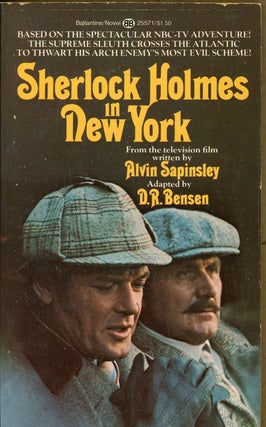
SHERLOCK HOLMES IN NEW YORK.
New York: Ballantine Books, 1976. Small octavo, pictorial wrappers. First edition. Paperback original. Sherlockiana. Novelization of the made for television movie starring Roger Moore and Patrick MacNee. Photo cover.
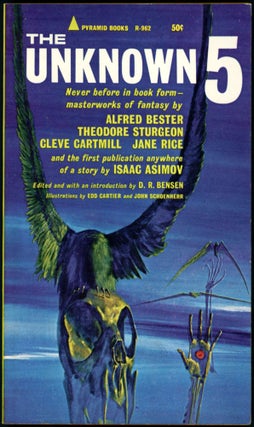
THE UNKNOWN FIVE.
New York: Pyramid Books, [1964]. Small octavo, pictorial wrappers. First edition. Pyramid R-962. Paperback original. Collects five stories, four published in UNKNOWN /UNKNOWN WORLDS pulp magazine. The fifth story by Isaac Asimov, "Author! Author!" was accepted by John W. Campbell for UNKNOWN but the magazine folded before it was published. This is the first publication. Other authors are Alfred Bester, Theodore Sturgeon, Cleve Cartmill and Jane Rice.
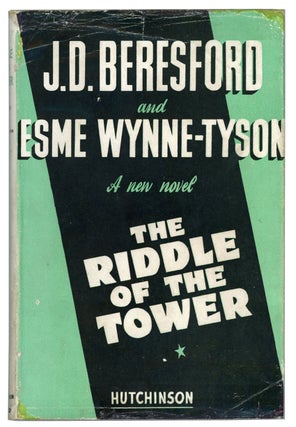
THE RIDDLE OF THE TOWER.
London, New York, Melbourne: Hutchinson & Co. (Publishers), Ltd., n.d., [1944]. Octavo, pp. [1-6] 7-152, original tan cloth, front and spine panels stamped in dark green. First edition. A presentation copy signed by both authors with inscription in Wynne-Tyson's hand on the front free endpaper: "For Winifred -- / With the very best of / good wishes, / from / Esme W.-T. / and / J. D. Beresford / The Retreat / Holt Wilts. / 1944." "Mankind descends through successful regimentation and mechanization to the final status of insects." - Gerber, Utopian Fantasy (1973), p. 155. [Reference: Clarke, Tale of the Future (1978), p. 78. Sargent, British and American Utopian Literature, 1516-1985, p. 226. Stableford, Scientific Romance in Britain 1890-1950, p. 181. Bleiler (1978), p. 21. Reginald 01162].
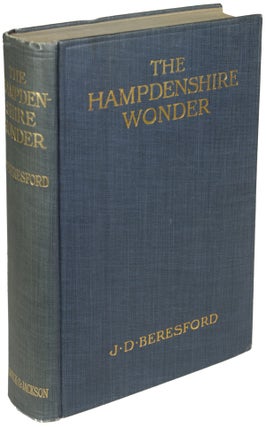
THE HAMPDENSHIRE WONDER ...
London: Sidgwick & Jackson, Ltd., 1911. Octavo, pp. [i-vi] vii-viii [1-2] 3-295 [296: printer's imprint], original medium blue cloth, front panel ruled in blind and lettered in gold, spine panel lettered in gold. First edition, probable first binding. One of the major science fiction novels published in Britain prior to World War II. This story of a homo superior in contemporary society influenced Stapledon's ODD JOHN. "The first important novel about a superman, and in many respects still the best." - Bleiler, Science-Fiction: The Early Years 182. [Reference: Anatomy of Wonder (1976) 2-15; (1981) 1-21; (1987) 1-11; (1995) 1-11; and (2004) II-113. Clareson, Science Fiction in America, 1870s-1930s 068. Locke, A Spectrum of Fantasy, p. 32 (binding variant B; no sequence established). Stableford, Scientific Romance in Britain 1890-1950, pp. 103-05. Survey of Science Fiction Literature II, pp. 945-49. In 333. Bleiler (1978), p. 21. Reginald 01157].
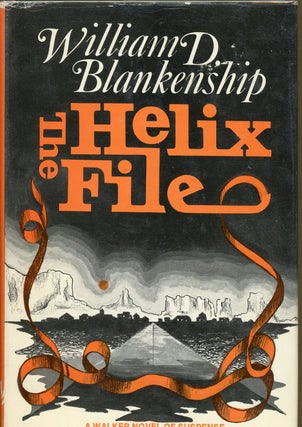
THE HELIX FILE.
New York: Walker, 1972. Octavo, Hardcover. First edition. Author's first book.
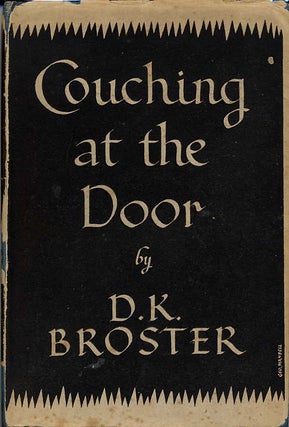
COUCHING AT THE DOOR.
London..Toronto: William Heinemann Ltd., [1942]. Octavo, original light blue cloth, spine stamp in gold. First edition. "Effective and unusual tales." - Barron: Horror Literature 3-37. [Reference: Bleiler: The Guide to Supernatural Literature #297].
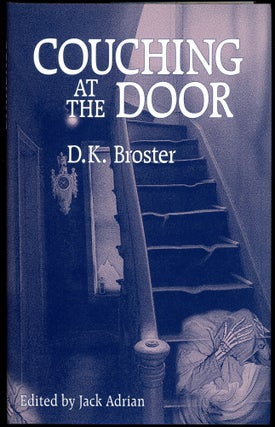
COUCHING AT THE DOOR: STRANGE AND MACABRE STORIES. Introduction by Jack Adrian.
Ashcroft, British Columbia: Ash-Tree Press, 2001. Octavo, cloth. First printing of the enlarged edition. Limited to 600 copies. The Ash-Tree edition collects the contents of COUCHING AT THE DOOR (1942), the weird tales from A FIRE OF DRIFTWOOD (1932) and "The Taste of Pomegranates," a previously uncollected tale, with an introduction by editor Jack Adrian.

CANYONS.
New York: Tor, [2000]. Octavo, boards. First edition. A werewolf novel. The author's fiction has been nominated for awards numerous times, she has won both the World Fantasy award and Bram Stoker award.
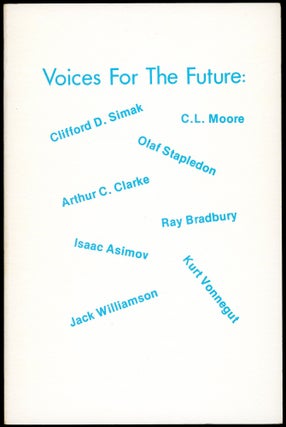
VOICES FOR THE FUTURE: ESSAYS ON MAJOR SCIENCE FICTION WRITERS... VOLUME I.
Bowling Green, Ohio: Bowling Green University Popular Press, [1976]. Octavo, printed wrappers. First edition, trade paperback issue. Collects twelve critical essays on Jack Williamson, Olaf Stapledon, Clifford Simak, Isaac Asimov, Robert A. Heinlein, Theodore Sturgeon, Ray Bradbury (2), Arthur C. Clarke, Kurt Vonnegut and the collaborations of Henry Kuttner and C.L. Moore.
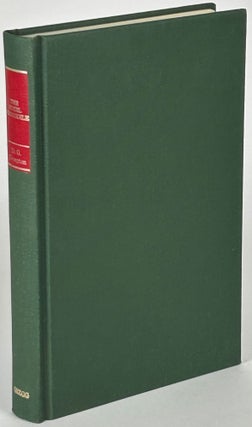
THE STEEL CROCODILE.
Boston: Gregg Press, 1976. Octavo, cloth. First U.S. hardcover edition, first printing. 250 copies printed. "The Colindale Institute functions ostensibly to anticipate new developments in research so as to be in a position to encourage or suppress them. A major special project aims to generate a new messiah to better control the masses. The work is aided by a computer system capable of highly sophisticated, associative retrieval, and naturally, the computer nominate itself for the role of messiah." - Mowshowitz, p. 303. Text offset from that of the 1970 Hodder and Stoughton edition published as THE ELECTRIC CROCODILE. New introduction by David G. Hartwell. 1970 Nebula nominee. [Reference: Anatomy of Wonder (2004) II-273].
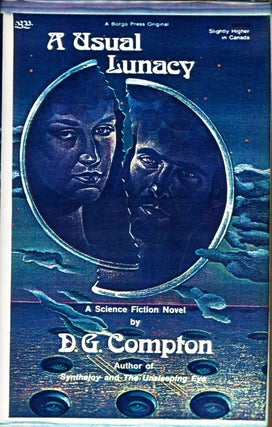
A USUAL LUNACY.
San Bernadino: The Borgo Press, 1978. Octavo, Hardcover. First edition. One of 50 signed copies done in hardcover produced by Barry Levin and the Borgo Press.
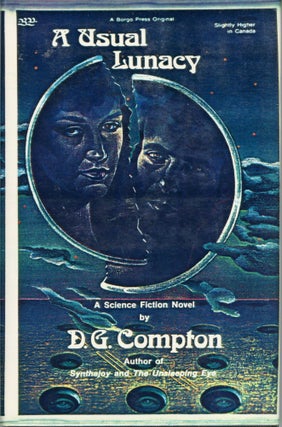
A USUAL LUNACY.
San Bernardino, California: The Borgo Press, 1978. Octavo, black buckram, spine stamped in gold. First edition. The hardbound issue, limited to 61 copies signed by Compton, of which this is letter "I" of eleven lettered copies "reserved for distribution to the author and his friends ..."

WINDOWS.
New York: Published by Berkley Publishing Corporation Distributed by G. P. Putnam's Sons, [1979]. Octavo, boards. First edition. Sequel to THE CONTINUOUS KATHERINE MORTENHOE, a.k.a. THE UNSLEEPING EYE (1974). "A good sequel to a fine original -- but barely SF." - Pringle, The Ultimate Guide to Science Fiction, second edition (1995), p. 422. [Reference: Anatomy of Wonder (2004) II-272. Sargent, British and American Utopian Literature, 1516-1985, p. 392].
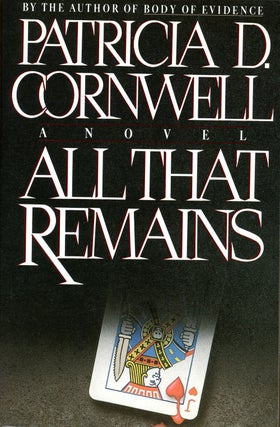
ALL THAT REMAINS.
New York: Scribner's, 1992. Wrappers. First U.S. edition. Signed. Advance reading copy (proof). The third Kay Scarpetta novel.
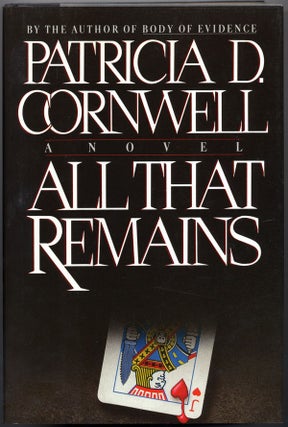
ALL THAT REMAINS.
New York: Charles Scribner's Sons, 1992. Octavo, cloth backed boards. First U.S. edition. Signed inscription by Cornwell on the half title page. The third Kay Scarpetta novel.
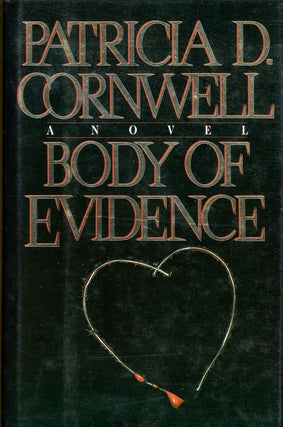
BODY OF EVIDENCE.
New York: Scribner's, 1990. Wrappers. First edition. Signed. Advance uncorrected reading copy (proof).
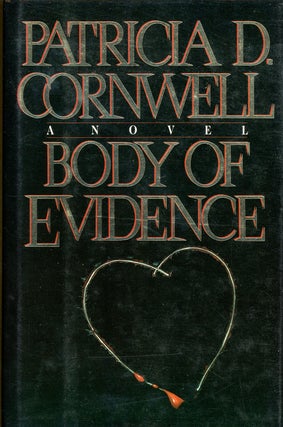
BODY OF EVIDENCE.
New York: Scribners, 1991. Octavo, Hardcover. First edition. The second Kay Scarpetta mystery.
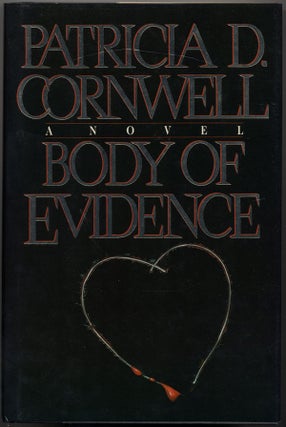
BODY OF EVIDENCE.
New York: Charles Scribner's Sons, [1991]. Octavo, cloth backed boards. First edition. The second Kay Scarpetta mystery novel.
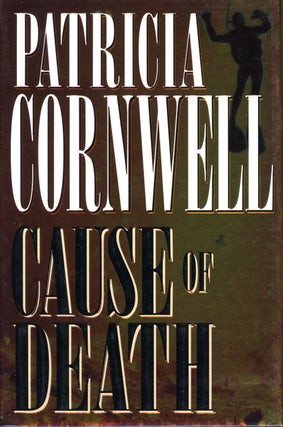
CAUSE OF DEATH.
New York: Scribner's, 1996. Octavo, Hardcover. First trade edition. Signed by Cornwell. The seventh Kay Scarpetta novel.
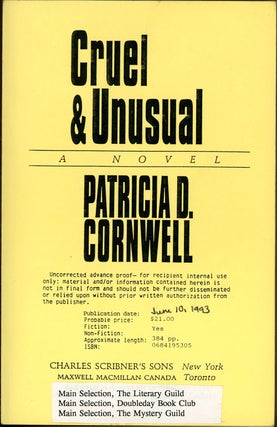
CRUEL & UNUSUAL.
New York: Charles Scribner's Sons, [1993]. Octavo, printed wrappers. Advance uncorrected proof. The fourth Kay Scarpetta novel.
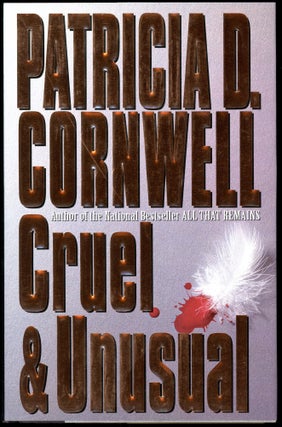
CRUEL & UNUSUAL.
New York: Charles Scribner's Sons, [1993]. Octavo, cloth backed boards. First edition. Signed by Cornwell on the title page. The fourth Kay Scarpetta novel.
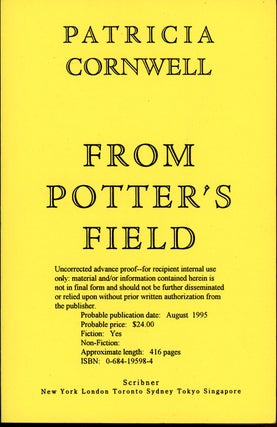
FROM POTTER'S FIELD.
New York: Scribner's, 1995. Wrappers. First edition. Advance uncorrected proof. The sixth Kay Scarpetta novel.
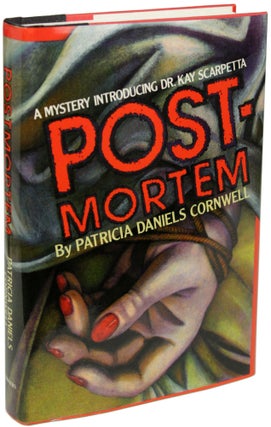
POST-MORTEM.
New York: Charles Scribner's Sons, [1990]. Octavo, quarter cloth with boards. First edition. The first Kay Scarpetta mystery. Edgar Award winner for best first novel.
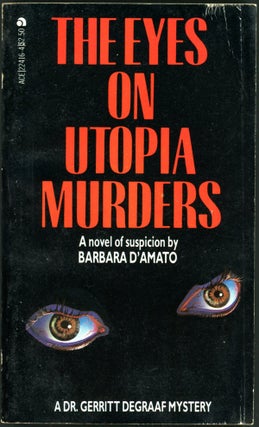
THE EYES ON UTOPIA MURDERS.
New York: Ace Books, [1981]. Small octavo, pictorial wrappers. First edition. The author's second mystery novel and second to feature Dr. Gerritt Degraaf.