
Results
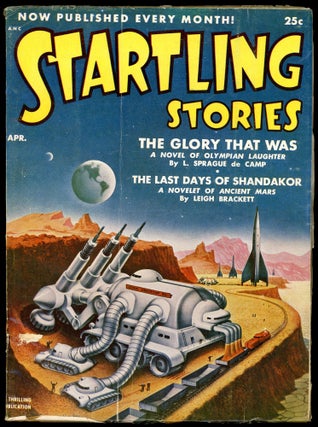
STARTLING STORIES.
Kokomo, IN: Better Publications, Inc., 1952. Octavo, single issue, cover by Alex Schomburg, pictorial wrappers. Pulp magazine. Includes fiction by L. Sprague De Camp, Leigh Brackett, Frank Herbert and others. The Herbert story, "Looking For Something" is his first published science fiction story. [Reference: Tymm and Ashley, Science Fiction, Fantasy, and Weird Fiction Magazines, pp. 611-617].

NEBULA AWARD STORIES FIFTEEN.
New York, Cambridge, Hagerstown, Philadelphia, San Francisco, London, Mexico City, S o Paulo, Sydney: Harper & Row, Publishers, [1981]. Octavo, cloth backed boards. First edition. Collects six stories by Jack Dann, George R. R. Martin, Barry Longyear, Edward Bryant, Joanna Russ and Orson Scott Card. Also two articles by Vonda N. McIntyre and Ben Bova. [Reference: Anatomy of Wonder (2004) II-1364].
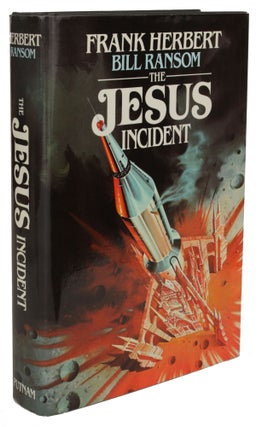
THE JESUS INCIDENT.
New York: Published by Berkley Publishing Corporation Distributed by G. P. Putnam's Sons, [1979]. Octavo, cloth. First edition. Inscribed and signed by Herbert on the title page. A sequel to Herbert's DESTINATION: VOID (1966). "The earlier novel's star-farers and their godlike computer arrive at the planet Pandora, where they come into conflict with some particularly vile life-forms. An ineffective adventure, but stuffed with ideas." - Pringle, The Ultimate Guide to Science Fiction, second edition (1995), p. 195. [Reference: See Anatomy of Wonder (1987) 4-267].
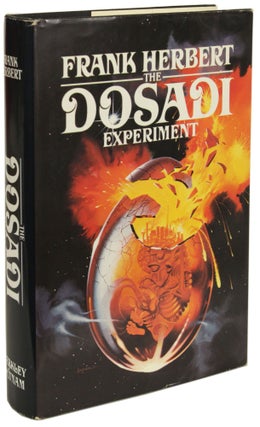
THE DOSADI EXPERIMENT.
New York: G. P. Putnam's Sons, [1977]. Octavo, cloth. First edition. Inscribed and signed by Herbert, dated 1977, on the title page. THE DOSADI EXPERIMENT, a sequel to WHIPPING STAR, is a detailed examination of alien intelligence. "Among contemporary sf writers only Ian Watson has addressed this theme as frequently and as convincingly." - Clute and Nicholls (eds), The Encyclopedia of Science Fiction (1993), p. 559.

THE DRAGON IN THE SEA.
Garden City, New York: Doubleday & Company, Inc., 1956. Octavo, illustration by Mel Hunter, boards. First edition. Author's first science fiction book. Good first novel of a submarine on a sensitive mission and the extreme stress on the crew. [Reference: Anatomy of Wonder (2004) II-523. Survey of Science Fiction Literature II, pp. 595-99].

DUNE serialized in ANALOG SCIENCE FICTION/SCIENCE FACT (eight issues).
New York: Conde Nast Publications, 1963-1965. Large and small octavo, eight issues, pictorial wrappers. Eight issues of Analog with the two serials "Dune World" (December 1963-February 1964) and "The Prophet of Dune" (January-May 1965), revised as the fixup novel DUNE (1965). Themes of intergalactic politics, religion, feudal societies, messiah, and perhaps most important-ecology. Basis for two feature films.

DUNE.
Philadelphia and New York: Chilton Books, [1965]. Octavo, cloth. First edition. First novel in the Dune series, an immensely popular work which led to many sequels. "Politics and metaphysics are tightly bound into a remarkably detailed and coherent pattern; an imaginative tour de force ... The series demonstrates how a good SF writer's ability to build a coherent and convincing hypothetical world can serve the purpose of making philosophical and sociological questions concrete; the series thus becomes a massive thought experiment in social philosophy ..." - Anatomy of Wonder (2004) II-524. "What, in its entirety, does the Dune saga represent? Nearly 2300 pages -- more than a million words. A saga covering some six thousand or so years. A cast of hundreds. Dune is, undoubtedly, an epic. In its own way it achieves what earlier models failed at. It is not merely the present retold as the future. It is much more than a power fantasy. Unlike E. E. 'Doc' Smith's Lensman universe, or Asimov's Foundation universe, it has depth as well as breadth. Unlike those earlier models it grasped the concept that the future would have different modes of behavior, different motivations to our own. For all its seemingly mediaeval setting, DUNE is a thoroughly futuristic novel. It transcends its ANALOG origins. The Dune sequence is not, in its totality, easy reading. Like the best of anything, it requires and rewards attention. It is not wholly successful, and the later volumes are, perhaps, over-cerebral, yet in its ambitious design the sequence does not fall short of its target. Its existence has influenced younger writers to attempt more complex schemes than they might otherwise have ventured upon. Bruce Sterling and Greg Bear are writers who can been seen to have benefited from Herbert's trailblazing efforts. Many others would admit that Herbert's influence has added rigor to their work." - Aldiss and Wingrove, Trillion Year Spree, pp. 399-400. Winner of the 1965 Nebula and 1966 Hugo awards for best novel. Filmed several times, as a feature film in 1984 and a TV mini-series in 2000. In post-production for a new theatrical release (2021). [Reference: Anatomy of Wonder (2004) II-524. Pringle, Science Fiction: The 100 Best Books 48. Survey of Science Fiction Literature II, pp. 647-58].

DUNE.
New York: Ace Books, [1999]. Octavo, boards. Later edition. First hardcover edition from this publlisher. First novel in the Dune series, an immensely popular work which led to many sequels. "Politics and metaphysics are tightly bound into a remarkably detailed and coherent pattern; an imaginative tour de force ... The series demonstrates how a good SF writer's ability to build a coherent and convincing hypothetical world can serve the purpose of making philosophical and sociological questions concrete; the series thus becomes a massive thought experiment in social philosophy ..." - Anatomy of Wonder (2004) II-524. "What, in its entirety, does the Dune saga represent? Nearly 2300 pages -- more than a million words. A saga covering some six thousand or so years. A cast of hundreds. Dune is, undoubtedly, an epic. In its own way it achieves what earlier models failed at. It is not merely the present retold as the future. It is much more than a power fantasy. Unlike E. E. 'Doc' Smith's Lensman universe, or Asimov's Foundation universe, it has depth as well as breadth. Unlike those earlier models it grasped the concept that the future would have different modes of behavior, different motivations to our own. For all its seemingly mediaeval setting, DUNE is a thoroughly futuristic novel. It transcends its ANALOG origins. The Dune sequence is not, in its totality, easy reading. Like the best of anything, it requires and rewards attention. It is not wholly successful, and the later volumes are, perhaps, over-cerebral, yet in its ambitious design the sequence does not fall short of its target. Its existence has influenced younger writers to attempt more complex schemes than they might otherwise have ventured upon. Bruce Sterling and Greg Bear are writers who can been seen to have benefited from Herbert's trailblazing efforts. Many others would admit that Herbert's influence has added rigor to their work." - Aldiss and Wingrove, Trillion Year Spree, pp. 399-400. Winner of the 1965 Nebula and 1966 Hugo awards for best novel. Filmed several times, as a feature film in 1984 and a TV mini-series in 2000. In post-production for a new theatrical release (2021). [Reference: Anatomy of Wonder (2004) II-524. Pringle, Science Fiction: The 100 Best Books 48. Survey of Science Fiction Literature II, pp. 647-58].

EYE.
London: Victor Gollancz Ltd, 1986. Octavo, illustrations by Jim Burns, boards. First British edition. Collects thirteen stories. Includes "The Road to Dune" a short guide with numerous illustrations and a six page introduction by Herbert in which he writes about the production of the David Lynch film.

HELLSTROM'S HIVE.
[London]: New English Library, [1974]. Octavo, boards. First British edition. Inscribed and signed by Herbert on the title page. "A scientist runs an underground project which is designed to further the next stage in human evolution. This is a powerful story which investigates the psychology of "hive" behavior in human beings (analogous to the societies of insects)." - Pringle, The Ultimate Guide to Science Fiction, second edition (1995), p. 171. Somewhat of a novelization suggested by the script of the film "The Hellstrom Chronicle" (1971). This edition preceded by the Science Fiction Book Club and the mass market paperback editions.

THE PRIESTS OF PSI AND OTHER STORIES.
London: Victor Gollancz Ltd, 1980. Octavo, boards. First edition. Signed by Herbert. Collects five stories, three appearing here for the first time in a book and another collected here for the first time in a book solely by Herbert.

THE SANTAROGA BARRIER.
[London]: Rapp & Whiting, [1970]. Octavo, boards. First British (and first hardcover) edition. Signed by Herbert on the title page. "A small American town harbors a mystery: all its citizens seem to be unified against the outside world. It transpires that an experiment with a new drug has endowed the townsfolk with group-mindedness. One of Herbert's more effective treatments of the hive mentality-and the possible next step in the evolution of human intelligence." - Pringle, The Ultimate Guide to Science Fiction, second edition (1995), p. 313. [Reference: Anatomy of Wonder (1981) 3-398. Survey of Science Fiction Literature IV, pp. 1859-62].

THE SANTAROGA BARRIER.
New York: Published by Berkley Publishing Corporation Distributed by G. P. Putnam's Sons, [1977]. Octavo, cloth. First U.S. hardcover edition. "A small American town harbors a mystery: all its citizens seem to be unified against the outside world. It transpires that an experiment with a new drug has endowed the townsfolk with group-mindedness. One of Herbert's more effective treatments of the hive mentality-and the possible next step in the evolution of human intelligence." - Pringle, The Ultimate Guide to Science Fiction, second edition (1995), p. 313. [Reference: Anatomy of Wonder (1981) 3-398. Survey of Science Fiction Literature IV, pp. 1859-62].

THE WHITE PLAGUE.
New York: G. P. Putnam's Sons, [1982]. Octavo, cloth backed boards. First edition. As revenge for the death of his wife and children a molecular biologist creates a pathogen that kills only women, but men are the carriers. Targeting only three countries it quickly gets out of hand and becomes a world wide pandemic. [Reference: Anatomy of Wonder (2004) II-526].
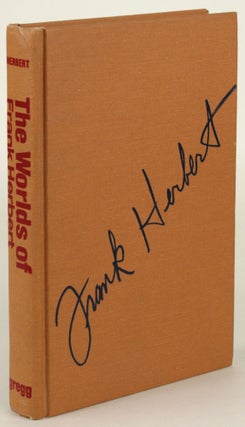
THE WORLDS OF FRANK HERBERT...
Boston: Gregg Press, 1980. Octavo, cloth. First hardcover edition. Text offset from that of the 1977 Berkley edition. Collection of nine stories. New introduction by William M. Schuyler, Jr.