
Results

ARTIFICIAL THINGS.
Toronto, New York, London, Sydney, Auckland: Bantam Books, [1986]. Small octavo, pictorial wrappers. First edition. The author's first book, a collection of thirteen stories. Nominee for the 1987 Philip K. Dick Award. "SF and fantasy stories of remarkable sensitivity..."Gradually one becomes aware of a performative glamour investing each tale with an urgency that seems increasingly humane" - John Clute." - Pringle, The Ultimate Guide to Science Fiction (1995), p. 20. [Reference: Anatomy of Wonder (2004) II-418. Hartwell, 200 Significant SF Books by Women, 1984-2001].

BLACK GLASS: SHORT FICTIONS...
New York: Henry Holt and Company, [1998]. Octavo, boards. First edition. Collects fifteen stories, the author's second story collection. "There are three different kinds of stories here: vignettes that elliptically portray women's fantasies of escaping the figurative (and sometimes literal) prisons men build for them; more fully developed tales of girls and women in and out of love with variously disappointing partners; and revisionist comedies (Fowler has been called ``an American Angela Carter''), in which the fantastic and magical-realist elements that crop up in her novels are central and crucial." - Kirkus review 1 January, 1998.

PERIPHERAL VISION.
Eugene, OR: Author's Choice Monthly Pulphouse Publishing, [1990]. Octavo, cloth. First edition. One of 300 numbered clothbound copies signed by Fowler. Collects five stories. Author's Choice Monthly, Issue Six.
THE CASE OF ANNE BICKERTON.
New York: Albert and Charles Boni, 1930. Octavo, boards. First U.S. edition. Published in the U. K. as THE KING AGAINST ANNE BICKERTON. [Reference: Hubin, p. 299].

CRIME & CO.
New York: Macaulay, 1931. Octavo, cloth. First edition. Mystery novel published later in Britain as THE HAND-PRINT MYSTERY under Wright's "Sydney Fowler" pseudonym. [Reference: Hubin, p. 299].
DELUGE: A ROMANCE.
New York: Cosmopolitan Book Corporation, 1928. Octavo, pp. [1-10] 1-395 [396-398: blank] [note: first and last leaves are blanks], original blue cloth, front and spine panels stamped in light green, top edge stained yellow, decorated endpapers. First U.S. edition. "Geological upheavals result in widespread flooding, but southern England is elevated to make the Cotswolds a tiny archipelago. The inhabitants' struggle for existence is described with a cold realism not previously seen." - Anatomy of Wonder (1995) 2-149. "...one of the very best catastrophe stories." - Bleiler, Science-Fiction: The Early Years 2439. A film based on this novel was released in 1933 with the setting changed to New York. [Reference: Anatomy of Wonder (1976) 3-71; (1981) 2-126; (1987) 2-139; (1995) 2-149; and (2004) II-1289. Clareson, Science Fiction in America, 1870s-1930s 829. Clarke, Tale of the Future (1978), p. 55. Lewis, Utopian Literature, p. 215. Locke, A Spectrum of Fantasy, p. 235. In 333. Bleiler (1978), p. 213. Reginald 15657].

ELFWIN: A ROMANCE OF HISTORY
London, Bombay, Sydney: George G. Harrap & Co. Ltd., [1930]. Octavo, pp. [1-4] 1-291 [292: blank], stiff printed wrappers. Advance proof copy. Historical novel set in ancient Britain.

S. FOWLER WRIGHT'S SHORT STORIES ...
Ludlow: FWB, [1996]. Octavo, stiff pictorial wrappers. First edition. Trade paperback size. In addition to the short fiction, this book includes several poems by Wright, the text of a speech by J. E. Clare McFarlane, and a bibliography of Wright's literary works, as well as an 11-page critical "foreword" by Brian Stableford.
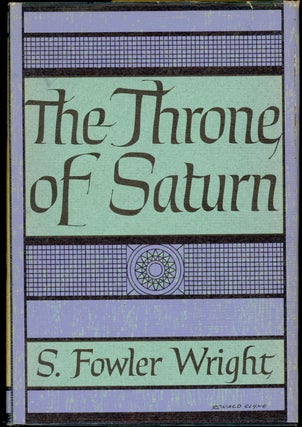
THE THRONE OF SATURN.
Sauk City, WI: Arkham House: Publishers, 1949. Octavo, cloth. First U. S. edition, expanded. 3062 copies printed. Includes the contents of THE NEW GODS LEAD (1932) plus two stories first collected here and a new 2-page author's "foreword."
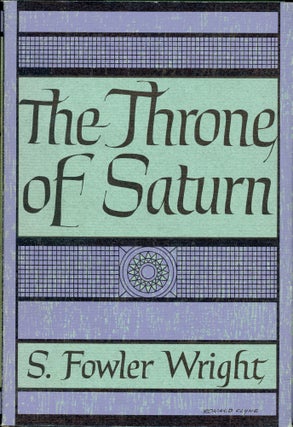
THE THRONE OF SATURN.
Sauk City, WI: Arkham House: Publishers, 1949. Octavo, cloth. First U. S. edition, expanded. 3062 copies printed. Includes the contents of THE NEW GODS LEAD (1932) plus two stories first collected here and a new 2-page author's "foreword."
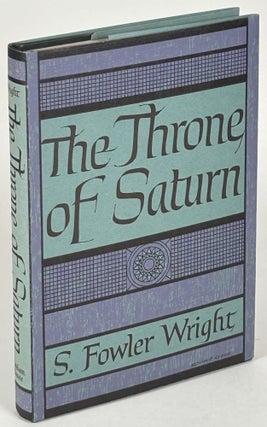
THE THRONE OF SATURN.
Sauk City, WI: Arkham House: Publishers, 1949. Octavo, cloth. First U. S. edition, expanded. 3062 copies printed. Includes the contents of THE NEW GODS LEAD (1932) plus two stories first collected here and a new 2-page author's "foreword."
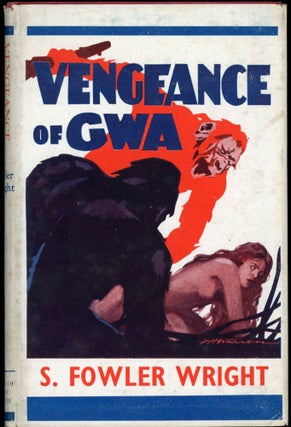
VENGEANCE OF GWA.
London: Books of To-Day Ltd, [1945]. Octavo, cloth. Later edition. Reissue of a novel first published under the pseudonym Anthony Wingrave by Thornton Butterworth in 1935. [Reference: Angenot and Khouri, "An International Bibliography of Prehistoric Fiction," SFS, VIII (March 1981), 48. Bleiler (1978), p. 210. Reginald 15673A].

THE WAR OF 1938.
New York: G. P. Putnam's Sons, [1936]. Octavo, pp. [1-8] 1-308 [309-312: blank] [note: first and last two leaves are blanks], original tan cloth, front and spine panels stamped in black and red, top edge stained red, fore-edge untrimmed, bottom edge rough-trimmed. First edition. Published in Britain as PRELUDE IN PRAGUE: A STORY OF THE WAR OF 1938 (1935). The first book of a future war trilogy, followed by FOUR DAYS WAR (1936) and MEGIDDO'S RIDGE (1937). PRELUDE IN PRAGUE begins prophetically with the proposition that Germany would embark on the road to war by manufacturing an excuse to invade Czechoslovakia in order to reclaim part of her 'traditional territory.' It rapidly develops, though, into a horror story which put the actual events of 1938 (and even those of 1939) in the shade. The final chapters present a clinically horrific catalogue of atrocities, imagining the effects of devastating aerial bombing and the use of a new chemical weapon -- a 'freezing gas.' PRELUDE IN PRAGUE ends with the delivery of a German ultimatum to Britain, and its sequel, FOUR DAYS WAR (1936), takes up the story with its rejection." - Stableford, Scientific Romance in Britain 1890-1950, p. 195. [Reference: Anatomy of Wonder (1987) 2-143; (1995) 2-153; and (2004) II-1292. Clareson, Science Fiction in America, 1870s-1930s 832. Clarke, Tale of the Future (1978), p. 69. Clarke, Voices Prophesying War: Future Wars 1763-3749 (1992), p. 240. Gerber, Utopian Fantasy (1973), p. 153. Locke, A Spectrum of Fantasy, p.236 (describing the British edition). Bleiler (1978), p. 213. Reginald 1566A].

THE WORLD BELOW ...
New York, Toronto: Longmans, Green and Co., 1930. Octavo, pp. [i-iv] v-viii 1-344, original gray cloth, front and spine panels stamped in black. First U.S. edition. The U.S. edition adds a preface by Wright dated "New York, January 15, 1930" that did not appear in the 1929 Collins edition. A superior novel in which Wright explores human evolution based on degeneration of the race due primarily to continual destruction of past civilizations through the misuse of scientific discoveries. Comprises "The Amphibians," first published in book form in 1925, and its sequel, "The World Below," first published here. A third book was planned but never written. The story is "set in the far future, when humans are extinct and forgotten... the time traveling protagonist accidentally precipitates a crisis in the affairs of a race of telepathic Amphibians who coexist with the giant humanoid Dwellers... the first part [is] an imaginative tour de force." - Anatomy of Wonder (1981) 2-128. THE AMPHIBIANS is "a work comparable in its scope only to [Wells's ] THE TIME MACHINE and [Hodgson's] THE NIGHT LAND." - Stableford, Scientific Romance in Britain 1890-1950, pp. 183-85. [Reference: Anatomy of Wonder (1976) 3-72; (1981) 2-128; (1987) 2-144; (1995) 2-154; and (2004) II-1293. Bleiler, Science-Fiction: The Early Years 2437. Clareson, Science Fiction in America, 1870s-1930s 833. Clarke, Tale of the Future (1978), p. 58. Gerber, Utopian Fantasy (1973), p. 150. Locke, A Spectrum of Fantasy, p. 235. Negley, Utopian Literature: A Bibliography 1217. Sargent, British and American Utopian Literature, 1516-1985, pp. 188. Survey of Science Fiction Literature V, pp. 2497-2500. In 333. Bleiler (1978), p. 213. Reginald 15670].

THE WORLD BELOW.
Chicago: Shasta Publishers, 1949. Octavo, cloth. First edition. Limited to 1000 copies of which this is one of 500 signed by Wright. New introduction by Everett F. Bleiler. A superior novel in which Wright explores human evolution based on degeneration of the race due primarily to continual destruction of past civilizations through the misuse of scientific discoveries. Comprises "The Amphibians," first published in book form in 1925, and its sequel, "The World Below," first published here. A third book was planned but never written. The story is "set in the far future, when humans are extinct and forgotten... the time traveling protagonist accidentally precipitates a crisis in the affairs of a race of telepathic Amphibians who coexist with the giant humanoid Dwellers... the first part [is] an imaginative tour de force." - Anatomy of Wonder (1981) 2-128. THE AMPHIBIANS is "a work comparable in its scope only to [Wells's ] THE TIME MACHINE and [Hodgson's] THE NIGHT LAND." - Stableford, Scientific Romance in Britain 1890-1950, pp. 183-85. [Reference: Anatomy of Wonder (1976) 3-72; (1981) 2-128; (1987) 2-144; (1995) 2-154; and (2004) II-1293. Bleiler, Science-Fiction: The Early Years 2437. Clareson, Science Fiction in America, 1870s-1930s 833. Clarke, Tale of the Future (1978), p. 58. Gerber, Utopian Fantasy (1973), p. 150. Locke, A Spectrum of Fantasy, p. 235. Negley, Utopian Literature: A Bibliography 1217. Sargent, British and American Utopian Literature, 1516-1985, pp. 188. Survey of Science Fiction Literature V, pp. 2497-2500. In 333. Bleiler (1978), p. 213. Reginald 15670].