
Results

MISS HARGREAVES: A FANTASY.
[Leyburn, North Yokshire]: Tartarus Press, [2004]. Octavo, boards. New edition. New introduction by Glen Cavaliero. The author's first successful novel. A tale of two men who invent an elderly poetess who then becomes real. It was adapted as a play and the lead role was immortalized by Margaret Rutherford. Limited to 300 copies. [Reference: Barron (ed), Fantasy Literature 3-13. Bleiler, The Guide to Supernatural Fiction 77. Bleiler (1978), p. 13. Reginald 00741].

THE MASTER OF MYSTERIES: BEING AN ACCOUNT OF THE PROBLEMS SOLVED BY ASTRO, SEER OF SECRETS...
Indianapolis: The Bobb-Merrill Company Publishers, [1912]. Octavo, pp. [1-12] 1-479 [480: blank], illustrated by Karl Anderson and George Brehm with frontispiece and twenty-four inserted plates. original red cloth, front and spine stamped in blind and white. First edition. Tipped in is an envelope with a signed typed letter from Burgess (dated 1930) answering some queries about the book. Collection of twenty-four interconnected stories in the which the detective, posing as a psychic and his assistant, solve mysteries with the power of observation. The book contains cyphers, one being the first letter at the start of each story spells out "The author is Gelett Burgess." [Reference: Hubin, p. 23, Queen's Quorum #50].
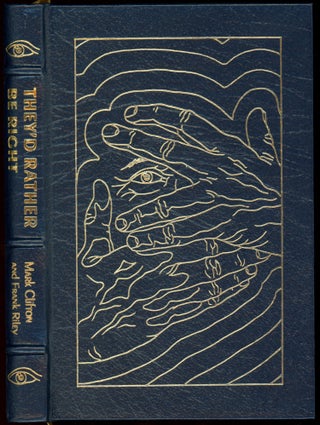
THEY'D RATHER BE RIGHT.
Norwalk, CT: The Easton Press, [1995]. Octavo, frontispiece by Frank Mayo, full leather, a.e.g. Later edition. New introduction by Barry Malzberg. 1955 Hugo Award winner. Part of the "Masterpieces of Science Fiction" series.
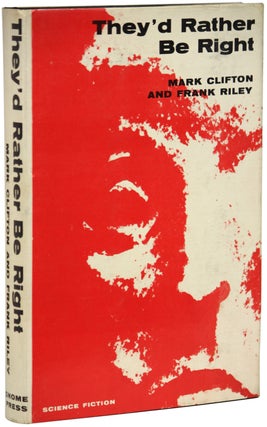
THEY'D RATHER BE RIGHT.
New York: Gnome Press, Inc., Publishers, 1957. Octavo, boards. First edition. A supercomputer helps humans attain paranormal powers and longevity. Winner of the 1955 Hugo award for best novel. [Reference: Anatomy of Wonder (2004) II-262. Sargent, British and American Utopian Literature, 1516-1985, p. 250. Survey of Science Fiction Literature V, pp. 2255-59].

THEY'D RATHER BE RIGHT.
New York: Gnome Press, Inc., Publishers, 1957. Octavo, boards. First edition. A supercomputer helps humans attain paranormal powers and longevity. Winner of the 1955 Hugo award for best novel. [Reference: Anatomy of Wonder (2004) II-262. Sargent, British and American Utopian Literature, 1516-1985, p. 250. Survey of Science Fiction Literature V, pp. 2255-59].
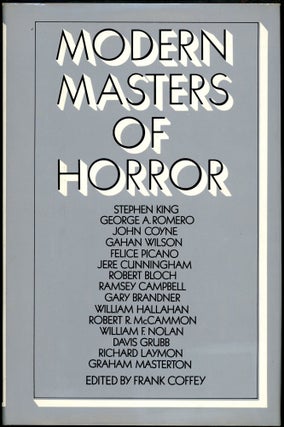
MODERN MASTERS OF HORROR.
New York: Coward, McCann & Geoghegan, [1981]. Octavo, boards. First edition. Partially original anthology of fifteen stories. Includes the first hardcover appearances of "The Monkey" by Stephen King, "The Champion" by Richard Laymon, & "Makeup" by Robert McCammon. Other fiction by Davis Grubb, graham Masterton, Ramsey Campbell, Robert Bloch and more. One of the better horror anthologies of the eighties.
GANGLAND'S DOOM: THE SHADOW OF THE PULPS.
N.p. Robert Weinberg Publisher, 1974. Octavo, pictorial wrappers. First edition. Pictorial wrappers, original paperbound booklet. Signed inscription on the front cover by Walter Gibson, author the Shadow novels (also signed as Maxwell Grant).
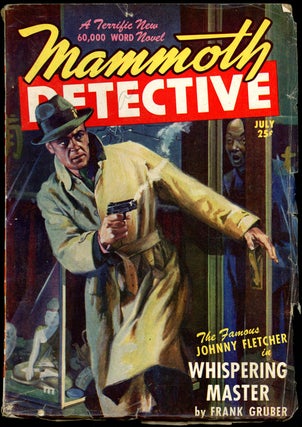
MAMMOTH DETECTIVE.
Chicago: Ziff-Davis Publishing Company, 1947. Octavo, single issue, pictorial wrappers. Pulp magazine. Hard boiled novelette by Frank Gruber (Johnny Fletcher), "Whispering Master." Also a story by William McGivern. [Reference: Cook, Mystery, Detective and Espionage Magazine, p. 314-315].
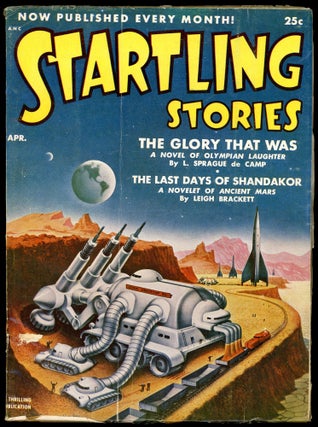
STARTLING STORIES.
Kokomo, IN: Better Publications, Inc., 1952. Octavo, single issue, cover by Alex Schomburg, pictorial wrappers. Pulp magazine. Includes fiction by L. Sprague De Camp, Leigh Brackett, Frank Herbert and others. The Herbert story, "Looking For Something" is his first published science fiction story. [Reference: Tymm and Ashley, Science Fiction, Fantasy, and Weird Fiction Magazines, pp. 611-617].

ALAS, BABYLON.
Philadelphia and New York: J.B. Lippincott Company, [1959]. Octavo, cloth. First edition. Post nuclear holocaust novel. A group of survivors in Florida cope with the aftermath, and day to day survival. A well received novel with a warning toward nuclear war as well as an ethical statement on the responsibility of citizens toward the prevention of one. [Reference: Magill: Survey of Science Fiction Literature, Volume 1, pp. 38-42. Anatomy of Wonder (1995) 3-74. Pringle, Science Fiction: The 100 Best Novels 29].

WHITE INDIAN.
Toronto: Comic and Crypt Publications, 1972. Octavo, pictorial wrappers. First edition. Stiff pictorial wrappers. Contains a White Indian story, a Thunda story and another feature.
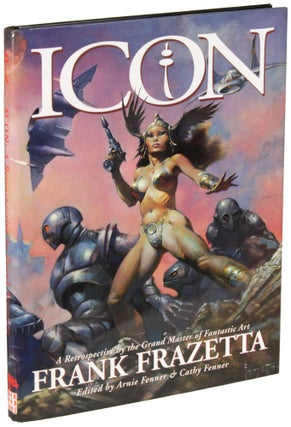
ICON: A RETROSPECTIVE... with LEGACY: SELECTED DRAWINGS AND OF FRANK FRAZETTA with TESTAMENT: A CELEBRATION OF THE LIFE AND ART OF FRANK FRAZETTA. 3 volumes.
Grass Valley, CA: Underwood Books, 1998, 1999, 2001. 3 volumes, pictorial boards. First trade editions. All three volumes produced by Underwood Books. Besides much of his legendary work the volumes include work previously unpublished and work that has not been published in any previous Frazetta art book as well as revised works and essays about Frazetta and his art.
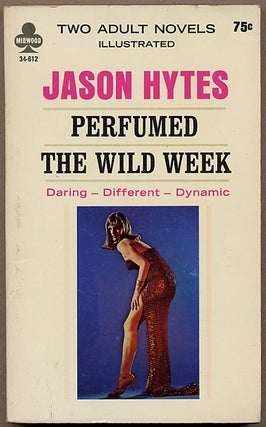
PERFUMED bound with THE WILD WEEK.
[New York: Tower Publications, Inc., 1963]. Small octavo, illustrations by Frank Frazetta, pictorial wrappers. First thus. Midwood #34-612. First combination of two previously published novels. Two novels bound together. 8 inserted full page ink illustrations by Frank Frazetta. Scarce.

AS HE SEES IT.
[London: Paper Tiger an imprint of Collins & Brown Limited, 2000]. Large octavo, pictorial boards. First edition. A retrospective of the artists work.
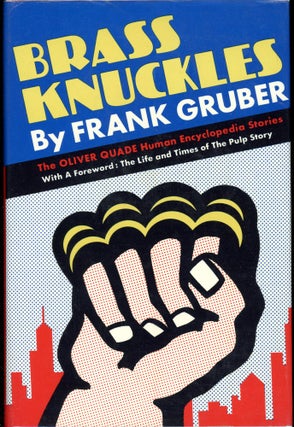
BRASS KNUCKLES: THE OLIVER QUADE HUMAN ENCYCLOPEDIA STORIES.
Los Angeles: Sherbourne Press, 1966. Octavo, Hardcover. First edition. Includes a foreword: The Life and Times of the Pulp Story. Collection of stories from Black Mask Magazine except for one which was printed in Thrilling Detective magazine.
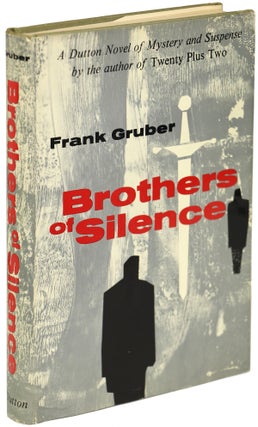
BROTHERS OF SILENCE.
New York: E.P. Dutton & Co., Inc., 1962. Octavo, boards. First edition. Signed inscription by Gruber, "To/---/with the/best wishes/of/Frank Gruber." [Reference: Hubin, p. 357].
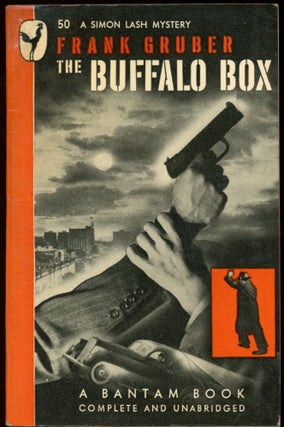
THE BUFFALO BOX.
New York: Bantam Books, [1946]. Small octavo, pictorial wrappers. First paperback edition. Bantam 50. A Simon Lash mystery.
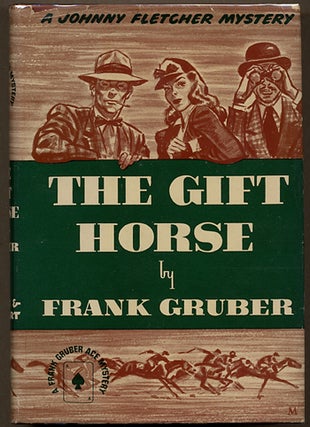
THE GIFT HORSE: A JOHNNY FLETCHER MYSTERY.
New York, Toronto: Farrar & Rinehart, Inc., [1942]. Octavo, cloth. First edition. A Johnny Fletcher and Sam Cragg mystery concerning a race horse.

NEBULA AWARD STORIES SEVENTEEN.
New York: Holt, Rinehart and Winston, [1983]. Octavo, boards. First edition. Collects nine stories by Kim Stanley Robinson, George Florence-Guthridge, Jack Dann, William Gibson, Timothy Robert Sullivan, Poul Anderson, Gardner Dozois, Michael Bishop, John Varley and an excerpt of a novel by Gene Wolfe. Also two articles by Algis Budrys and Baird Searles. [Reference: Anatomy of Wonder (2004) II-1364].

NEBULA AWARD STORIES FIFTEEN.
New York, Cambridge, Hagerstown, Philadelphia, San Francisco, London, Mexico City, S o Paulo, Sydney: Harper & Row, Publishers, [1981]. Octavo, cloth backed boards. First edition. Collects six stories by Jack Dann, George R. R. Martin, Barry Longyear, Edward Bryant, Joanna Russ and Orson Scott Card. Also two articles by Vonda N. McIntyre and Ben Bova. [Reference: Anatomy of Wonder (2004) II-1364].
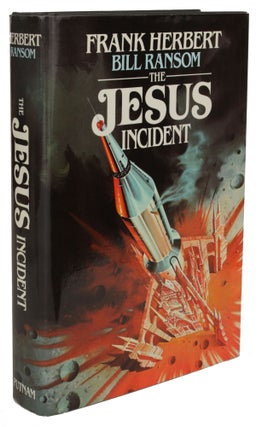
THE JESUS INCIDENT.
New York: Published by Berkley Publishing Corporation Distributed by G. P. Putnam's Sons, [1979]. Octavo, cloth. First edition. Inscribed and signed by Herbert on the title page. A sequel to Herbert's DESTINATION: VOID (1966). "The earlier novel's star-farers and their godlike computer arrive at the planet Pandora, where they come into conflict with some particularly vile life-forms. An ineffective adventure, but stuffed with ideas." - Pringle, The Ultimate Guide to Science Fiction, second edition (1995), p. 195. [Reference: See Anatomy of Wonder (1987) 4-267].
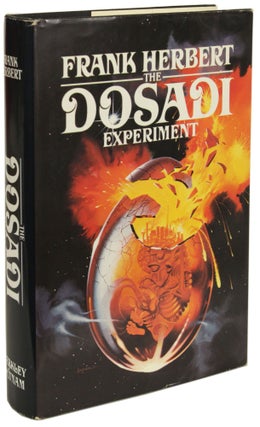
THE DOSADI EXPERIMENT.
New York: G. P. Putnam's Sons, [1977]. Octavo, cloth. First edition. Inscribed and signed by Herbert, dated 1977, on the title page. THE DOSADI EXPERIMENT, a sequel to WHIPPING STAR, is a detailed examination of alien intelligence. "Among contemporary sf writers only Ian Watson has addressed this theme as frequently and as convincingly." - Clute and Nicholls (eds), The Encyclopedia of Science Fiction (1993), p. 559.
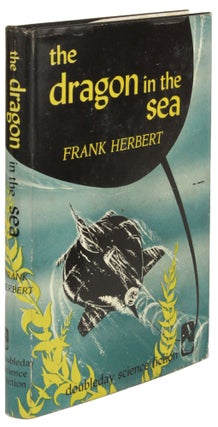
THE DRAGON IN THE SEA.
Garden City, New York: Doubleday & Company, Inc., 1956. Octavo, illustration by Mel Hunter, boards. First edition. Author's first science fiction book. Good first novel of a submarine on a sensitive mission and the extreme stress on the crew. [Reference: Anatomy of Wonder (2004) II-523. Survey of Science Fiction Literature II, pp. 595-99].

DUNE serialized in ANALOG SCIENCE FICTION/SCIENCE FACT (eight issues).
New York: Conde Nast Publications, 1963-1965. Large and small octavo, eight issues, pictorial wrappers. Eight issues of Analog with the two serials "Dune World" (December 1963-February 1964) and "The Prophet of Dune" (January-May 1965), revised as the fixup novel DUNE (1965). Themes of intergalactic politics, religion, feudal societies, messiah, and perhaps most important-ecology. Basis for two feature films.

DUNE.
Philadelphia and New York: Chilton Books, [1965]. Octavo, cloth. First edition. First novel in the Dune series, an immensely popular work which led to many sequels. "Politics and metaphysics are tightly bound into a remarkably detailed and coherent pattern; an imaginative tour de force ... The series demonstrates how a good SF writer's ability to build a coherent and convincing hypothetical world can serve the purpose of making philosophical and sociological questions concrete; the series thus becomes a massive thought experiment in social philosophy ..." - Anatomy of Wonder (2004) II-524. "What, in its entirety, does the Dune saga represent? Nearly 2300 pages -- more than a million words. A saga covering some six thousand or so years. A cast of hundreds. Dune is, undoubtedly, an epic. In its own way it achieves what earlier models failed at. It is not merely the present retold as the future. It is much more than a power fantasy. Unlike E. E. 'Doc' Smith's Lensman universe, or Asimov's Foundation universe, it has depth as well as breadth. Unlike those earlier models it grasped the concept that the future would have different modes of behavior, different motivations to our own. For all its seemingly mediaeval setting, DUNE is a thoroughly futuristic novel. It transcends its ANALOG origins. The Dune sequence is not, in its totality, easy reading. Like the best of anything, it requires and rewards attention. It is not wholly successful, and the later volumes are, perhaps, over-cerebral, yet in its ambitious design the sequence does not fall short of its target. Its existence has influenced younger writers to attempt more complex schemes than they might otherwise have ventured upon. Bruce Sterling and Greg Bear are writers who can been seen to have benefited from Herbert's trailblazing efforts. Many others would admit that Herbert's influence has added rigor to their work." - Aldiss and Wingrove, Trillion Year Spree, pp. 399-400. Winner of the 1965 Nebula and 1966 Hugo awards for best novel. Filmed several times, as a feature film in 1984 and a TV mini-series in 2000. In post-production for a new theatrical release (2021). [Reference: Anatomy of Wonder (2004) II-524. Pringle, Science Fiction: The 100 Best Books 48. Survey of Science Fiction Literature II, pp. 647-58].