
Results
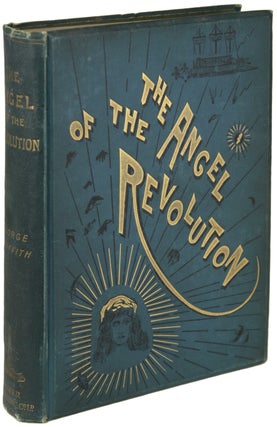
THE ANGEL OF THE REVOLUTION: A TALE OF THE COMING TERROR.
London: Tower Publishing Company Limited, 1893. Octavo, pp. [i-vi] vii-viii [1] 2-393 [394: ad], inserted frontispiece with illustration by E. S. Hope and sixteen inserted plates with illustrations by Fred T. Jane, original pictorial bevel-edged blue cloth, front panel stamped in black and gold, spine panel stamped in gold, slate coated endpapers. First edition. The author's first novel, preceded by two poetry books published pseudonymously as "Lara." From the period of 1870 up to 1914, the start of WW I, future war fiction was at it's height of popularity. Griffith was one of the writers who realized the destructive power that aerial warfare would bring to future conflict, as well as the overall impact of new technology on armed conflict. In Griffith's hugely popular and very influential novel the inventor of a new flying ship joins the Brotherhood of Freedom, an organization that controls the work of Nihilists, Anarchists, and Socialists throughout the world and is popularly known as the Terror. When war starts in Europe the daughter of the mysterious Master of the Terrorists, Natas (Satan backwards), plans to let the European powers destroy each other and then the Brotherhood will step in and take over Europe which will then be united (under Anglo-Saxon rule) into a single force to meet the "impending flood of yellow barbarians" assumed to be forming in the East. As the war progresses the Russians overrun all of Europe and invade England. After England's king (Edward VII) surrenders to the Brotherhood, the Russian attackers in England are slaughtered and the Brotherhood's air force quickly conquers the Russian homeland. There is no invasion from Asia and the West is at peace under socialist rule. "THE ANGEL OF THE REVOLUTION is remarkable not only for its extravagant visions of aerial bombing and mass destruction but also for its bastardized political ideology, which is a curious mixture of radical opinions ... Along with M. P. Shiel and H. G. Wells, he anticipated that the next war might be 'the most frightful carnival of destruction the world has ever seen,' involving the slaughter of millions of people, mostly noncombatants. This did not, however, deter him from looking forward to that conflict hopefully and enthusiastically. Like Shiel, he was an Anglo-Saxon chauvinist; like Wells a socialist; and he was hopeful that the apocalyptic clash of forces might result in the end of tyranny in Europe and the permanent victory of Christendom over the religious empires of the East. The attainment of such an end, in his view, would easily justify the death of millions ... By the time Griffith wrote his last novel, THE LORD OF LABOUR (published posthumously in 1911), his war of the imminent future was being fought with atomic missiles and disintegrator rays. He was still looking forward eagerly to the conflict. What effect the spectacle of the actual Great War might have had on his imaginative enthusiasm we can only guess." - Survey of Science Fiction Literature I, pp. 67-71. [Reference: Anatomy of Wonder (1976) 2-84; (1981) 1-83; (1987) 1-41; (1995) 1-41; and (2004) II-465. Bleiler, Science-Fiction: The Early Years 929. Clareson, Science Fiction in America, 1870s-1930s 365. Clarke, Tale of the Future (1978), p. 19. Clarke, Voices Prophesying War: Future Wars 1763-3749, p. 229. Lewis, Utopian Literature, p. 76. Locke, A Spectrum of Fantasy, p. 97. Negley, Utopian Literature 468. Sargent, British and American Utopian Literature, 1516-1985, Additions. Stableford, Scientific Romance in Britain 1890-1950, pp. 36, 45-7. Survey of Science Fiction Literature I, pp. 67-71. Suvin, Victorian Science Fiction in the UK, p. 52. Bleiler (1978), p. 87. Reginald 06364. Hubin (1994), p. 355].
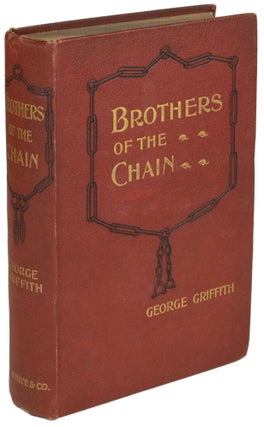
BROTHERS OF THE CHAIN ...
London: F. V. White & Co., 1900. Octavo, pp. [i-iv] v-vi [vii-viii] [1] 2-312 [note: pages 309-312 comprise publisher’s ads], original decorated chocolate-brown pebbled cloth, front and spine panels stamped in black and gold, publisher's monogram stamped in blind on rear panel. First edition, second issue with cancel title leaf dated 1900 tipped in on a stub. Sensational thriller concerning the activities of a Mafia-like international secret society of criminals who are run to ground by Pinkerton detectives. [Reference: Glover & Greene, Victorian Detective Fiction 218. Currey, p. [209]. Hubin (1994), p. 355. Wolff 2793 (describing this second issue)].
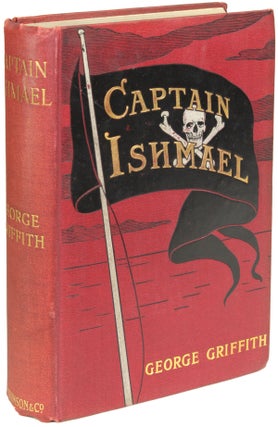
CAPTAIN ISHMAEL: A SAGA OF THE SOUTH SEAS ...
London: Hutchinson & Co, 1901. Octavo, pp. [1-4] [1-2] 3-344 [345-348: ads dated "Autumn 1901"], inserted frontispiece, original pictorial red cloth, front panel stamped in black, white and gold, spine panel stamped in gold. First edition. "...an extraordinary novel of a man doomed to wander deathless through the ages, who several times meets the Wandering Jew, and in the end invents long-range guns with explosive shells in a 'world of if,' long before anybody else." – Sam Moskowitz, "George Griffith-Warrior of If" in George Locke (ed), The Raid of 'Le Vengeur' and Other Stories by George Griffith (1974), p. 44. "One of Griffith's rarest books..." – Locke, A Spectrum of Fantasy, p. 97. [Reference: Stableford, Scientific Romance in Britain 1890-1950, p. 53. Reginald 06366. Not in Bleiler (1948; 1978)].

THE JUSTICE OF REVENGE.
London: F. V. White & Co., 1901. Octavo, pp. [i-iv] v-vi [vii-viii] [1] 2-303 [304: printer's imprint] [1] 2-7: ads [8: blank], original pictorial green cloth, front panel stamped in black, spine panel stamped in gold, publisher's monogram stamped in black on rear panel, bottom edge rough-trimmed. First edition. Daughter of a scientist who dies while imprisoned for anarchist activities seeks revenge on society. Marginal science fiction novel with use of powerful explosives and synthetic poisons. Thematically similar to Thomas Mullett Ellis' ZALMA (1897). [Reference: Locke, A Spectrum of Fantasy Volume II, p. 53. Reginald 06375. Not in Bleiler (1948; 1978). Hubin (1994), p. 355].
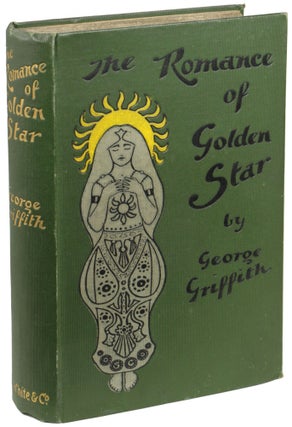
THE ROMANCE OF GOLDEN STAR.
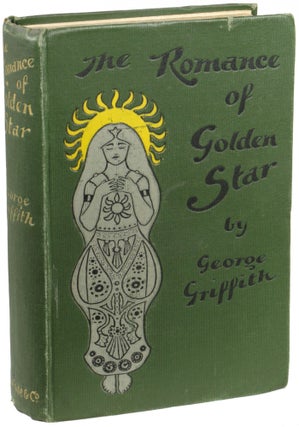
London: F. V. White & Co., 1897. Octavo, pp. [i-iv] v-vii [viii] [1] 2-284 [285]-300: ads, six inserted plates with illustrations by Alfred Pearse, original pictorial green cloth, front panel stamped in yellow, white and black, spine panel stamped in gold, publisher's monogram stamped in black on rear panel, top edge rough-trimmed fore and bottom edges untrimmed. First edition. A pair of Incas, held in suspended animation for hundreds of years, are revived scientifically; they mount a successful campaign to restore South America to Indian rule. [Reference: Bleiler, Science-Fiction: The Early Years 933. Locke, A Spectrum of Fantasy, p. 98. Stableford, Scientific Romance in Britain 1890-1950, p. 50. Suvin, Victorian Science Fiction in the UK, pp. 67-8. Bleiler (1978), p. 87. Reginald 06384. Wolff 2798].
THE ROMANCE OF GOLDEN STAR.
London: F. V. White & Co., 1897. Octavo, pp. [i-iv] v-vii [viii] [1] 2-284 [285]-300: ads, six inserted plates with illustrations by Alfred Pearse, original pictorial green cloth, front panel stamped in yellow, white and black, spine panel stamped in gold, publisher's monogram stamped in black on rear panel, top edge rough-trimmed fore and bottom edges untrimmed. First edition. A pair of Incas, held in suspended animation for hundreds of years, are revived scientifically; they mount a successful campaign to restore South America to Indian rule. [Reference: Bleiler, Science-Fiction: The Early Years 933. Locke, A Spectrum of Fantasy, p. 98. Stableford, Scientific Romance in Britain 1890-1950, p. 50. Suvin, Victorian Science Fiction in the UK, pp. 67-8. Bleiler (1978), p. 87. Reginald 06384. Wolff 2798].
VALDAR THE OFT-BORN: A SAGA OF SEVEN AGES ...
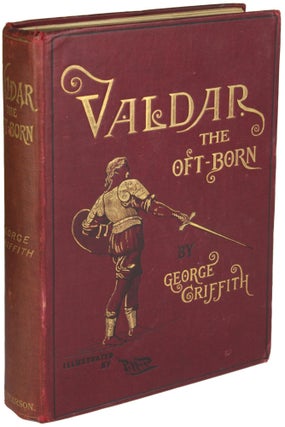
London: C. Arthur Pearson, Limited, 1895. Octavo, pp. [i-v] vi [vii-viii] [1] 2-416, sixteen inserted plates with illustrations by Harold Piffard, original pictorial maroon cloth, front panel stamped in black and gold, spine panel stamped in gold. First edition, first binding. "Fantasy saga of a son of Odin who, upsetting the laws of his polar country and bringing about ragnarok, is doomed to many reincarnations through the ages; basically a series of bloodthirsty historical adventures in a similar vein to [Arnold's] PHRA THE PHOENICIAN." - Locke, A Spectrum of Fantasy, p. 98. [Reference: Barron (ed), Fantasy Literature 2-70. Bleiler, The Guide to Supernatural Fiction 717. Clareson, Science Fiction in America, 1870s-1930s 370. Bleiler (1978), p. 87. Reginald 06387. Wolff 2799].
VALDAR THE OFT-BORN: A SAGA OF SEVEN AGES ...
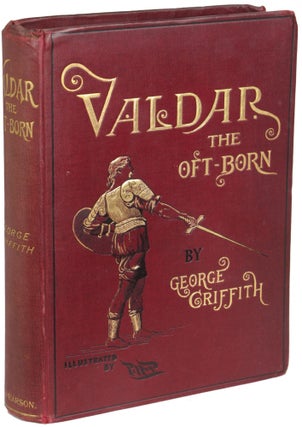
London: C. Arthur Pearson, Limited, 1895. Octavo, pp. [i-v] vi [vii-viii] [1] 2-416, sixteen inserted plates with illustrations by Harold Piffard, original pictorial maroon cloth, front panel stamped in black and gold, spine panel stamped in gold. First edition, first binding. "Fantasy saga of a son of Odin who, upsetting the laws of his polar country and bringing about ragnarok, is doomed to many reincarnations through the ages; basically a series of bloodthirsty historical adventures in a similar vein to [Arnold's] PHRA THE PHOENICIAN." - Locke, A Spectrum of Fantasy, p. 98. [Reference: Barron (ed), Fantasy Literature 2-70. Bleiler, The Guide to Supernatural Fiction 717. Clareson, Science Fiction in America, 1870s-1930s 370. Bleiler (1978), p. 87. Reginald 06387. Wolff 2799].

THE WHITE WITCH OF MAYFAIR.
London: F. V. White & Co., 1902. Octavo, pp. [1-8] [1] 2-312, publisher's pictorial red cloth, front and spine panels stamped in black, publisher's monogram stamped in black on rear panel, all edges trimmed. First edition, second binding.