
Results

LAST AND FIRST MEN.
New York: Jonathan Cape and Harrison Smith, [1931]. Octavo, pp. [i-iv] v [vi] vii-ix [x] xi [xii] xiii-xvi 1-371 [372: blank], original tan cloth, spine stamped in black, bottom edge rough trimmed. First U. S. edition, later binding. The author's first novel, "one of the most remarkable imaginative works in the field of futuristic fiction: an account of human development during the next hundreds of millions of years." - Clarke, Tale of the Future (1978), p. 58. "On his own terms, Stapledon is unequaled, and he certainly has been one of the major influences on contemporary science fiction." - Survey of Science Fiction Literature III, pp. 1140-43. "LAST AND FIRST MEN and STAR MAKER soar far beyond the accepted limits of science fiction... Stapledon is the great classical example, the cold pitch of perfection as he turns scientific concepts into vast ontological epic prose poems, the ultimate SF writer." - Aldiss, Trillion Year Spree: The History of Science Fiction, p. 198. Stapledon's "influence, both direct and indirect, on the development of many concepts which now permeate genre SF is probably second only to that of H. G. Wells." - Clute and Nicholls (eds), The Encyclopedia of Science Fiction (1993), pp. 1151-53. [Reference: Aldiss, Trillion Year Spree: The History of Science Fiction, p. 198. Anatomy of Wonder (1976) 3-56; (1981) 2-98; (1987) 2-109; and (1995) 2-119. Bleiler, Science-Fiction: The Early Years 2086. Clareson, Science Fiction in America, 1870s-1930s 718. Clarke, Tale of the Future (1978), p. 58. Clute and Nicholls (eds), The Encyclopedia of Science Fiction (1993), pp. 1151-52. Gerber, Utopian Fantasy (1973), p. 151. Locke, A Spectrum of Fantasy, pp. 204-05. Stableford, Scientific Romance in Britain 1890-1950, pp. 200-03. Survey of Science Fiction Literature III, pp. 1140-43. In 333. Bleiler (1978), p. 185. Reginald 13553. Satty and Smith A3.2.1].
STAR MAKER.
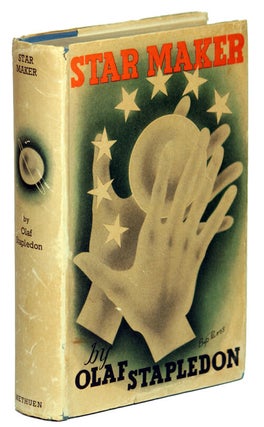
London: Metheun & Co. Ltd., [1937]. Ocatvo, pp. [i-iv] v-ix [x] xi-xii 1-339 [340: printer's imprint], original blue cloth, spine panel stamped in red. First edition, first impression, later issue. 2513 copies of this issue were distributed. The author's fourth novel, often regarded as Stapledon's greatest work, and one of the very few truly seminal modern SF novels. "...mind-boggling imaginative tour de force..."– Survey of Science Fiction Literature V, pp. 2150-55. "...a tremendously exciting exposition of Stapledon's philosophy, which extends his thought to its logical conclusion."– Anatomy of Wonder (1976) 3-60. "A magnificent work by any standards; the most important speculative work of the period."– Anatomy of Wonder (1995) 2-121. "Last and First Men is just slightly an atheist's tract, based largely on nineteenth-century thought, and in particular on Winwood Reade's Martyrdom of Man. In Star Maker, the atheism has become a faith in itself, so that it inevitably approaches higher religion, which is bodied forth on a genuinely new twentieth-century perception of cosmology. It therefore marks a great step forward in Stapledon's art, the thought unfolding with little sense of strain through chapter after chapter. It is magnificent. It is almost unbearable... Last and First Men and Star Maker soar far beyond the accepted limits of science fiction... Stapledon is the great classical example, the cold pitch of perfection as he turns scientific concepts into vast ontological epic prose poems, the ultimate SF writer."– Aldiss and Wingrove, Trillion Year Spree: The History of Science Fiction, p. 198. Stapledon's "influence, both direct and indirect, on the development of many concepts which now permeate genre SF is probably second only to that of H. G. Wells."– Clute and Nicholls (eds), The Encyclopedia of Science Fiction (1993), pp. 1151-53. [Reference: Anatomy of Wonder (1981) 2-101 and (1987) 2-112. Bleiler, The Guide to Supernatural Fiction 1514. Clareson, Science Fiction in America, 1870s-1930s 722. Clarke, Tale of the Future (1978), p. 72. Locke, A Spectrum of Fantasy, pp. 205. Stableford, Scientific Romance in Britain 1890-1950, pp. 209-12. In 333. Bleiler (1978), p. 185. Reginald 13562. Satty and Smith A7.1.1.1].

STAR MAKER.
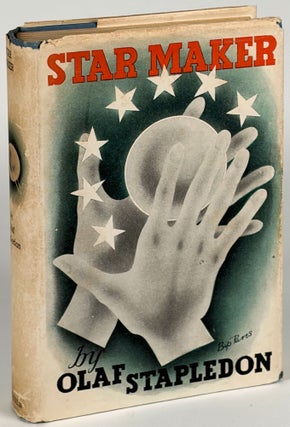
London: Metheun & Co. Ltd., [1937]. Ocatvo, pp. [i-iv] v-ix [x] xi-xii 1-339 [340: printer's imprint], original blue cloth, spine panel stamped in red. First edition, first impression. 2513 copies of this issue were distributed. The author's fourth novel, often regarded as Stapledon's greatest work, and one of the very few truly seminal modern SF novels. "...mind-boggling imaginative tour de force..."– Survey of Science Fiction Literature V, pp. 2150-55. "...a tremendously exciting exposition of Stapledon's philosophy, which extends his thought to its logical conclusion."– Anatomy of Wonder (1976) 3-60. "A magnificent work by any standards; the most important speculative work of the period."– Anatomy of Wonder (1995) 2-121. "Last and First Men is just slightly an atheist's tract, based largely on nineteenth-century thought, and in particular on Winwood Reade's Martyrdom of Man. In Star Maker, the atheism has become a faith in itself, so that it inevitably approaches higher religion, which is bodied forth on a genuinely new twentieth-century perception of cosmology. It therefore marks a great step forward in Stapledon's art, the thought unfolding with little sense of strain through chapter after chapter. It is magnificent. It is almost unbearable... Last and First Men and Star Maker soar far beyond the accepted limits of science fiction... Stapledon is the great classical example, the cold pitch of perfection as he turns scientific concepts into vast ontological epic prose poems, the ultimate SF writer."– Aldiss and Wingrove, Trillion Year Spree: The History of Science Fiction, p. 198. Stapledon's "influence, both direct and indirect, on the development of many concepts which now permeate genre SF is probably second only to that of H. G. Wells."– Clute and Nicholls (eds), The Encyclopedia of Science Fiction (1993), pp. 1151-53. [Reference: Anatomy of Wonder (1981) 2-101 and (1987) 2-112. Bleiler, The Guide to Supernatural Fiction 1514. Clareson, Science Fiction in America, 1870s-1930s 722. Clarke, Tale of the Future (1978), p. 72. Locke, A Spectrum of Fantasy, pp. 205. Stableford, Scientific Romance in Britain 1890-1950, pp. 209-12. In 333. Bleiler (1978), p. 185. Reginald 13562. Satty and Smith A7.1.1.1].
THE STAR MAKER.
London: Metheun & Co. Ltd., [1937]. Ocatvo, pp. [i-iv] v-ix [x] xi-xii 1-339 [340: printer's imprint], original blue cloth, spine panel stamped in red. First edition. 2513 copies of this issue were distributed. The author's fourth novel, often regarded as Stapledon's greatest work, and one of the very few truly seminal modern SF novels. "...mind-boggling imaginative tour de force..."– Survey of Science Fiction Literature V, pp. 2150-55. "...a tremendously exciting exposition of Stapledon's philosophy, which extends his thought to its logical conclusion."– Anatomy of Wonder (1976) 3-60. "A magnificent work by any standards; the most important speculative work of the period."– Anatomy of Wonder (1995) 2-121. "Last and First Men is just slightly an atheist's tract, based largely on nineteenth-century thought, and in particular on Winwood Reade's Martyrdom of Man. In Star Maker, the atheism has become a faith in itself, so that it inevitably approaches higher religion, which is bodied forth on a genuinely new twentieth-century perception of cosmology. It therefore marks a great step forward in Stapledon's art, the thought unfolding with little sense of strain through chapter after chapter. It is magnificent. It is almost unbearable... Last and First Men and Star Maker soar far beyond the accepted limits of science fiction... Stapledon is the great classical example, the cold pitch of perfection as he turns scientific concepts into vast ontological epic prose poems, the ultimate SF writer."– Aldiss and Wingrove, Trillion Year Spree: The History of Science Fiction, p. 198. Stapledon's "influence, both direct and indirect, on the development of many concepts which now permeate genre SF is probably second only to that of H. G. Wells."– Clute and Nicholls (eds), The Encyclopedia of Science Fiction (1993), pp. 1151-53. [Reference: Anatomy of Wonder (1981) 2-101 and (1987) 2-112. Bleiler, The Guide to Supernatural Fiction 1514. Clareson, Science Fiction in America, 1870s-1930s 722. Clarke, Tale of the Future (1978), p. 72. Locke, A Spectrum of Fantasy, pp. 205. Stableford, Scientific Romance in Britain 1890-1950, pp. 209-12. In 333. Bleiler (1978), p. 185. Reginald 13562. Satty and Smith A7.1.1.1].

LAST MEN IN LONDON.
London: Methuen & Co. Ltd., [1932]. pp. [i-iv] v-viii 1-312 + 8-page publisher's catalogue dated "932" at bottom of page 8 inserted at rear, original blue cloth, front panel stamped in blind, spine panel stamped in gold, fore and bottom edges untrimmed. First edition, first impression, first issue. 1518 copies were prepared in this format. Stapledon's elusive second novel, written as a companion piece to his LAST AND FIRST MEN (1930). With its unique perspective and autobiographical focus, LAST MEN IN LONDON is one of Stapledon's most powerful and personal novels. [Reference: Anatomy of Wonder (1976) 3-57. See Anatomy of Wonder (1981) 2-98; (1987) 2-109 and (1995) 2-119. Clareson, Science Fiction in America, 1870s-1930s 719. Clarke, Tale of the Future (1978), p. 62. Clute and Nicholls (eds), The Encyclopedia of Science Fiction (1993), p. 1152. Gerber, Utopian Fantasy (1973), p. 151. Locke, A Spectrum of Fantasy, p. 205. Sargent, British and American Utopian Literature, 1516-1985, p. 196. Stableford, Scientific Romance in Britain 1890-1950, pp. 203-06. In 333. Bleiler (1978), p. 185. Reginald 13556. Satty and Smith A4.1.1.1].

LAST MEN IN LONDON.
London: Methuen & Co. Ltd., [1932]. pp. [i-iv] v-viii 1-312 + 8-page publisher's catalogue dated "932" at bottom of page 8 inserted at rear, original blue cloth, front panel stamped in blind, spine panel stamped in gold, fore and bottom edges untrimmed. First edition, first impression, second issue. 1518 copies were prepared in this format of which 237 were issued with the second dust jacket. Stapledon's elusive second novel, written as a companion piece to his LAST AND FIRST MEN (1930). With its unique perspective and autobiographical focus, LAST MEN IN LONDON is one of Stapledon's most powerful and personal novels. [Reference: Anatomy of Wonder (1976) 3-57. See Anatomy of Wonder (1981) 2-98; (1987) 2-109 and (1995) 2-119. Clareson, Science Fiction in America, 1870s-1930s 719. Clarke, Tale of the Future (1978), p. 62. Clute and Nicholls (eds), The Encyclopedia of Science Fiction (1993), p. 1152. Gerber, Utopian Fantasy (1973), p. 151. Locke, A Spectrum of Fantasy, p. 205. Sargent, British and American Utopian Literature, 1516-1985, p. 196. Stableford, Scientific Romance in Britain 1890-1950, pp. 203-06. In 333. Bleiler (1978), p. 185. Reginald 13556. Satty and Smith A4.1.1.1].
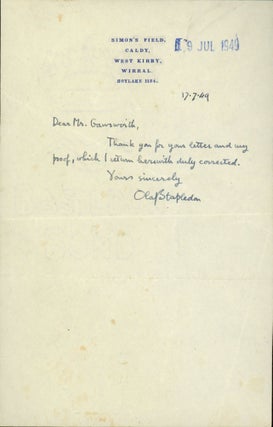
"Conflict of Wisdom." Typed Manuscript (TMs).
10 leaves, plus cover sheet. Corrected throughout in Stapledon's hand with amendments, additions, and strikeouts. At the top edge of the cover sheet Gawsworth has written: "Published by me / when editing ENQUIRY / (1949) / John Gawsworth." Accompanied by a handwritten note (ANS) from Stapledon to Gawsworth dated 17 July 1949 returning a corrected proof of the essay. The essay, published in ENQUIRY, August 1949, addresses the "need both for fidelity to the spirit and agnosticism about the ultimate ends of the universe." - Satty and Smith C190. William Olaf Stapledon (1886-1950) "is best remembered for the extraordinary works of speculative fiction published between 1930 and 1950. As a novelist, he was known as the spokesman for the Age of Einstein and has influenced writers as diverse as Virginia Woolf, Arthur C. Clarke, and Doris Lessing ... Stapledon's novels -- LAST AND FIRST MEN (1930), ODD JOHN (1935), STAR MAKER (1937), and SIRIUS (1944) -- have gathered a passionate following, and they have seldom been out of print in the last twenty-five years ... In his social activism as in his fiction, Stapledon embodied many of the of modern era's anxieties and hopes that allow his works to continue to speak to and for the future." - Robert Crossley.
WAKING WORLD.
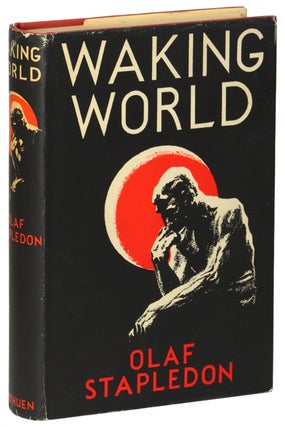
London: Methuen & Co. Ltd., [1934]. Octavo, pp. [i-iv] v-viii 1-280 + 8-page publisher's catalogue dated "634" at bottom of page 8 inserted at rear, original red cloth, spine panel stamped in gold. First edition. 1523 copies printed. Collection of essays on politics, humanism, and science. [Reference: Satty and Smith A5.1].

LAST AND FIRST MEN.
London: Methuen & Co. Ltd., [1930]. Octavo, pp. [i-iv] v-xi [xii] 1-355 [356: printer's imprint] + 8-page publisher's catalogue dated "630" at bottom of page 8 inserted at rear, original dark blue cloth, front panel stamped in blind, spine panel stamped in gold. First edition. Variant with 8-page publisher's catalogue dated "630" inserted at rear. Published 23 October 1930. 2036 copies printed. The author's first novel, "one of the most remarkable imaginative works in the field of futuristic fiction: an account of human development during the next hundreds of millions of years." - Clarke, Tale of the Future (1978), p. 58. "On his own terms, Stapledon is unequaled, and he certainly has been one of the major influences on contemporary science fiction." - Survey of Science Fiction Literature III, pp. 1140-43. "LAST AND FIRST MEN and STAR MAKER soar far beyond the accepted limits of science fiction... Stapledon is the great classical example, the cold pitch of perfection as he turns scientific concepts into vast ontological epic prose poems, the ultimate SF writer." - Aldiss, Trillion Year Spree: The History of Science Fiction, p. 198. Stapledon's "influence, both direct and indirect, on the development of many concepts which now permeate genre SF is probably second only to that of H. G. Wells." - Clute and Nicholls (eds), The Encyclopedia of Science Fiction (1993), pp. 1151-53. [Reference: Aldiss, Trillion Year Spree: The History of Science Fiction, p. 198. Anatomy of Wonder (1976) 3-56; (1981) 2-98; (1987) 2-109; and (1995) 2-119. Bleiler, Science-Fiction: The Early Years 2086. Clareson, Science Fiction in America, 1870s-1930s 718. Clarke, Tale of the Future (1978), p. 58. Clute and Nicholls (eds), The Encyclopedia of Science Fiction (1993), pp. 1151-52. Gerber, Utopian Fantasy (1973), p. 151. Locke, A Spectrum of Fantasy, pp. 204-05. Stableford, Scientific Romance in Britain 1890-1950, pp. 200-03. Survey of Science Fiction Literature III, pp. 1140-43. In 333. Bleiler (1978), p. 185. Reginald 13553. Satty and Smith A3.1.1].
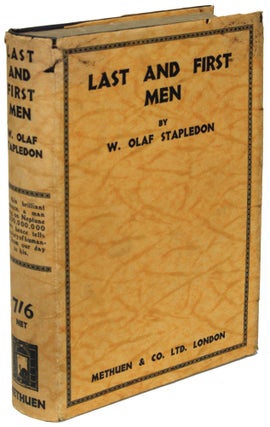
LAST AND FIRST MEN: A STORY OF THE NEAR AND FAR FUTURE.
London: Methuen & Co. Ltd., [1930]. Octavo, pp. [i-iv] v-xi [xii] 1-355 [356: printer's imprint], original dark blue cloth, front panel stamped in blind, spine panel stamped in gold. First edition. Laid into this copy are two brief notes signed by Stapledon, one dated 1929 and one dated 1930, a brief signed telegram, newspaper tear sheet with a long review for the book from John O London's Weekly, dated 15 November 1930 and a small newspaper clipping with the author's obituary. Variant without publisher's catalogue inserted at rear. Published 23 October 1930. 2036 copies printed. The author's first novel, "one of the most remarkable imaginative works in the field of futuristic fiction: an account of human development during the next hundreds of millions of years." - Clarke, Tale of the Future (1978), p. 58. "On his own terms, Stapledon is unequaled, and he certainly has been one of the major influences on contemporary science fiction." - Survey of Science Fiction Literature III, pp. 1140-43. "LAST AND FIRST MEN and STAR MAKER soar far beyond the accepted limits of science fiction... Stapledon is the great classical example, the cold pitch of perfection as he turns scientific concepts into vast ontological epic prose poems, the ultimate SF writer." - Aldiss, Trillion Year Spree: The History of Science Fiction, p. 198. Stapledon's "influence, both direct and indirect, on the development of many concepts which now permeate genre SF is probably second only to that of H. G. Wells." - Clute and Nicholls (eds), The Encyclopedia of Science Fiction (1993), pp. 1151-53. [Reference: Aldiss, Trillion Year Spree: The History of Science Fiction, p. 198. Anatomy of Wonder (1976) 3-56; (1981) 2-98; (1987) 2-109; and (1995) 2-119. Bleiler, Science-Fiction: The Early Years 2086. Clareson, Science Fiction in America, 1870s-1930s 718. Clarke, Tale of the Future (1978), p. 58. Clute and Nicholls (eds), The Encyclopedia of Science Fiction (1993), pp. 1151-52. Gerber, Utopian Fantasy (1973), p. 151. Locke, A Spectrum of Fantasy, pp. 204-05. Stableford, Scientific Romance in Britain 1890-1950, pp. 200-03. Survey of Science Fiction Literature III, pp. 1140-43. In 333. Bleiler (1978), p. 185. Reginald 13553. Satty and Smith A3.1.1].
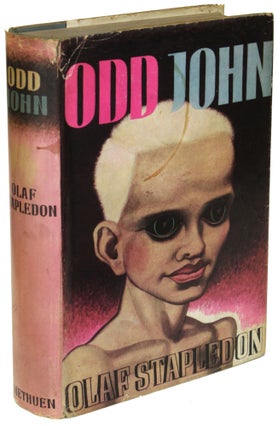
ODD JOHN: A STORY BETWEEN JEST AND EARNEST.
London: Methuen & Co. Ltd., [1935]. Octavo, pp. [i-iv] v [vi] 1-282 + 8-page publisher's catalogue dated "835" at bottom of page 8 inserted at rear, original blue cloth, spine panel stamped in dark blue. First edition, first impression. 3096 copies printed, this copy with later form of inserted catalogue dated "835" on page 8. Stapledon's third novel. "... the most radically thoughtful of the many fictional extrapolations of ON THE ORIGIN OF SPECIES and one of the least comfortable in its conclusion. Above all it exposes the flimsiness of thinking that 'Superman' will always be on the side of the police, that evolution has stopped, or that from now on evolution will only take place nicely." - Survey of Science Fiction Literature IV, pp. 1583-87. "Although the narrative voices Stapledon's biases, it remains perhaps the finest early novel in which mankind is unable to accept and live with advanced mutations (supermen)." - Clareson, Science Fiction in America, 1870s-1930s 720. [Reference: Anatomy of Wonder (1976) 3-58; (1981) 2-99; (1987) 2-110; (1995) 2-120; and (2004) II-1070. Clute and Nicholls (eds), The Encyclopedia of Science Fiction (1993), p. 1152. Locke, A Spectrum of Fantasy, p. 205. Sargent, British and American Utopian Literature, 1516-1985, Additions. Stableford, Scientific Romance in Britain 1890-1950, pp. 206-09. In 333. Bleiler (1978), p. 185. Reginald 13558. Satty and Smith A6.1.1.1].

ODD JOHN: A STORY BETWEEN JEST AND EARNEST.
Norwalk, CT: The Easton Press, [1987]. Octavo, full leather, a.e.g. Later edition. New introduction by Alfred Bester. Stapledon's third novel. "... the most radically thoughtful of the many fictional extrapolations of ON THE ORIGIN OF SPECIES and one of the least comfortable in its conclusion. Above all it exposes the flimsiness of thinking that 'Superman' will always be on the side of the police, that evolution has stopped, or that from now on evolution will only take place nicely." - Survey of Science Fiction Literature IV, pp. 1583-87. "Although the narrative voices Stapledon's biases, it remains perhaps the finest early novel in which mankind is unable to accept and live with advanced mutations (supermen)." - Clareson, Science Fiction in America, 1870s-1930s 720. Collector's notes laid in. Issued as part of the Easton Press "Masterpieces of Science Fiction" series. [Reference: Anatomy of Wonder (1976) 3-58; (1981) 2-99; (1987) 2-110; (1995) 2-120; and (2004) II-1070. Clute and Nicholls (eds), The Encyclopedia of Science Fiction (1993), p. 1152. Locke, A Spectrum of Fantasy, p. 205. Sargent, British and American Utopian Literature, 1516-1985, Additions. Stableford, Scientific Romance in Britain 1890-1950, pp. 206-09. In 333. Bleiler (1978), p. 185. Reginald 13558. Satty and Smith A6.1.1.1].

ODD JOHN: A STORY BETWEEN JEST AND EARNEST.
London: Methuen & Co. Ltd., [1935]. Octavo, pp. [i-iv] v [vi] 1-282 + 8-page publisher's catalogue dated "835" at bottom of page 8 inserted at rear, original blue cloth, spine panel stamped in dark blue. First edition, first impression, first issue. 3096 copies printed, this copy with earliest inserted catalogue dated "535" on page 8. Stapledon's third novel. "... the most radically thoughtful of the many fictional extrapolations of ON THE ORIGIN OF SPECIES and one of the least comfortable in its conclusion. Above all it exposes the flimsiness of thinking that 'Superman' will always be on the side of the police, that evolution has stopped, or that from now on evolution will only take place nicely." - Survey of Science Fiction Literature IV, pp. 1583-87. "Although the narrative voices Stapledon's biases, it remains perhaps the finest early novel in which mankind is unable to accept and live with advanced mutations (supermen)." - Clareson, Science Fiction in America, 1870s-1930s 720. [Reference: Anatomy of Wonder (1976) 3-58; (1981) 2-99; (1987) 2-110; (1995) 2-120; and (2004) II-1070. Clute and Nicholls (eds), The Encyclopedia of Science Fiction (1993), p. 1152. Locke, A Spectrum of Fantasy, p. 205. Sargent, British and American Utopian Literature, 1516-1985, Additions. Stableford, Scientific Romance in Britain 1890-1950, pp. 206-09. In 333. Bleiler (1978), p. 185. Reginald 13558. Satty and Smith A6.1.1.1].

SIRIUS: A FANTASY OF LOVE AND DISCORD.
London: Secker & Warburg, 1944. Octavo, pp. [1-4] 5 [6] 7-200, original brown cloth, spine panel stamped in dark brown. First edition, first impression. The world as seen through the eyes of an intelligent dog and his observations on society. "The story is convincing and genuinely moving, a classic of the genre." - Anatomy of Wonder (1987) 2-111. [Reference: Anatomy of Wonder (2004) II-1071. Clareson, Science Fiction in America, 1870s-1930s 721. Survey of Science Fiction Literature V, pp. 2085-90. Bleiler (1978), p. 185. Reginald 13561. Satty and Smith A14.1.1].

SIRIUS: A FANTASY OF LOVE AND DISCORD.
London: Secker & Warburg, 1944. Octavo, pp. [1-4] 5 [6] 7-200, original brown cloth, spine panel stamped in dark brown. First edition. The world as seen through the eyes of an intelligent dog and his observations on society. "The story is convincing and genuinely moving, a classic of the genre." - Anatomy of Wonder (1987) 2-111. [Reference: Anatomy of Wonder (2004) II-1071. Clareson, Science Fiction in America, 1870s-1930s 721. Survey of Science Fiction Literature V, pp. 2085-90. Bleiler (1978), p. 185. Reginald 13561. Satty and Smith A14.1.1].
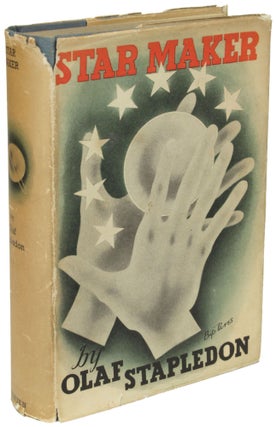
STAR MAKER.
London: Methuen & Co. Ltd., [1937]. Octavo, pp. [i-iv] v-ix [x] xi-xii 1-339 [340: printer's imprint], original blue cloth, spine panel stamped in red. First edition, first impression. 2513 copies of this issue were distributed. The author's fourth novel, often regarded as Stapledon's greatest work, and one of the very few truly seminal modern SF novels. "... mind-boggling imaginative tour de force..." - Survey of Science Fiction Literature V, pp. 2150-55. "... a tremendously exciting exposition of Stapledon's philosophy, which extends his thought to its logical conclusion." - Anatomy of Wonder (1976) 3-60. "A magnificent work by any standards; the most important speculative work of the period." - Anatomy of Wonder (1995) 2-121. "LAST AND FIRST MEN is just slightly an atheist's tract, based largely on nineteenth-century thought, and in particular on Winwood Reade's MARTYRDOM OF MAN. In STAR MAKER, the atheism has become a faith in itself, so that it inevitably approaches higher religion, which is bodied forth on a genuinely new twentieth-century perception of cosmology. It therefore marks a great step forward in Stapledon's art, the thought unfolding with little sense of strain through chapter after chapter. It is magnificent. It is almost unbearable ... LAST AND FIRST MEN and STAR MAKER soar far beyond the accepted limits of science fiction ... Stapledon is the great classical example, the cold pitch of perfection as he turns scientific concepts into vast ontological epic prose poems, the ultimate SF writer." - Aldiss and Wingrove, Trillion Year Spree: The History of Science Fiction, p. 198. Stapledon's "influence, both direct and indirect, on the development of many concepts which now permeate genre SF is probably second only to that of H. G. Wells." - Clute and Nicholls (eds), The Encyclopedia of Science Fiction (1993), pp. 1151-53. [Reference: Anatomy of Wonder (1981) 2-101; (1987) 2-112; and (2004) II-1072. Bleiler, The Guide to Supernatural Fiction 1514. Clareson, Science Fiction in America, 1870s-1930s 722. Clarke, Tale of the Future (1978), p. 72. Gerber, Utopian Fantasy (1973), p. 153. Locke, A Spectrum of Fantasy, pp. 205. Sargent, British and American Utopian Literature, 1516-1985, p. 215. Stableford, Scientific Romance in Britain 1890-1950, pp. 209-12. In 333. Bleiler (1978), p. 185. Reginald 13562. Satty and Smith A7.1.1.1].