
Results
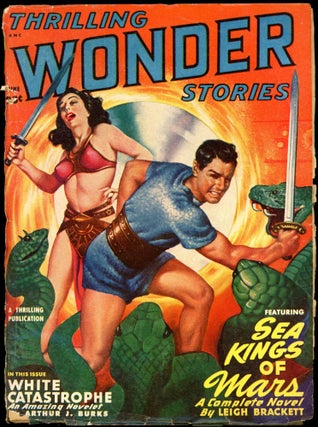
THRILLING WONDER STORIES.
New York: Standard Magazines, Inc., 1949. Octavo, single issue, pictorial wrappers. Pulp magazine. An important issue. Notable for "The Alien Machine" by Raymond F. Jones, basis for the novel and later film "THIS ISLAND EARTH." Also includes "Sea Kings of Mars" by Leigh Brackett (published later as THE SWORD OF RHIANNON). Fiction by John D. MacDonald, "Like a Keepsake," Henry Kuttner, Murray Leinster, Fredric Brown, James Blish and others. [Reference: Tymm and Ashley, Science Fiction, Fantasy, and Weird Fiction Magazines, pp. 743-762].
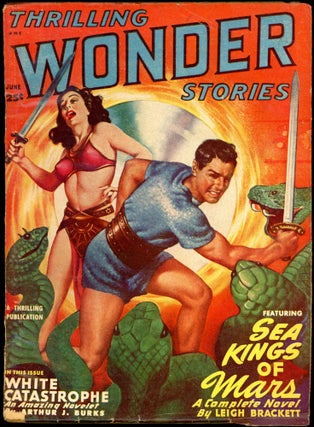
THRILLING WONDER STORIES.
New York: Standard Magazines, Inc., 1949. Octavo, single issue, pictorial wrappers. Pulp magazine. An important issue. Notable for "The Alien Machine" by Raymond F. Jones, basis for the novel and later film "THIS ISLAND EARTH." Also includes "Sea Kings of Mars" by Leigh Brackett (published later as THE SWORD OF RHIANNON). Fiction by John D. MacDonald, "Like a Keepsake," Henry Kuttner, Murray Leinster, Fredric Brown, James Blish and others. [Reference: Tymm and Ashley, Science Fiction, Fantasy, and Weird Fiction Magazines, pp. 743-762].
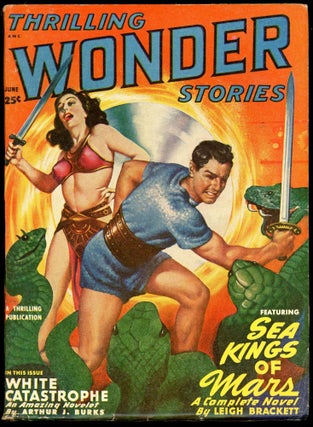
THRILLING WONDER STORIES.
New York: Standard Magazines, Inc., 1949. Octavo, single issue, pictorial wrappers. Pulp magazine. An important issue. Notable for "The Alien Machine" by Raymond F. Jones, basis for the novel and later film "THIS ISLAND EARTH." Also includes "Sea Kings of Mars" by Leigh Brackett (published later as THE SWORD OF RHIANNON). Fiction by John D. MacDonald, "Like a Keepsake," Henry Kuttner, Murray Leinster, Fredric Brown, James Blish and others. [Reference: Tymm and Ashley, Science Fiction, Fantasy, and Weird Fiction Magazines, pp. 743-762].
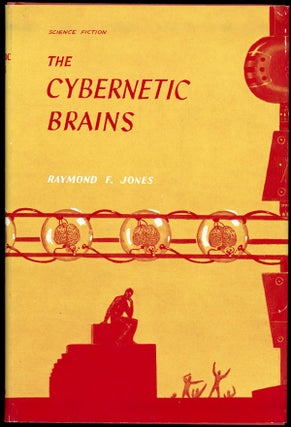
THE CYBERNETIC BRAINS.
New York: Avalon Books, [1962]. Octavo, cloth. First edition. In the twenty-fifth century the brains of two million dead, willed to the State by their donors, monitor the nation's automated factories, creating a land of leisure and plenty for its inhabitants. "But the brains, assumed to be only mindless neutral networks, are not dead. They are alive, conscious of their identity, capable of thought, and agonizingly aware of their fate -- eternal, disembodied slavery in a metal box, When, in time, the directors of the Cybernetics Institute discover the truth about the brains, they keep their findings secret and continue to accept donors. The directors justify their actions on the grounds that the State's entire manufacturing structure, functioning under cybernetic brain control, would crumble without the brain slaves ... [Jones' story] carries the mind invasion to a Dantesque extremity." - Berger, Science Fiction and the New Dark Age, p. 108. [Reference: Sargent, British and American Utopian Literature, 1516-1985, p. 238].
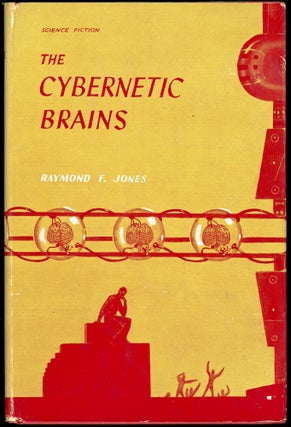
THE CYBERNETIC BRAINS.
New York: Avalon Books, [1962]. Octavo, cloth. First edition. In the twenty-fifth century the brains of two million dead, willed to the State by their donors, monitor the nation's automated factories, creating a land of leisure and plenty for its inhabitants. "But the brains, assumed to be only mindless neutral networks, are not dead. They are alive, conscious of their identity, capable of thought, and agonizingly aware of their fate -- eternal, disembodied slavery in a metal box, When, in time, the directors of the Cybernetics Institute discover the truth about the brains, they keep their findings secret and continue to accept donors. The directors justify their actions on the grounds that the State's entire manufacturing structure, functioning under cybernetic brain control, would crumble without the brain slaves ... [Jones' story] carries the mind invasion to a Dantesque extremity." - Berger, Science Fiction and the New Dark Age, p. 108. [Reference: Sargent, British and American Utopian Literature, 1516-1985, p. 238].
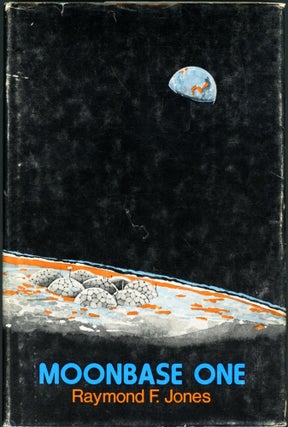
MOONBASE ONE.
London, New York, Toronto: Criterion Books, Published by Abelard Schuman-Limited, [1972]. Octavo, cloth. First edition. Juvenile novel. Teenagers go on a colonization mission to the Moon. There is a sabotage event and dissension among the colonists.
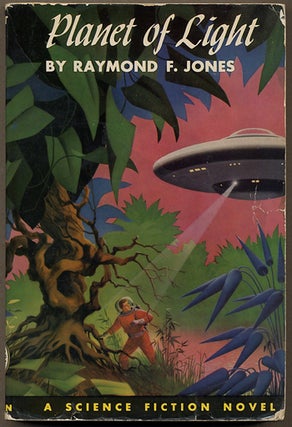
PLANET OF LIGHT.
Philadelphia, Toronto: The John C. Winston Company, [1953]. Octavo, pictorial wrappers. First edition. Once thought to be an advance issue or uncorrected proof, this paperwraps issue is possibly prepared for use at U.S. Military base libraries or perhaps a simple low cost remainder issue. The book is made up of first edition sheets complete with the illustrated Schomburg end papers enclosed in stiff paper wrappers which has the dust jacket pasted to them. The jacket is a later state jacket with 29 titles listed on the rear panel instead of 20 that are listed on the first. This is an uncommon issue.
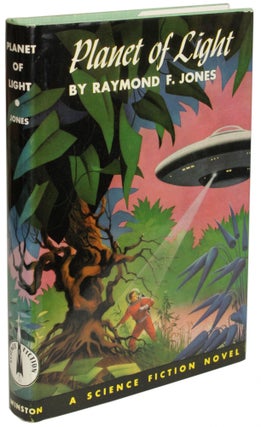
PLANET OF LIGHT.
Philadelphia, Toronto: The John C. Winston Company, [1958]. Octavo, jacket illustration by Kenneth Fagg, cloth. Later, second printing. Sequel to SON OF THE STARS (1952) in which a conference of the Galactic Federation, meeting on Rorla, a planet in the Andromeda galaxy, will decide the fate of Earth, whose civilization is considered dangerous by some who believe Earth's destruction is necessary. Part of the popular Winston juvenile series published between 1952-1961, which introduced many young readers to science fiction.

PLANET OF LIGHT.
Philadelphia, Toronto: The John C. Winston Company, [1953]. Octavo, stiff pictorial wrappers. First edition. later issue. Part of the classic Winston science fiction series for young readers published between 1952 and 1961. These later issues are often called in error advance copies. This has the "first edition" statement on the copyright page, but is bound in a later printing dust jacket (listing 29 volumes in the series on the rear panel, rather than the 20 listed on first printing jackets for this title) which is adhered to unprinted stiff white wrappers.
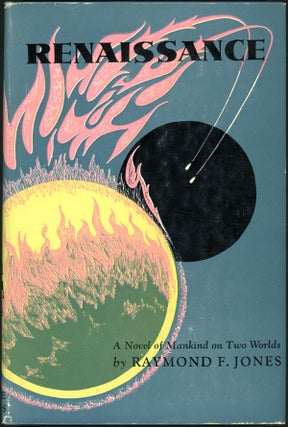
RENAISSANCE.
New York: Gnome Press Publishers, [1951]. Octavo, cloth. First edition. The author's second book and first SF novel, a "long, complicated parallel-worlds adventure with an exciting narrative –- future war, super science and echoes of nuclear holocaust -– and a number of lively variations on favorite SF themes, told with some of the intricacy of his contemporary at ASTOUNDING, A. E. van Vogt." - John Clute and Peter Nicholls, SFE (online). Both future worlds are authoritarian dystopias, one controlled by an elite of computer scientists.
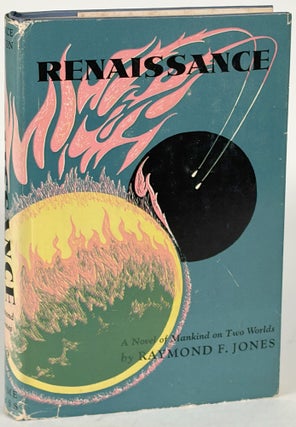
RENAISSANCE.
New York: Gnome Press Publishers, [1951]. Octavo, cloth. First edition. The author's second book and first SF novel, a "long, complicated parallel-worlds adventure with an exciting narrative –- future war, super science and echoes of nuclear holocaust -– and a number of lively variations on favorite SF themes, told with some of the intricacy of his contemporary at ASTOUNDING, A. E. van Vogt." - John Clute and Peter Nicholls, SFE (online). Both future worlds are authoritarian dystopias, one controlled by an elite of computer scientists.
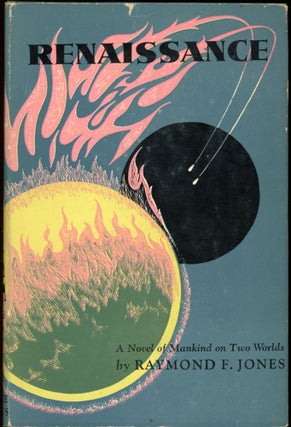
RENAISSANCE.
New York: Gnome Press Publishers, [1951]. Octavo, cloth. First edition. The author's second book and first SF novel, a "long, complicated parallel-worlds adventure with an exciting narrative –- future war, super science and echoes of nuclear holocaust -– and a number of lively variations on favorite SF themes, told with some of the intricacy of his contemporary at ASTOUNDING, A. E. van Vogt." - John Clute and Peter Nicholls, SFE (online). Both future worlds are authoritarian dystopias, one controlled by an elite of computer scientists.
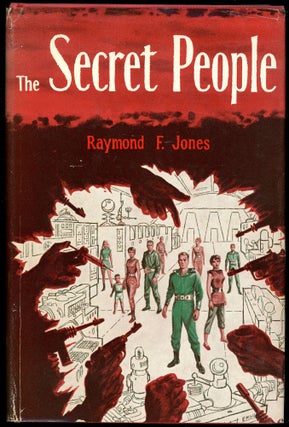
THE SECRET PEOPLE.
New York: Avalon Books, [1956]. Octavo, jacket by Ed Emshwiller, cloth. First edition. Science fiction novel involving genetics.
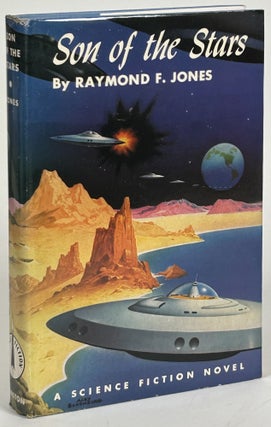
SON OF THE STARS.
Philadelphia, Toronto: The John C. Winston Company, [1958]. Octavo, jacket illustration by Alex Schomburg, cloth. Later, fourth printing. A young shipwrecked castaway from another galaxy is befriended by an American boy, but the military turns friendship into treachery and brings the Earth to the brink of destruction. Part of the popular Winston juvenile series published between 1952-1961, which introduced many young readers to science fiction.
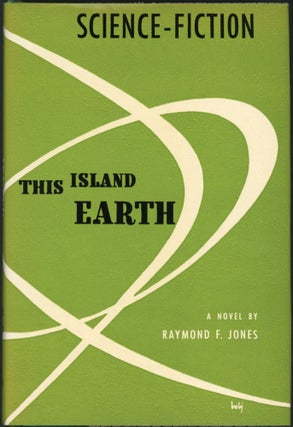
THIS ISLAND EARTH.
Chicago: Shasta Publishers, [1952]. Octavo, quarter cloth with boards. First edition. Basis for the 1955 film starring Jeff Morrow. While not a great film, it is a science fiction classic, the sequences on the planet Metaluna are highly imaginative. [Reference: Anatomy of Wonder (1987) 3-222].
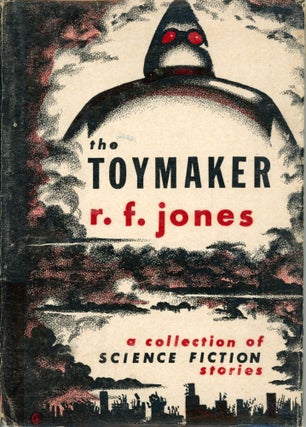
THE TOYMAKER.
Los Angeles: Fantasy Publishing Company, Inc., 1951. Octavo, original blue wrappers printed in black. First edition, later issue. Collects six stories. "Generally, fine SF that leaves space opera behind." - Anatomy of Wonder (1987) 3-223.