
Results

THE BENSON MURDER CASE: A PHILO VANCE STORY ...
New York: Charles Scribner's Sons, MCMXXVI [1926]. Octavo, pp. [1-2] [i-vi] vii-ix [x] xi-xii [xiii-xiv] 1-348 [349-352: blank], publisher's black cloth, front and spine panels stamped in red, fore-edge untrimmed, bottom edge rough trimmed. First edition, first printing. The first of Van Dine's twelve Philo Vance novels, many of which were made into feature films. THE BENSON MURDER CASE was the first detective novel to make the bestseller list. The Philo Vance books were incredibly popular during their time and Philo even had his own radio show. "In 1923, a combination of overwork, emotional strain, and drug abuse brought about the collapse of a little-known art critic named Willard Huntington Wright. During his long convalescence, he began reading detective stories for amusement. After devouring several hundred, he decided that he could write better whodunits than those he'd read, prepared synopses for three murder puzzles, and was offered a contract by Maxwell Perkins, the legendary Scribner's editor. Thus was born Philo Vance, the first important character in the history of novel-length American detective fiction ... Though today's readers tend to find him intolerably stilted, Van Dine is of crucial historical importance as the creator of the skeletal structure for the classic American detective novel and of the first great American Sherlock Holmes figure. The structure was perfected in the early 1930s by Ellery Queen, and both Queen and Rex Stout created more durable American Holmeses, but Van Dine was the pioneer, and it's most unlikely that Ellery Queen and Nero Wolfe would have come into existence without him" (Francis M. Nevins). A Haycraft-Queen cornerstone. [Reference: Pronzini and Muller, 1001 Midnights, pp. 807-808].
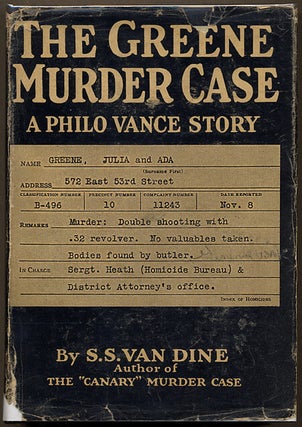
THE GREENE MURDER CASE: A PHILO VANCE STORY.
New York: Charles Scribner's Sons, 1928. Octavo, cloth. First edition, second issue. The second issue or state of the first edition with "Copyright, 1927, 1928, by Charles Scribner's Sons" on the copyright page. The first impression was issued March 1928, (the dedication copy has been observed with line "copyright, 1928"), the second issue the same month. A Philo Vance novel.