
Results

BUFFALO GALS AND OTHER ANIMAL PRESENCES.
Santa Barbara: Capra Press, 1987. Octavo, cloth-backed boards. First edition. Signed by Le Guin on the title page. Collects the title novella, ten stories including "Vaster Than Empires and More Slow," and twenty poems. [Reference: Hartwell, 200 Significant SF Books by Women, 1984-2001].

CHANGING PLANES.
Orlando, Austin, New York, San Diego, Toronto, London: Harcourt, Inc., [2003]. Octavo, illustrations by Eric Beddows, boards. First edition. Signed and dated (2003) by Le Guin on the title page. Includes “Social Dreaming of the Frin," a short story with both eutopian and dystopian elements describing a world in which everyone experiences the dreams of other people and of animals. This creates a 'communion of all sentient creatures' but also involves a radical questioning of the self." - Sargent, British and American Utopian Literature, 1986-2009.
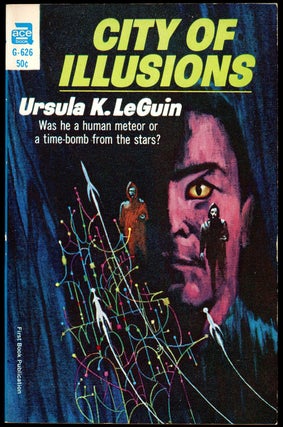
CITY OF ILLUSIONS.
New York: Ace Books, Inc., [1967]. Small octavo, pictorial wrappers. First edition. Ace G-626. Paperback original. Sixth installment in the author's future history series. Earth has reverted to barbarism. The alien Shing crush all efforts to rekindle learning and science. A leader appears who may be able to help them, but he is himself an alien. Can he be trusted? The third Hainish novel. [Reference: Sargent, British and American Utopian Literature, 1516-1985, Additions. Survey of Science Fiction Literature II, pp. 681-66. Reginald 08807].

THE DISPOSSESSED: AN AMBIGUOUS UTOPIA.
New York, Evanston, San Francisco, London: Harper & Row, Publishers, [1974]. Octavo, cloth-backed boards. First edition. "The novel reveals the author's understanding of anarchist theories with the idea that the personal and political growth of the individual are complementary ... [With her] complex literary, philosophical, and political construction, Le Guin challenges the idea of utopia itself and sets the basis for what has been called the 'critical utopia' -- an imperfect utopia in progress that, by questioning the very notion and convention of the genre, revitalizes it." - R. Baccolini, Fortunati and Trousson (eds), Dictionary of Literary Utopias, pp. 174-6. Winner of the 1974 Nebula and 1975 Hugo awards for best novel. [Reference: Anatomy of Wonder (2004) II-640. Pringle, Science Fiction: The 100 Best Novels 74. Survey of Science Fiction Literature II, pp. 548-53].

THE DISPOSSESSED: AN AMBIGUOUS UTOPIA.
Norwalk, CT: The Easton Press, [1986]. Octavo, full leather, a.e.g. Later edition. New introduction by Fred Pohl. "The novel reveals the author's understanding of anarchist theories with the idea that the personal and political growth of the individual are complementary ... [With her] complex literary, philosophical, and political construction, Le Guin challenges the idea of utopia itself and sets the basis for what has been called the 'critical utopia' -- an imperfect utopia in progress that, by questioning the very notion and convention of the genre, revitalizes it." - R. Baccolini, Fortunati and Trousson (eds), Dictionary of Literary Utopias, pp. 174-6. Winner of the 1974 Nebula and 1975 Hugo awards for best novel. Collector's notes laid in. Issued as part of the Easton Press "Masterpieces of Science Fiction" series. [Reference: Anatomy of Wonder (2004) II-640. Pringle, Science Fiction: The 100 Best Novels 74. Survey of Science Fiction Literature II, pp. 548-53].

THE DISPOSSESSED: AN AMBIGUOUS UTOPIA.
Norwalk, CT: The Easton Press, [1986]. Octavo, two color illustrations by Pat Morrissey, full leather, a.e.g. Later edition. New introduction by Fred Pohl. "The novel reveals the author's understanding of anarchist theories with the idea that the personal and political growth of the individual are complementary ... [With her] complex literary, philosophical, and political construction, Le Guin challenges the idea of utopia itself and sets the basis for what has been called the 'critical utopia' -- an imperfect utopia in progress that, by questioning the very notion and convention of the genre, revitalizes it." - R. Baccolini, Fortunati and Trousson (eds), Dictionary of Literary Utopias, pp. 174-6. Winner of the 1974 Nebula and 1975 Hugo awards for best novel. Collector's notes laid in. Issued as part of the Easton Press "Masterpieces of Science Fiction" series. [Reference: Anatomy of Wonder (2004) II-640. Pringle, Science Fiction: The 100 Best Novels 74. Survey of Science Fiction Literature II, pp. 548-53].

THE DISPOSSESSED: AN AMBIGUOUS UTOPIA.
New York, Evanston, San Francisco, London: Harper & Row, Publishers, [1974]. Octavo, cloth-backed boards. First edition. "The novel reveals the author's understanding of anarchist theories with the idea that the personal and political growth of the individual are complementary ... [With her] complex literary, philosophical, and political construction, Le Guin challenges the idea of utopia itself and sets the basis for what has been called the 'critical utopia' -- an imperfect utopia in progress that, by questioning the very notion and convention of the genre, revitalizes it." - R. Baccolini, Fortunati and Trousson (eds), Dictionary of Literary Utopias, pp. 174-6. Winner of the 1974 Nebula and 1975 Hugo awards for best novel. [Reference: Anatomy of Wonder (2004) II-640. Pringle, Science Fiction: The 100 Best Novels 74. Survey of Science Fiction Literature II, pp. 548-53].

THE FARTHEST SHORE ...
New York: Atheneum, 1972. Octavo, cloth. First edition. The third volume in the 'Earthsea' series. Winner of the 1973 National Book Award for Children's Books. [Reference: Barron (ed), Fantasy and Horror (1999) 7-255. Barron (ed), Fantasy Literature 4B-98. Survey of Modern Fantasy Literature I, pp. 447-59. Survey of Science Fiction Literature II, pp. 692-97. Tymn (ed), Fantasy Literature, pp. 111-2].

THE FARTHEST SHORE ...
New York: Atheneum, 1972. Octavo, cloth. First edition. The third volume in the 'Earthsea' series. Winner of the 1973 National Book Award for Children's Books. [Reference: Barron (ed), Fantasy and Horror (1999) 7-255. Barron (ed), Fantasy Literature 4B-98. Survey of Modern Fantasy Literature I, pp. 447-59. Survey of Science Fiction Literature II, pp. 692-97. Tymn (ed), Fantasy Literature, pp. 111-2].
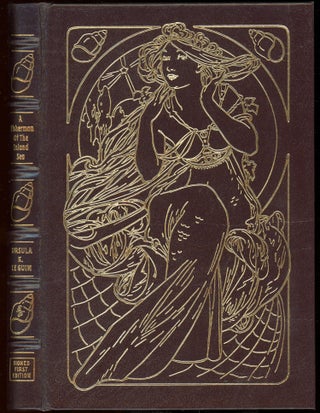
A FISHERMAN OF THE INLAND SEA.
Norwalk, Connecticut: The Easton Press, [1995]. Octavo, frontispiece by Pat Morrissey, full leather, a.e.g. First limited edition. One of an unspecified number of copies signed by LeGuin. Collects eight stories. Includes "Newton's Sleep," a story that "begins in a dystopia of a future North America with a destroyed environment and constant regional wars. The story then moves to a satellite that is supposed to be a eutopia based on reason, but anti-Semitism and the struggle for power undermine the eutopia while, at the end, imagination seems to be beginning to reshape even the physical layout." - Sargent, British and American Utopian Literature, 1986-2009. Introduction by James Gunn. Part of the Easton press signed first edition series. [Reference: Hartwell, 200 Significant SF Books by Women, 1984-2001].

A FISHERMAN OF THE INLAND SEA: SCIENCE FICTION STORIES.
[New York]: HarperPrism, [1994]. Octavo, cloth. Advance readers edition. Special edition of 1500 copies distributed as gifts of the author and publisher. Collects eight stories. Includes "Newton's Sleep," a story that "begins in a dystopia of a future North America with a destroyed environment and constant regional wars. The story then moves to a satellite that is supposed to be a eutopia based on reason, but anti-Semitism and the struggle for power undermine the eutopia while, at the end, imagination seems to be beginning to reshape even the physical layout." - Sargent, British and American Utopian Literature, 1986-2009. [Reference: Hartwell, 200 Significant SF Books by Women, 1984-2001].

A FISHERMAN OF THE INLAND SEA: SCIENCE FICTION STORIES.
[New York]: HarperPrism, [1994]. Octavo, cloth. Advance readers edition. Signed by Le Guin on the title page. Special edition of 1500 copies distributed as gifts of the author and publisher. Collects eight stories. Includes "Newton's Sleep," a story that "begins in a dystopia of a future North America with a destroyed environment and constant regional wars. The story then moves to a satellite that is supposed to be a eutopia based on reason, but anti-Semitism and the struggle for power undermine the eutopia while, at the end, imagination seems to be beginning to reshape even the physical layout." - Sargent, British and American Utopian Literature, 1986-2009. [Reference: Hartwell, 200 Significant SF Books by Women, 1984-2001].
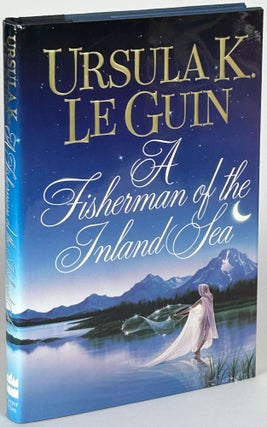
A FISHERMAN OF THE INLAND SEA: SCIENCE FICTION STORIES.
[New York]: HarperPrism, [1994]. Octavo, cloth backed boards. First edition. Signed by Le Guin on the title page. Collects eight stories. Includes "Newton's Sleep," a story that "begins in a dystopia of a future North America with a destroyed environment and constant regional wars. The story then moves to a satellite that is supposed to be a eutopia based on reason, but anti-Semitism and the struggle for power undermine the eutopia while, at the end, imagination seems to be beginning to reshape even the physical layout." - Sargent, British and American Utopian Literature, 1986-2009. [Reference: Hartwell, 200 Significant SF Books by Women, 1984-2001].
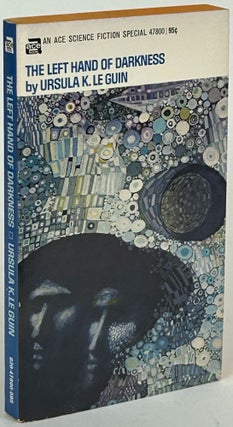
THE LEFT HAND OF DARKNESS.
New York: Ace Publishing Corporation, [1969]. Small octavo, printed wrappers. First edition. Ace 47800. Paperback original. Winner of the 1969 Nebula and 1970 Hugo awards. Part of the prestigious ACE "Science Fiction Special" series. [Reference: Anatomy of Wonder (2004) II-643. Pringle, Science Fiction: The 100 Best Novels 60. Sargent, British and American Utopian Literature, 1516-1985, p. 319. Survey of Science Fiction Literature III, pp. 1171-77].
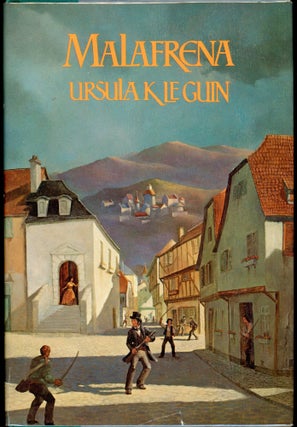
MALAFRENA.
New York: G. P. Putnam's Sons, [1979]. Octavo, cloth-backed boards. First edition. "Malafrena asks something that cannot have occurred to very many of us: what it might have been like to live in a small, quiet principality of the Habsburg Empire during the great 19th-century upwellings of liberalism and nationalism. The country in question is the imaginary "Orsinia," whose history and geography Le Guin has been sketching to herself for a good many years. (See the short-story collection Orsinian Tales, 1976)....Malafrena is Le Guin's masterpiece to date—a provocative adventure firmly founded on an unmodish and undeviating nobility of style, of mind, and above all of responsible imagination." - Kirkus review, 1 October, 1979.
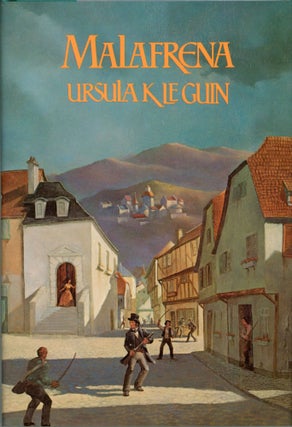
MALAFRENA.
New York: G. P. Putnam's Sons, [1979]. Octavo, cloth-backed boards. First edition.
NINE LIVES.
[Eugene, OR: Pulphouse Publishing, Inc., 1992]. Small octavo, boards. First separate edition. One of 100 numbered copies signed by Le Guin. Short Story Hardback #30. A short fiction involving cloning. This short story was originally published in Playboy magazine under the byline U. K. Le Guin, later revised for hardcover publication in the collection THE WIND'S TWELVE QUARTERS. Nominated for a Nebula Award in 1969.
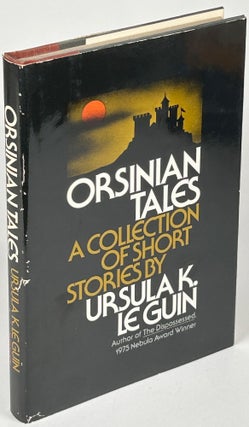
ORSINIAN TALES.
New York, Hagerstown, San Francisco, London: Harper & Row, Publishers, [1976]. Octavo, cloth-backed boards. First edition. Collects eleven stories. [Reference: Barron (ed), Fantasy Literature 4A-163].

PLANET OF EXILE.
[New York & London: Garland Publishing, Inc., [1975]. Octavo, cloth. First edition. Text offset from a 1972 Tandem paperback edition. Second Hainish novel. [Reference: Survey of Science Fiction Literature II, pp. 681-86].

POWERS.
Orlando, Austin, New York, San Diego, London: Harcourt, Inc., [2007]. Octavo, boards. First edition. Signed and dated by Le Guin on the title page. The third volume in the "Annals of the Western Shore" trilogy. Winner of the 2009 Nebula Award for Best Novel.

TEHANU: THE LAST BOOK OF EARTHSEA.
New York: Atheneum, 1990. Octavo, cloth backed boards. First edition. The final book of the "Earthsea" series, "a book somewhat more mature in its themes and plot." - Barron (ed) Horror and Fantasy (1999) 7-225. Winner of the 1990 Nebula Award for best novel.

UNLOCKING THE AIR AND OTHER STORIES.
[New York]: HarperCollinsPublishers, [1996]. Octavo, cloth backed boards. First edition. Signed by Le Guin on the title page. A collection of eighteen stories ranging from "plain realism, or magic realism, or surrealism, or postmodern genres that don't even have names yet" (Le Guin), spanning twelve years of writing, from the early eighties to the mid-nineties.

THE WIND'S TWELVE QUARTERS.
New York, Evanston, San Francisco, London: Harper & Row, Publishers, [1975]. cloth-backed boards. First edition. Retrospective collection of Le Guin's short stories published during the decade following her debut as a writer. Seventeen stories including many of her major early stories: "The Rule of Names, "Nine Lives," "Vaster than Empires and More Slow" and "The Ones Who Walk Away from Omelas." One of the major short story collections of the 1970s. [Reference: Anatomy of Wonder (2004) II-645. Barron (ed), Fantasy Literature 4A-164. Tymn (ed), Fantasy Literature, pp. 112-13].

NEBULA AWARD STORIES ELEVEN.
New York, Hagerstown, San Francisco, London: Harper & Row, Publishers, [1977]. Octavo, cloth backed boards. First edition. Collects eight stories by Fritz Leiber, Joe Haldeman, Roger Zelazny, P.J. Plauger, Vonda N. McIntyre, Harlan Ellison, Tom Reamy and Craig Strete. Also includes an article by Peter Nichols. [Reference: Anatomy of Wonder (2004) II-1364].
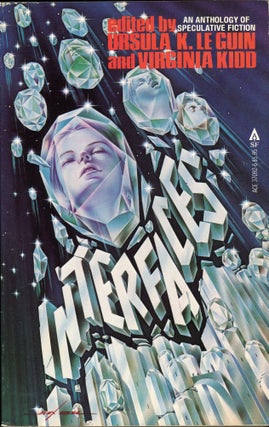
INTERFACES.
New York: Ace Books, [1980]. Octavo, pictorial wrappers. First edition. Trade paperback format. Original anthology of eighteen stories. Author's include John Crowley, Avram Davidson and Grania Davis, Michael Bishop, Vonda McIntyre, Ed Bryant, James Tiptree, Jr. and others.