
Results
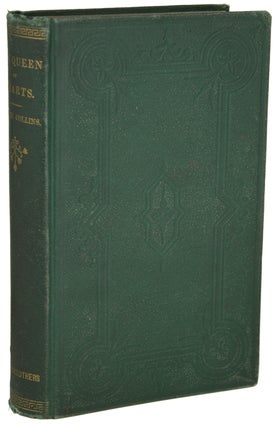
THE QUEEN OF HEARTS ...
New York: Harper & Brothers, Publishers, Franklin Square, 1859. 12mo, pp. [i-v] vi [7] 8-472 [note: first leaf is a blank] 1-8: ads, flyleaves at front and rear, original decorated green cloth, front and rear panels stamped in blind, spine panel stamped in gold, brown coated endpapers. First U.S. edition. "The ten linked stories in THE QUEEN OF HEARTS (1859) show Collins at the height of his powers. Three of the pieces are macabre ['Brother Griffith's Story of Mad Monkton,' 'Brother Morgan's Story of the Dead Hand' and 'Brother Morgan's Story of the Dream Woman'], and two of the three are supernatural." - Bleiler (ed), Supernatural Fiction Writers: Fantasy and Horror, pp. 235-6. Additionally, the collection includes the detective story, "The Biter Bit." The three-volume 1859 Hurst & Blackett edition is a notorious rarity. [Reference: Bleiler, The Guide to Supernatural Fiction 408. Tymn (ed), Horror Literature 2-25. Wilson, Shadows in the Attic, p. 141. See Barron (ed), Horror Literature 2-14. Queen's Quorum 3. Queen, The Detective Short Story, p. 27. See Glover and Greene, Victorian Detective Fiction 80 and 81].
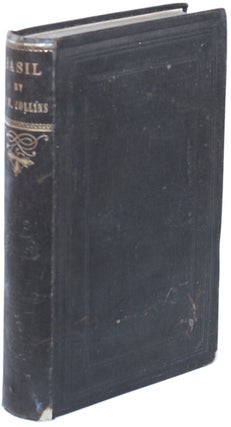
BASIL: A STORY OF MODERN LIFE ...
New York: D. Appleton & Company, 200 Broadway, 1853. 12mo, pp. [i-v] vi-xii [9] 10-317 [318: blank] [319-332: ads], flyleaves at front and rear, original black cloth, front and rear panels stamped in blind, spine panel stamped in gold and blind, fore and bottom edges rough trimmed, cream endpapers. First U.S. edition. Collins' second full-length novel and his first to be set in contemporary times. "With BASIL ..., his first characteristic novel, Collins began his search for a cosmic viewpoint that would encompass fate and chance, and the workings of human character with respect to both. He did not fulfill his objective until sixteen year later in THE MOONSTONE, but even in BASIL there is an oppressive feeling of foreordained events forever threatening, a feeling in which the weather is made to play a part. Although much of BASIL is weak, the symbolic thunderstorm during which Basil confronts Mannion and the visions seen by Basil in delirium have been praised. The text of BASIL usually read by modern readers is that of the 1862 revision, in which Collins dropped much of the quasi-supernatural background. This editing may simply have been an attempt to restore balance to the story by removing padding, but it is more likely to have been an early instance of Collins' uncertainty (evidenced again in the appendix to ARMADALE) of how far to go in attributing to Providence a series of coincidences otherwise inexplicable." - Bleiler (ed), Supernatural Fiction Writers: Fantasy and Horror, p. 234. [Reference: Bleiler (1978), p. 47 Not in Reginald (1979; 1992). Hubin (1994), p. 180].
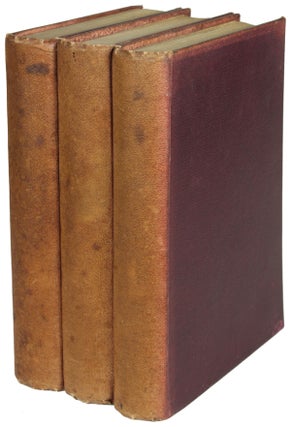
LITTLE NOVELS ...
London: Chatto and Windus, Piccadilly, 1887. Octavo, three volumes: pp. [1-6] [1-3] 4-319 [320: blank]; [1-6] [1-3] 4-331 [332: blank]; [1-8] [1-3] 4-303 [304: blank], half title leaves present in all three volumes, the preliminary blank leaf follows the contents leaf in volume 3, original maroon pebbled binder's cloth. First edition. Collects fourteen stories, including four ghost stories ("Mrs. Zant and the Ghost," "Miss Jeromette and the Clergyman," "Miss Bertha and the Yankee," "Miss Dulane and My Lord"), a tale of the occult (Mr. Percy and the Prophet"), and two stories of murder and attempted poisoning ("Mr. Policeman and the Cook," "Mr. Lepel and the Housekeeper"). "These tales of terror and the supernatural have been considered by many to be comparable to those of Poe, Dickens and Le Fanu." - Bleiler. [Reference: Bleiler, The Guide to Supernatural Fiction 412. Bleiler (1978), p. 47. Not in Reginald (1979; 1992). Sadleir 596. Wolff 1363].
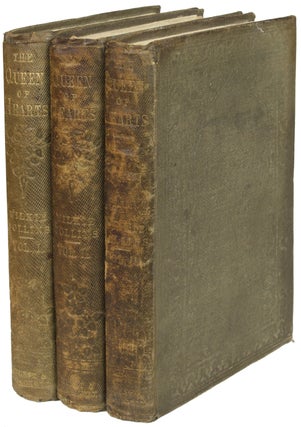
THE QUEEN OF HEARTS ...
London: Hurst & Blackett, Publishers, Successors to Henry Colburn, 13, Great Marlborough Street, 1859. Octavo, three volumes: pp. [1-2] [i] ii-iii [iv] [1] 2-314; [1-2] [1] 2-359 [360: blank]; [1-2] [1] 2-307 [308: blank], original decorated gray green cloth, front and rear panels stamped in blind, spine panels stamped in gold and blind, top edges untrimmed, light yellow coated endpapers. First edition. Collects the title story and "The Ten Days," a group of stories with narrative bridge. "The ten linked stories in THE QUEEN OF HEARTS (1859) show Collins at the height of his powers. Three of the pieces are macabre ['Brother Griffith's Story of Mad Monkton,' 'Brother Morgan's Story of the Dead Hand' and 'Brother Morgan's Story of the Dream Woman'], and two of the three are supernatural." - Bleiler (ed), Supernatural Fiction Writers: Fantasy and Horror, pp. 235-6. These three stories "reveal Collins's technique of grounding his horrors in fact, and domesticating the old ghost-in-a-bedsheet into realistic characters, and the supernatural, or apparently supernatural, elements into everyday phenomena." - Tymn (ed), Horror Literature 2-25. Additionally, the collection includes the classic detective story, "The Biter Bit." [Reference: Bleiler, The Guide to Supernatural Fiction 408. Wilson, Shadows in the Attic, p. 141. See Barron (ed), Horror Literature 2-14. Queen's Quorum 3. Queen, The Detective Short Story, p. 27. Sadleir 603. Wolff 1373].

THE WOMAN IN WHITE ... In Three Volumes ... New Edition.
London: Sampson Low, Son, & Co., 47 Ludgate Hill, 1860. Octavo, three volumes, publisher's decorated purple cloth, front and rear panels stamped in blind, spine panels stamped in gold, all edges untrimmed, yellow coated endpapers. First edition, first printing, second issue. An early reissue of first printing sheets with title pages marked "NEW EDITION" and a publisher's catalogue inserted in volume III dated "November 1, 1860" (most first issue copies have catalogues dated "August 1, 1860"). A celebrated thriller considered by many to be Collins's best novel. "A series of imprisonment's in country houses, a burning church, forgery for high station, and near murder combine with the author's inimitable social satire to make this work one of his most appealing" (Tymn). "It remains today one of the finest examples of its own genre" (Haycraft). Filmed a number of times, both silent and sound. [Reference: A Haycraft-Queen Cornerstone volume, Barron (ed), Horror Literature 2-15. Barzun & Taylor, A Catalogue of Crime (1989), p. 138. Tymn (ed), Horror Literature 2-26. Bleiler (1948), p. 81. Hubin, p. 181. Parrish, p. 39-40 (first issue). Sadleir, Victorian Bibliography, p. 140-141. Wolff 1377a].

THE CHRISTMAS NUMBERS FROM ALL THE YEAR ROUND (1859; 1862-1867).
London: Chapman and Hall, 1859; 1862-1867. Octavo, seven numbers, all with their original self wrappers or blue printed wrappers, sewn, as issued. First editions. Seven of the nine issues -- those for 1859; 1862-1867 -- of ALL THE YEAR ROUND (1859-1867). The issues present include THE HAUNTED HOUSE (1859), SOMEBODY'S LUGGAGE (1862), MRS. LIRRIPER'S LODGINGS (1863), MRS. LIRRIPER'S LEGACY (1864), DOCTOR MARIGOLD'S PRESCRIPTIONS (1965), MUGBY JUNCTION (1866), and NO THOROUGHFARE (1867). Dickens and Wilkie Collins were the major contributors to these issues. Others include Amelia B. Edwards and Jane Gaskell. For aficionados of the ghost story the highlight here is the first appearance in print of Dickens's classic "No. 1 Branch Line, The Signalman," which is part of the "Mugby Junction" cycle written by Dickens, Andrew Halliday, Charles Collins, Hesba Stretton and Amelia B. Edwards. Also present is "The Haunted House" (1859), a collaborative work by various authors, including Wilkie Collins and Mrs. Gaskell, combined with material by Dickens to create a supernatural story. The Dickens contributions to this work are the chapters "The Mortals in the House" and "The Ghost in Master B.'s Room." Wilkie Collins' story, "The Ghost in the Cupboard Room," is the original version of his classic non-supernatural nautical suspense story which Collins revised and published in 1873 as "Blow Up With the Brig."