
Results
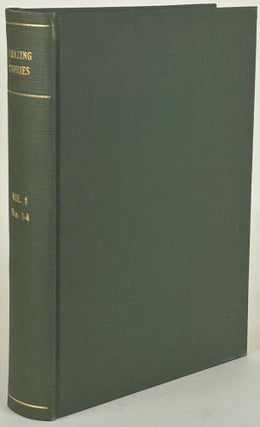
AMAZING STORIES. (Issues 1-4 bound).
New York: Experimenter Publications, Inc., 1926. Large octavo, bound volume, covers by Frank R. Paul, pictorial wrappers in green cloth spine stamped in gold. Pulp magazine, bedsheet format, bound. The first four issues of Amazing stories. [Reference: Tymm and Ashley, Science Fiction, Fantasy, and Weird Fiction Magazines, pp. 14-49].
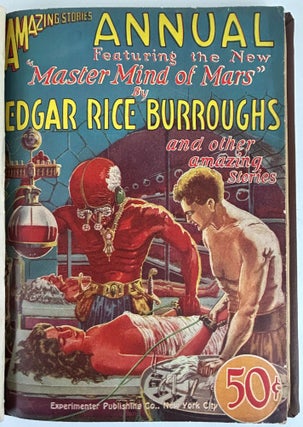
AMAZING STORIES ANNUAL (Bound Volume).
New York: Experimenter Publishing Co., 1927. Large octavo, single issue, bound volume, pictorial wrappers in brown cloth with spine stamped in gold. Bedsheet-sized pulp, bound. This features the first printing of "Master Mind of Mars" by Edgar Rice Burroughs. The only issue of AMAZING STORIES ANNUAL. Released in July 1927, its 100,000-print run sold out. The success of the ANNUAL encouraged Gernsback to launch AMAZING STORIES QUARTERLY in January 1928. [Reference: Tymn and Ashley (eds), Science Fiction, Fantasy, and Weird Fiction Magazines, pp. 49-51].

DOC SAVAGE MAGAZINE.
New York: Street & Smith Publications, Inc., 1933-1949. Octavo, thirty-two volumes, pictorial wrappers uniformly bound in green cloth. A complete file of 181 issues in bound volumes. Doc Savage was a precursor to the modern super hero. Clark "Doc" Savage, Jr. was trained from birth with a rigorous regimen resulting in extraordinary strength and intelligence. He never killed unless necessary, he had scientific gadgets, a headquarters and a secret base (a fortress of solitude). The stories combined mystery, adventure and some science fiction. He also had a team of five experts in various fields to assist in his adventures. His stories were extremely popular during the pulp era and then found a new audience in the 1960s-70s when the series was reprinted in paperback. The novels were written using the house pseudonym of Kenneth Robeson, the main author was Lester Dent who wrote nearly 80% of the novels. Other author contributors as Robeson included William Bogart, Alan Hathway, Harold Davis, Laurence Donovan and W. Ryerson Johnson. There were many excellent contributors to the short stories which rounded out the magazine with authors such as Steve Fisher, E. Hoffman Price, Q. Patrick, John D. MacDonald, Bruno Fischer, Frank Herbert, William Lindsay Gresham, to name a few. Street and Smith publishing executive Henry Ralston and editor John Nanovic established the initial idea for Clark "Doc" Savage, Jr. - ...a brawny 'superman,' a master of many fields-surgeon, mineralogist, engineer, inventor, linguist. His skin was a glowing bronze...his hair was a matching hue, and so too his eyes, resembling gold flake. He would be known as the Man of Bronze."- Server, Encyclopedia of Pulp Fiction Writers, p.81. "Doc Savage was intended to be an adventure character, but under Lester Dent's imaginative manipulations he became something more - the first superhero and an inspiration for countless pulp, comic-book, and television characters." - Cook, Mystery, Detective and Espionage Magazines, pp. 521-527. "The enormously wealthy Doc Savage – headquartered in a fantasticated New York with his five sidekicks, who specialize in various crafts and sciences at the borderline of sf – devotes his life to combating criminal conspiracies, almost all masterminded by the kind of charismatic villain later given definitive form by Ian Fleming in the James Bond books. Doc Savage himself clearly influenced the creation of Superman." - SFE online. A note on artists, Walter Baumhofer contributed the initial look to the character with his striking cover painting through late 1936. Other artists include R[obert] G[eorge] Harris, Emery Clarke, Modest Stein, and George Rozen. An ideal collection for an institution. [Reference: Tymm and Ashley, Science Fiction, Fantasy, and Weird Fiction Magazines, pp. 183-185].