
Results

THE ARKHAM SAMPLER.
Sauk City, Wisconsin: Arkham House, 1948-1949 (volume 1, number 1-volume 2, number 4). Octavo, printed wrappers. First edition. All published. A short lived, but important periodical. In addition to printing first appearances of fiction by Ray Bradbury, H. P. Lovecraft, Clark Ashton Smith, Robert Bloch, Theodore Sturgeon, A. E. van Vogt and many others, the magazine published essays, criticism, memoirs and book reviews. One issue was devoted to science fiction. The final issue included an index. All issues were limited to 1200 copies except the "All Science-Fiction Issue" that had a 2000-copy print run. [Reference: Parnell, Monthly Terrors, pp. 14-15 (listing contents). Tymn and Ashley, eds., Science Fiction, Fantasy, and Weird Fiction Magazines, pp. 112-114].
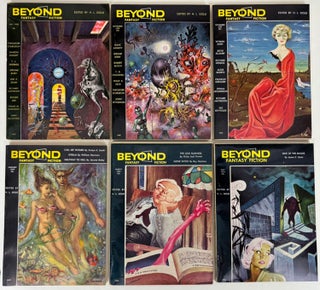
BEYOND FANTASY FICTION. (Ten issues, all published).
New York: Galaxy Publishing Corporation, 1953-1955. Small octavo, ten issues, pictorial wrappers. Digest magazine. This was to be a companion to Galaxy Science Fiction, in the tradition of Unknown. Author's include Damon Knight, Frank Robinson, Richard Matheson, Robert Bloch, Philip K. Dick, Isaac Asimov, John Wyndham, Algis Budrys, Zenna Henderson, Jerome Bixby, Philip Jose Farmer, Fredric Brown, and others. It could not duplicate the audience of Campbell's Unknown which failed due to WWII paper shortages. This magazine's content was not broad based fantasy fiction, while it did publish quality fiction, it stayed away from traditional fantasy and popular sword and sorcery. It also got lost in the SF digest magazine boom. The covers of the first two issues are by Richard Powers. [Reference: Tymm and Ashley, Science Fiction, Fantasy, and Weird Fiction Magazines, pp. 137-142].

CLUES.
Bowling Green, OH: Bowling Green University Popular Press, 1980-1983. Octavo, 8 issues, printed wrappers. The first eight numbers of this scholarly journal devoted to mystery and detective fiction. The first number includes a large section devoted to John D. MacDonald, focused on paper presented at conference on MacDonald at the University of South Florida. There is also introduction and comments by MacDonald. The issues devote articles to classic and modern authors and their characters. Books, pulps and media are covered.

THE FANTASY COMMENTATOR. (1944-1948) in two bound volumes.
New York: A. Langley Searles. 1943-1948. Large octavo, twenty issues. mimeographed bound in two cloth volumes, volume one: issues 1-12 pp. 1-340 [note: 339-340 index]. volume two, issues 13-20 pp. 1-294 [note: 294 index]. A major amateur magazine devoted to the study of fantastic fiction. "...one of the earliest fan-based magazines that could be regarded as an Academic Journal based on its scholarly articles." - SFE online. Contributors included William Evans, David H. Keller, H. C. Koenig, A. Merritt, Sam Moskowitz, Darrell C. Richardson, George Wetzel and many others. Articles and commentary on books, authors, themes, etc. In these pages was the first publication of the first major work on fandom, "The Immortal Storm" by Sam Moskowitz. Vol. 1, no. 1 is a second printing limited to 60 copies, July 1946, Vol. 1, no. 2, second printing, limited to 90 copies, January 1947, Vol. 1, no. 3, second printing limited to 60 copies, March 1946. Hightlights: Issue one. 12/43. E.F. Benson, critical notes of September FAPA mailing. Issue two. 6/44. Notes on March 1944 FAPA Issue three. 9/44. Notes on June 1944 FAPA. This issue largely devoted to Wm. Hope Hodgson and Moskowtiz reviews on old magazines. Issue four. 12/44. Haggard checklist, fantasy in Blue Book. Review of George Fowler book. Issue five. W. 44/45. Lost Race article. Moskowitz article on Marvel Tales amateur magazine. Article on forgotten supernatural fiction writer Wintle. Retrospective on past 10 years of SF in magazines. Article by A. Merritt. Issue six. Sp. 45. M. Onderdonk on HPL. (over 9 pages). Appreciation of Wm. Hope Hodgson. Article on Ralph Adams Cram. Issue seven. Su. 45. "Future Destiny" article. WTs article focused on Munn. M. Onderdonk on William Sloane and HPL. Article on crackpot stories in Amazing (i.e. Lemuria). Letters from Leiber and Bloch. Issue eight. F. 45. Part 1 of The Immortal Storm by Moskowitz. Article on Dick Donovan. Issue nine. W. 45/46. Article on paperback fantasy in England 1941-45. Article on H. Rider Haggard. Article on Bessie Kyffin-Taylor. Part 2 of The Immortal Storm. Issue ten. Sp. 46. "The Superman in Modern English Fiction" by Richard Witter. The Immortal Storm part 3. Issue eleven. Su 46. The Immortal Storm part 4. Fantasy in "The Idler". Issue twelve. F 46. The Immortal Storm part 5. Article on more British paperback fantasy, 1945-46. Article on HPL by George Wetzel. Issue thirteen (Vol 2). W. 46-47. The Immortal Storm part 6. Fantasy in Munsey publications part 1. Issue fourteen. Sp. 47. The Immortal Storm part 7. Fantasy in Munsey publications (conclusion). David H. Keller on his writing with bibliography. Issue fifteen. Su. 47. The Immortal Storm part 8. Article by Henry Kuttner. Issue sixteen. F. 47. The Immortal Storm part 9. Article on "The Gothic Novel and Percy B. Shelley." Article on The Thrill Book. Issue seventeen. W. 48. The Immortal Storm part 10. Issue eighteen. Sp. 48. The Immortal Storm part 11. Several articles on HPL. Issue nineteen. Su. 48. The Immortal Storm part 12. Fantasy in Romance magazine. HPL article by Keller. Issue twenty. F. 48. The Immortal Storm part 13. Article on Talbot Mundy. [Reference: Pavlat and Evans, Fanzine Index (1965), pp. 36-7. Tymn and Ashley (eds), Science Fiction, Fantasy, and Weird Fiction Magazines, p. 822].
THE FANTASY FAN: THE FAN'S OWN MAGAZINE.
Elizabeth, New Jersey: Charles D. Hornig, 1933-1935. Octavo, 18 issues, printed or self wrappers. The first important weird fiction fanzine, and one of the most desirable of the fanzines of the thirties. For two years it published news and fiction related to the genre. Stories first published in THE FANTASY FAN include H. P. Lovecraft's "The Other Gods" and "From Beyond," Clark Ashton Smith's "The Epiphany of Death," "The Ghoul," "The Kingdom of the Worm," and "The Primal City," as well as tales by Robert Bloch, August Derleth, Robert E. Howard, David H. Keller and others. THE FANTASY FAN was "an interesting mix of news, articles, stories, poems, and miscellany. Hornig however, made an error in initiating a column of controversy entitled 'The Boiling Point,' which quickly led to acrimonious letter exchanges between Lovecraft, Forrest J. Ackerman, Clark Ashton Smith, and numerous others; the column was terminated with the February 1934 issue. Perhaps Hornig's greatest accomplishment was the serialization of the revised version of Lovecraft's 'Supernatural Horror in Literature' (October 1933-February 1935). However, the serialization proceeded at such a slow pace that it had reached only the middle of Chapter VIII before the magazine folded. THE FANTASY FAN also saw the first publication of Lovecraft's stories. 'The Other Gods' (November 1933) and 'From Beyond' (June 1934) as well as reprints (from amateur papers) of 'Polaris' (February 1934) and 'Beyond the Wall of Sleep' (October 1934); it also published 'The Book' (October 1934), 'Pursuit' (October 1934), 'The Key' (January 1935), and 'Homecoming' (January 1935) from 'Fungi from Yuggoth.' Brief excerpts of Lovecraft's letters to Hornig appeared regularly in the magazine's letter column. The October 1934 issue was dedicated to Lovecraft. After the demise of THE FANTASY FAN, numerous attempts were made to revive or succeed it, but no magazine truly filled its place as a news organ, a forum for the expression of fan's views, and a venue for work by distinguished writers in the field" (Joshi and Schultz, An H. P. Lovecraft Encyclopedia, pp. 90-91). "As a real help to the lover of weird and fantasy fiction Hornig's magazine reigned supreme in the field at that time ... Almost every weirdist of importance in fandom was at one time or another represented in its pages. And as a love-feast for such fans it has never again been equaled" (Moskowitz, The Immortal Storm, pp. 18-20). "... one of the legendary magazines of the 1930s ... an extremely consistent and reliable magazine ..." (Tymn and Ashley, eds., Science Fiction, Fantasy, and Weird Fiction Magazines, pp. 822-23). According to Hornig (writing in 1988) "THE FANTASY FAN was printed by Conrad Ruppett of Jamaica, New York, hand set. Julius Schwartz and I helped him collate and staple each copy every month for eighteen months. Except for the second issue (500 copies), there were only 250 printed, and the paid circulation never reached over 50. What happened to the residue? Well, I found someone to buy up most of the unsold copies, and that was B. K. Gores of Austin, Texas. I never heard from him before or since, never knew him in fandom, and don't know whatever happened to him. Somewhere, there should be stacks of TFF, unless they're destroyed." [Reference: Joshi I-B-ii-232. Pavlat and Evans, Fanzine Index (1965), p. 37].

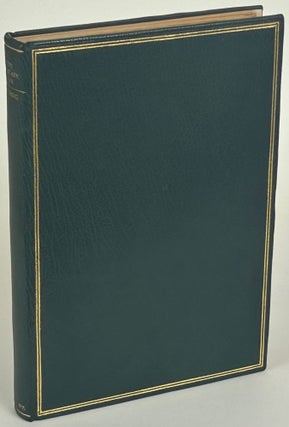
THE FANTASY FAN, THE: THE FANS' OWN MAGAZINE. Complete set of eighteen issues bound in cloth.
Elizabeth, New Jersey: Charles D. Hornig, 1933-1935. Octavo, 18 issues, printed or self wrappers, bound in cloth. Label affixed to front paste down with a presentation inscription from editor Charles D. Hornig to noted fan and publisher Gerry de la Ree. A contributor's complete set of this amateur magazine, the first important weird fiction fanzine, and one of the most desirable of the fanzines of the thirties. This set belonged to F. Lee Baldwin whose name is stamped in gold on the upper cover of the binding. "Franklin Lee Baldwin (1913-1987) corresponded with H. P. Lovecraft 1933-1936. "Baldwin first wrote HPL in the fall of 1933 proposing to issue 'The Colour Out of Space' as a booklet. HPL revised the tale slightly for the prospective publication, but the plan never materialized. In early 1934 HPL put Baldwin in touch with Duane W. Rimel, who by coincidence lived in the same small town (Asotin, Washington). The two took turns reading HPL's letters to each of them. Baldwin wrote two columns of news notes for the FANTASY FAN: 'Side Glances' (April, May, September 1934) and 'Within the Circle' (June, July, August, October, November 1934, January, February 1935), much of the information for which was derived from HPL's letters to him, as was the significant early article, 'H. P. Lovecraft: A Biographical Sketch,' originally scheduled to appear in the FANTASY FAN but, following the magazine's demise, published in FANTASY MAGAZINE (April 1935). Baldwin later revised the article as 'Some Lovecraft Sidelights' (FANTASY COMMENTATOR, Spring 1948)" (Joshi and Schultz, An H. P. Lovecraft Encyclopedia, pp. [14]-15). In 1989 Baldwin's copy was presented to early fantastic fiction fan and publisher Gerry de la Ree by Charles D. Hornig, the editor of THE FANTASY FAN. Stories first published in THE FANTASY FAN include H. P. Lovecraft's "The Other Gods" and "From Beyond," Clark Ashton Smith's "The Epiphany of Death," "The Ghoul," "The Kingdom of the Worm," and "The Primal City," as well as tales by Robert Bloch, August Derleth, Robert E. Howard, David H. Keller and others. THE FANTASY FAN was "an interesting mix of news, articles, stories, poems, and miscellany. Hornig however, made an error in initiating a column of controversy entitled 'The Boiling Point,' which quickly led to acrimonious letter exchanges between Lovecraft, Forrest J. Ackerman, Clark Ashton Smith, and numerous others; the column was terminated with the February 1934 issue. Perhaps Hornig's greatest accomplishment was the serialization of the revised version of Lovecraft's 'Supernatural Horror in Literature' (October 1933-February 1935). However, the serialization proceeded at such a slow pace that it had reached only the middle of Chapter VIII before the magazine folded. THE FANTASY FAN also saw the first publication of Lovecraft's stories. 'The Other Gods' (November 1933) and 'From Beyond' (June 1934) as well as reprints (from amateur papers) of 'Polaris' (February 1934) and 'Beyond the Wall of Sleep' (October 1934); it also published 'The Book' (October 1934), 'Pursuit' (October 1934), 'The Key' (January 1935), and 'Homecoming' (January 1935) from 'Fungi from Yuggoth.' Brief excerpts of Lovecraft's letters to Hornig appeared regularly in the magazine's letter column. The October 1934 issue was dedicated to Lovecraft. After the demise of THE FANTASY FAN, numerous attempts were made to revive or succeed it, but no magazine truly filled its place as a news organ, a forum for the expression of fan's views, and a venue for work by distinguished writers in the field" (Joshi and Schultz, An H. P. Lovecraft Encyclopedia, pp. 90-91). "As a real help to the lover of weird and fantasy fiction Hornig's magazine reigned supreme in the field at that time ... Almost every weirdist of importance in fandom was at one time or another represented in its pages. And as a love-feast for such fans it has never again been equaled" (Moskowitz, The Immortal Storm, pp. 18-20). "... one of the legendary magazines of the 1930s ... an extremely consistent and reliable magazine ..." (Tymn and Ashley, eds., Science Fiction, Fantasy, and Weird Fiction Magazines, pp. 822-23). According to Hornig (writing in 1988) "THE FANTASY FAN was printed by Conrad Ruppett of Jamaica, New York, hand set. Julius Schwartz and I helped him collate and staple each copy every month for eighteen months. Except for the second issue (500 copies), there were only 250 printed, and the paid circulation never reached over 50. What happened to the residue? Well, I found someone to buy up most of the unsold copies, and that was B. K. Gores of Austin, Texas. I never heard from him before or since, never knew him in fandom, and don't know whatever happened to him. Somewhere, there should be stacks of TFF, unless they're destroyed." [Reference: See Kenneth W. Faig, Jr., ed., Within the Circle: In Memoriam F. Lee Baldwin (Moshassuck Press, 1988). Pavlat and Evans, Fanzine Index (1965), p. 37].