
Results

AMAZING STORIES.
New York: Experimenter Publishing Company, 1928. Large octavo, single issue, cover by Frank R. Paul, pictorial wrappers. Pulp magazine, bedsheet format. The first appearance of the "scientifiction" logo on the cover, this logo was later adopted in more modern times by the members of "first fandom." This issue also includes part two of the serial "The Skylark of Space" by E. E. Smith and Lee Hawkins Garby. Other authors include Harl Vincent, David H. Keller, Fletcher Pratt and others. [Reference: Tymm and Ashley, Science Fiction, Fantasy, and Weird Fiction Magazines, pp. 14-49].
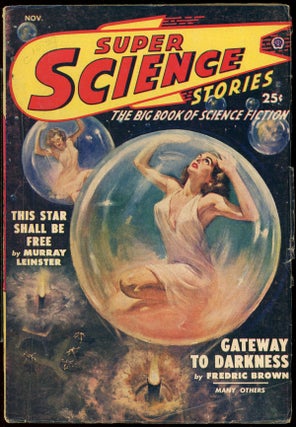
SUPER SCIENCE STORIES.
Toronto: Fictioneers, Inc., 1949. Octavo, single issue, cover by Lawrence, pictorial wrappers. Pulp magazine, Canadian issue, issued simultaneously with the U. S. edition with identical story content, editorial control in New York. Includes "Impossible" by Ray Bradbury. Other fiction by John D. MacDonald (2 stories-one as John Wade Farrell), Neil R. Jones, Fredric Brown and others. [Reference: Tymn and Ashley (eds), Science Fiction, Fantasy, and Weird Fiction Magazines, pp. 631-635].
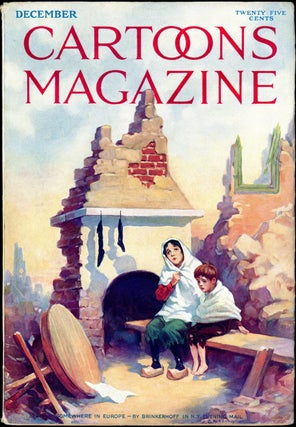
CARTOONS MAGAZINE.
Chicago, Illinois: H. H. Windsor Editor and Publishers, December 1916. Octavo, single issue, pictorial wrappers. Cartoon representation from both the U.S. and foreign sources. Commentary and cartoons about the recent election, much about the ongoing war in Europe. A feature piece on Dutch artist Louis Raemaekers at the front.

DOC SAVAGE (1975).
New York: Magazine Management Co., Inc., 1976. Large octavo, single issue, cover by Ken Barr, pictorial wrappers. The story feature "The Sky Stealers" is written by Doug Moench and illustrated by Tony DeZuniga.

FAMOUS FANTASTIC MYSTERIES.
Chicago: All-Fiction Field, Inc., 1947. Octavo, single issue cover by Virgil Finlay, printed wrappers. Pulp magazine. Features "MINIMUM MAN, OR, TIME TO BE GONE" by Andrew Marvell. [Reference: Tymm and Ashley, Science Fiction, Fantasy, and Weird Fiction Magazines, pp. 211-216].
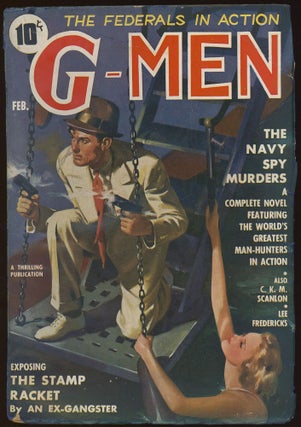
G-MEN.
New York: Beacon Magazines, Inc., 1937. Octavo, single issue, pictorial wrappers. Pulp magazine. "THE NAVY SPY MURDERS" by C.K.M. Scanlon. "The new G-Men magazine was probably the most popular pulp of those featuring federal agent crime stories and enjoyed a large following of devoted readers." - Cook, Mystery, Detective and Espionage Magazine, pp. 263-264. [Reference: Cook, Mystery, Detective and Espionage Magazine, pp. 263-264].
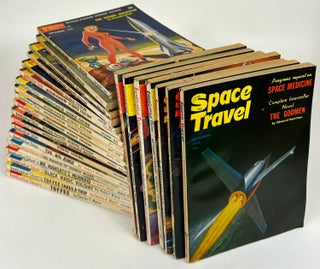
IMAGINATIVE TALES later SPACE TRAVEL. (Twenty six issues, all published).
Evanston, IL: Greenleaf Publishing Company, 1954-1958. Small octavo, 26 issues, pictorial wrappers. Digest magazine. This magazine initial started out with fiction leaning toward the humorous with a note of 'spice,' as evidenced by the titillating covers by Harold McCauley over the first seven issues. In the fall of 1956 the magazine moved to more conventional stories. In the waning days of the magazine the editor tried to move to a more serious image with the age of Sputnik and changed the title to Space Travel, in which the magazine lasted only three more issues. Authors included Robert Bloch, Edmond Hamiltion (some pseudonymous), Steven Marlowe (under pseudonym), Robert Silverberg (some pseudonymous), Randall Garrett, A. Bertram Chandler, Margeret St. Clair, Harlan Ellison and others. [Reference: Tymm and Ashley, Science Fiction, Fantasy, and Weird Fiction Magazines, pp. 347-350].
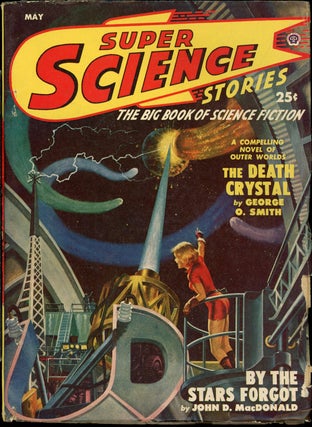
SUPER SCIENCE STORIES.
Kokomo, IN: Fictioneers, Inc., 1950. Octavo, single issue, cover by Lawrence, pictorial wrappers. Pulp magazine. Includes John D. MacDonald with two stories, the second as by Peter Reed. [Reference: Tymn and Ashley (eds), Science Fiction, Fantasy, and Weird Fiction Magazines, pp. 631-635].

SUPER SCIENCE STORIES.
Kokomo, IN: Fictioneers, Inc., 1950. Octavo, single issue, cover by Lawrence, pictorial wrappers. Pulp magazine. Includes John D. MacDonald with two stories, the second as by Peter Reed. [Reference: Tymn and Ashley (eds), Science Fiction, Fantasy, and Weird Fiction Magazines, pp. 631-635].
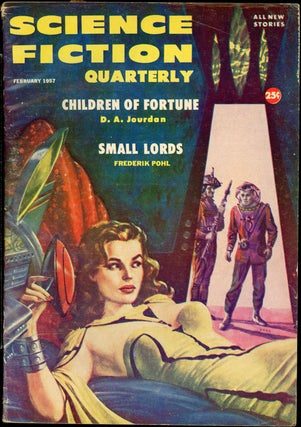
SCIENCE FICTION QUARTERLY.
Holyoke, MA: Columbia Publications, Inc., 1957. Octavo, single issue, cover by Emshwiller, pictorial wrappers. Pulp magazine. Includes "Midadjustment" by Philip K. Dick. SFQ is also notable as it became the last published SF pulp magazine, the last issue in 1958. [Reference: Tymn and Ashley (eds), Science Fiction, Fantasy, and Weird Fiction Magazines, pp. 545-550].
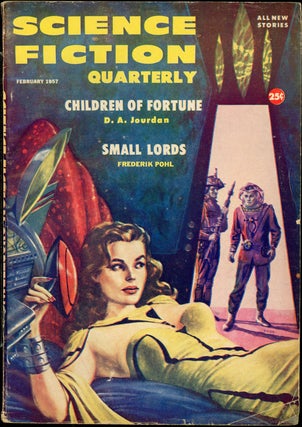
SCIENCE FICTION QUARTERLY.
Holyoke, MA: Columbia Publications, Inc., 1957. Octavo, single issue, cover by Emshwiller, pictorial wrappers. Pulp magazine. Includes "Midadjustment" by Philip K. Dick. SFQ is also notable as it became the last published SF pulp magazine, the last issue in 1958. [Reference: Tymn and Ashley (eds), Science Fiction, Fantasy, and Weird Fiction Magazines, pp. 545-550].

PLANET STORIES.
New York: Love Romances, 1954. Octavo, single issue, cover by Freas, pictorial wrappers. Pulp magazine. Includes fiction by Robert Sheckley. Unabashedly the magazine was a proponent of "space-opera." In Leigh Brackett's introduction in the anthology THE BEST OF PLANET STORIES (1974) she states "the so-called space opera is the folk-tale, the hero-tale of our particular niche in history." [Reference: Tymm and Ashley, Science Fiction, Fantasy, and Weird Fiction Magazines, pp. 476-481].

PLANET STORIES.
New York: Love Romances, 1954. Octavo, single issue, cover by Freas, pictorial wrappers. Pulp magazine. Includes fiction by Robert Sheckley. Unabashedly the magazine was a proponent of "space-opera." In Leigh Brackett's introduction in the anthology THE BEST OF PLANET STORIES (1974) she states "the so-called space opera is the folk-tale, the hero-tale of our particular niche in history." [Reference: Tymm and Ashley, Science Fiction, Fantasy, and Weird Fiction Magazines, pp. 476-481].
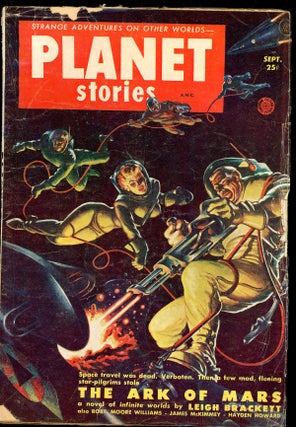
PLANET STORIES.
New York: Love Romances, 1953. Octavo, single issue, cover by Freas, pictorial wrappers. Pulp magazine. Includes a Leigh Brackett story. Unabashedly the magazine was a proponent of "space-opera." In Leigh Brackett's introduction in the anthology THE BEST OF PLANET STORIES (1974) she states "the so-called space opera is the folk-tale, the hero-tale of our particular niche in history." [Reference: Tymm and Ashley, Science Fiction, Fantasy, and Weird Fiction Magazines, pp. 476-481].
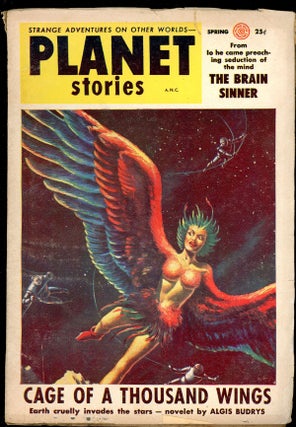
PLANET STORIES.
New York: Love Romances, 1955. Octavo, single issue, cover by Freas. pictorial wrappers. Pulp magazine. Includes fiction by Algis Budrys, Poul Anderson and others. Unabashedly the magazine was a proponent of "space-opera." In Leigh Brackett's introduction in the anthology THE BEST OF PLANET STORIES (1974) she states "the so-called space opera is the folk-tale, the hero-tale of our particular niche in history." [Reference: Tymm and Ashley, Science Fiction, Fantasy, and Weird Fiction Magazines, pp. 476-481].

PLANET STORIES.
New York: Love Romances, 1954. Octavo, single issue, cover by Freas (mistakenly credited to Algis Budrys), pictorial wrappers. Pulp magazine. Includes a Leigh Brackett story as well as early fiction by Michael Shaara (who would write THE KILLER ANGELS). Unabashedly the magazine was a proponent of "space-opera." In Leigh Brackett's introduction in the anthology THE BEST OF PLANET STORIES (1974) she states "the so-called space opera is the folk-tale, the hero-tale of our particular niche in history." [Reference: Tymm and Ashley, Science Fiction, Fantasy, and Weird Fiction Magazines, pp. 476-481].
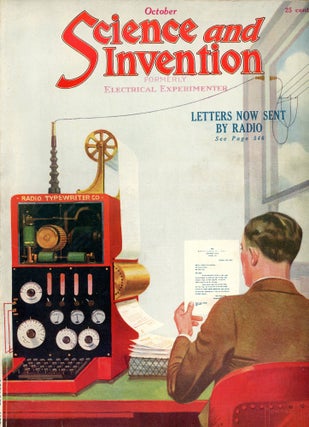
SCIENCE AND INVENTION.
New York: Experimenter Publishing Company, Inc., 1922. Large octavo, single issue, cover by Howard V. Brown, pictorial wrappers. Pulp magazine, bedsheet format. Includes a Dr. Hackensaw story by Clement Fezandie. [Reference: Tymn and Ashley (eds), Science Fiction, Fantasy, and Weird Fiction Magazines, pp. 500-04].
![Item #34592 SCIENCE FICTION DIGEST [later FANTASY MAGAZINE]. Complete set of 39 issues in six...](https://jwkbooks.cdn.bibliopolis.com/pictures/34592.jpg?width=320&height=427&fit=bounds&auto=webp&v=1750078579)
SCIENCE FICTION DIGEST [later FANTASY MAGAZINE]. Complete set of 39 issues in six bound volumes.
Jamaica, New York, later New York, New York: Conrad H. Ruppert, later Julius Schwartz, 1932-1937. Large octavo, later octavo, 39 issues, self wrappers, stapled, later pictorial or printed wrappers, stapled in six bound volumes. First edition. A complete set of the thirty-nine issues of this amateur magazine first published as SCIENCE FICTION DIGEST (name changed to FANTASY MAGAZINE as of seventeenth issue dated January 1934). Fiction published here includes "The man Who Invaded Time" by Raymond A. Palmer, "The Woman of the Wood" by A. Merritt, "Escape from Antarctica" by Raymond A. Palmer, "Alicia in Blunderland" by Nihil (P. Schuyler Miller), "Scroll of Armageddon" by Arthur J. Burks, "The Beast Men" by Lloyd Arthur Eshbach, "The Vortex World" by Raymond A. Palmer, "An Experiment with Time" by Francis Flagg and Forrest J. Ackerman, The first chapter of "The Radio War" by Ralph Milne Farley, "The Dead Woman" by David H. Keller, "The Return to Venus" by Rae Winters, "The Ship from the Past" by Arthur Jones, Jr., "The Drone," a short story by A. Merritt, "Nymph of Darkness," a short story by C. L. Moore and Forrest J. Ackerman, "The Ultimate Ultimatum," a satire by Robert Bloch, "The Challenge from Beyond," a science fiction story jointly written by Stanley G. Weinbaum, Donald Wandrei, Edward E. Smith, Harl Vincent and Murray Leinster, "The Challenge from Beyond," a weird fantasy story jointly written by C. L. Moore, A. Merritt, H. P. Lovecraft, Robert E. Howard and Frank Belknap Long, "Thirteen Phantasms" a psychological fantasy by Clark Ashton Smith, and "The Great Illusion," a story jointly written by Eando Binder, Jack Williamson, Edmond Hamilton, Raymond Z. Gallun and John Russell Fearn. In addition to original fiction, SCIENCE FICTION DIGEST featured biographical and autobiographical information on leading writers, artists, and editors. "For all-around quality SCIENCE FICTION DIGEST has never been surpassed in the history of fandom ... [In addition to special features it] printed solid, interesting, factual articles in every number. Up until the end of its life it remained the undisputed leader in the field, and its influence on the varied currents of fan history was profound indeed." - Moskowitz, The Immortal Storm (1974), p. 16. [Reference: Pavlat and Evans, Fanzine Index (1965), p. 98 and p. 39. Tymn and Ashley (eds), Science Fiction, Fantasy, and Weird Fiction Magazines, p. 838].

TALES OF WONDER.
Kingswood, Surrey: The World's Work (1913) Ltd., 1939. Octavo, single issue, pictorial wrappers. Pulp magazine. Britain's first adult oriented science fiction magazine, at first publishing solely original material from British authors and reprints from U.S. magazines, and later adding new material from American authors. "Tales of Wonder was a lively, entertaining and enjoyable magazine..." Tymm and Ashley, Science Fiction, Fantasy and Weird Fiction Magazine, pp. 652-654. The magazine had to cease publication due to wartime paper restrictions after sixteen issues.

TALES OF WONDER.
Kingswood, Surrey: The World's Work (1913) Ltd., 1939. Octavo, single issue, cover art by W. J. Roberts, pictorial wrappers. Pulp magazine. Britain's first adult oriented science fiction magazine, at first publishing solely original material from British authors and reprints from U.S. magazines, and later adding new material from American authors. "Tales of Wonder was a lively, entertaining and enjoyable magazine..." Tymm and Ashley, Science Fiction, Fantasy and Weird Fiction Magazine, pp. 652-654. The magazine had to cease publication due to wartime paper restrictions after sixteen issues. Includes Murray Leinster, Stanton Coblentz, A. Hyatt Verrill, and others.

THE FANTASY COMMENTATOR. (1948-1952).
New York: A. Langley Searles. 1948-1952. Large octavo, 6 issues, mimeographed self wrappers, stapled. A major amateur magazine devoted to the study of fantastic fiction. "...one of the earliest fan-based magazines that could be regarded as an Academic Journal based on its scholarly articles." - SFE online. Contributors included William Evans, David H. Keller, H. C. Koenig, A. Merritt, Sam Moskowitz, Darrell C. Richardson, George Wetzel and many others. Articles and commentary on books, authors, themes, etc. In these pages was the first publication of the first major work on fandom, "The Immortal Storm" by Sam Moskowitz. This volume 3 is the last volume published until revived by Searles in 1978. Though Searles had prepared volume 3, numbers 7 & 8 they were not published until he revived the magazine. Highlights: Issue twenty-one. W. 1948-49. Article on rare amateur magazine Leaves. Article on L. Ron Hubbard. The Immortal Storm part 14. Issue twenty-two. Sp. 1949. The Immortal Storm part 15. Long review of THE SHIP THAT SAILED TO MARS. Issue twenty-three. Su-F 1949. The Immortal Storm part 16. Issue twenty-four. W. 1949-1950. The Immortal Storm part 17. Issue twenty-five. W. 1951-1952. Article on Stanley Weinbaum. Verse by A. Merritt. Issue twenty-six. Sp.-Su. 1952. The Immortal Storm part 18. [Reference: Pavlat and Evans, Fanzine Index (1965), pp. 36-7. Tymn and Ashley (eds), Science Fiction, Fantasy, and Weird Fiction Magazines, p. 822].

THE FANTASY FAN: THE FAN'S OWN MAGAZINE.
Elizabeth, New Jersey: Charles D. Hornig, 1933-1935. Octavo, 18 issues, printed or self wrappers. The first important weird fiction fanzine, and one of the most desirable of the fanzines of the thirties. For two years it published news and fiction related to the genre. Stories first published in THE FANTASY FAN include H. P. Lovecraft's "The Other Gods" and "From Beyond," Clark Ashton Smith's "The Epiphany of Death," "The Ghoul," "The Kingdom of the Worm," and "The Primal City," as well as tales by Robert Bloch, August Derleth, Robert E. Howard, David H. Keller and others. THE FANTASY FAN was "an interesting mix of news, articles, stories, poems, and miscellany. Hornig however, made an error in initiating a column of controversy entitled 'The Boiling Point,' which quickly led to acrimonious letter exchanges between Lovecraft, Forrest J. Ackerman, Clark Ashton Smith, and numerous others; the column was terminated with the February 1934 issue. Perhaps Hornig's greatest accomplishment was the serialization of the revised version of Lovecraft's 'Supernatural Horror in Literature' (October 1933-February 1935). However, the serialization proceeded at such a slow pace that it had reached only the middle of Chapter VIII before the magazine folded. THE FANTASY FAN also saw the first publication of Lovecraft's stories. 'The Other Gods' (November 1933) and 'From Beyond' (June 1934) as well as reprints (from amateur papers) of 'Polaris' (February 1934) and 'Beyond the Wall of Sleep' (October 1934); it also published 'The Book' (October 1934), 'Pursuit' (October 1934), 'The Key' (January 1935), and 'Homecoming' (January 1935) from 'Fungi from Yuggoth.' Brief excerpts of Lovecraft's letters to Hornig appeared regularly in the magazine's letter column. The October 1934 issue was dedicated to Lovecraft. After the demise of THE FANTASY FAN, numerous attempts were made to revive or succeed it, but no magazine truly filled its place as a news organ, a forum for the expression of fan's views, and a venue for work by distinguished writers in the field" (Joshi and Schultz, An H. P. Lovecraft Encyclopedia, pp. 90-91). "As a real help to the lover of weird and fantasy fiction Hornig's magazine reigned supreme in the field at that time ... Almost every weirdist of importance in fandom was at one time or another represented in its pages. And as a love-feast for such fans it has never again been equaled" (Moskowitz, The Immortal Storm, pp. 18-20). "... one of the legendary magazines of the 1930s ... an extremely consistent and reliable magazine ..." (Tymn and Ashley, eds., Science Fiction, Fantasy, and Weird Fiction Magazines, pp. 822-23). According to Hornig (writing in 1988) "THE FANTASY FAN was printed by Conrad Ruppett of Jamaica, New York, hand set. Julius Schwartz and I helped him collate and staple each copy every month for eighteen months. Except for the second issue (500 copies), there were only 250 printed, and the paid circulation never reached over 50. What happened to the residue? Well, I found someone to buy up most of the unsold copies, and that was B. K. Gores of Austin, Texas. I never heard from him before or since, never knew him in fandom, and don't know whatever happened to him. Somewhere, there should be stacks of TFF, unless they're destroyed." [Reference: Joshi I-B-ii-232. Pavlat and Evans, Fanzine Index (1965), p. 37].

THE FANTASY FAN, THE: THE FANS' OWN MAGAZINE. Complete set of eighteen issues bound in cloth.
Elizabeth, New Jersey: Charles D. Hornig, 1933-1935. Octavo, 18 issues, printed or self wrappers, bound in cloth. Label affixed to front paste down with a presentation inscription from editor Charles D. Hornig to noted fan and publisher Gerry de la Ree. A contributor's complete set of this amateur magazine, the first important weird fiction fanzine, and one of the most desirable of the fanzines of the thirties. This set belonged to F. Lee Baldwin whose name is stamped in gold on the upper cover of the binding. "Franklin Lee Baldwin (1913-1987) corresponded with H. P. Lovecraft 1933-1936. "Baldwin first wrote HPL in the fall of 1933 proposing to issue 'The Colour Out of Space' as a booklet. HPL revised the tale slightly for the prospective publication, but the plan never materialized. In early 1934 HPL put Baldwin in touch with Duane W. Rimel, who by coincidence lived in the same small town (Asotin, Washington). The two took turns reading HPL's letters to each of them. Baldwin wrote two columns of news notes for the FANTASY FAN: 'Side Glances' (April, May, September 1934) and 'Within the Circle' (June, July, August, October, November 1934, January, February 1935), much of the information for which was derived from HPL's letters to him, as was the significant early article, 'H. P. Lovecraft: A Biographical Sketch,' originally scheduled to appear in the FANTASY FAN but, following the magazine's demise, published in FANTASY MAGAZINE (April 1935). Baldwin later revised the article as 'Some Lovecraft Sidelights' (FANTASY COMMENTATOR, Spring 1948)" (Joshi and Schultz, An H. P. Lovecraft Encyclopedia, pp. [14]-15). In 1989 Baldwin's copy was presented to early fantastic fiction fan and publisher Gerry de la Ree by Charles D. Hornig, the editor of THE FANTASY FAN. Stories first published in THE FANTASY FAN include H. P. Lovecraft's "The Other Gods" and "From Beyond," Clark Ashton Smith's "The Epiphany of Death," "The Ghoul," "The Kingdom of the Worm," and "The Primal City," as well as tales by Robert Bloch, August Derleth, Robert E. Howard, David H. Keller and others. THE FANTASY FAN was "an interesting mix of news, articles, stories, poems, and miscellany. Hornig however, made an error in initiating a column of controversy entitled 'The Boiling Point,' which quickly led to acrimonious letter exchanges between Lovecraft, Forrest J. Ackerman, Clark Ashton Smith, and numerous others; the column was terminated with the February 1934 issue. Perhaps Hornig's greatest accomplishment was the serialization of the revised version of Lovecraft's 'Supernatural Horror in Literature' (October 1933-February 1935). However, the serialization proceeded at such a slow pace that it had reached only the middle of Chapter VIII before the magazine folded. THE FANTASY FAN also saw the first publication of Lovecraft's stories. 'The Other Gods' (November 1933) and 'From Beyond' (June 1934) as well as reprints (from amateur papers) of 'Polaris' (February 1934) and 'Beyond the Wall of Sleep' (October 1934); it also published 'The Book' (October 1934), 'Pursuit' (October 1934), 'The Key' (January 1935), and 'Homecoming' (January 1935) from 'Fungi from Yuggoth.' Brief excerpts of Lovecraft's letters to Hornig appeared regularly in the magazine's letter column. The October 1934 issue was dedicated to Lovecraft. After the demise of THE FANTASY FAN, numerous attempts were made to revive or succeed it, but no magazine truly filled its place as a news organ, a forum for the expression of fan's views, and a venue for work by distinguished writers in the field" (Joshi and Schultz, An H. P. Lovecraft Encyclopedia, pp. 90-91). "As a real help to the lover of weird and fantasy fiction Hornig's magazine reigned supreme in the field at that time ... Almost every weirdist of importance in fandom was at one time or another represented in its pages. And as a love-feast for such fans it has never again been equaled" (Moskowitz, The Immortal Storm, pp. 18-20). "... one of the legendary magazines of the 1930s ... an extremely consistent and reliable magazine ..." (Tymn and Ashley, eds., Science Fiction, Fantasy, and Weird Fiction Magazines, pp. 822-23). According to Hornig (writing in 1988) "THE FANTASY FAN was printed by Conrad Ruppett of Jamaica, New York, hand set. Julius Schwartz and I helped him collate and staple each copy every month for eighteen months. Except for the second issue (500 copies), there were only 250 printed, and the paid circulation never reached over 50. What happened to the residue? Well, I found someone to buy up most of the unsold copies, and that was B. K. Gores of Austin, Texas. I never heard from him before or since, never knew him in fandom, and don't know whatever happened to him. Somewhere, there should be stacks of TFF, unless they're destroyed." [Reference: See Kenneth W. Faig, Jr., ed., Within the Circle: In Memoriam F. Lee Baldwin (Moshassuck Press, 1988). Pavlat and Evans, Fanzine Index (1965), p. 37].
![Item #21274 THE HOWARD COLLECTOR. [ALL PUBLISHED]. THE HOWARD COLLECTOR. Summer 1961 - Autumn...](https://jwkbooks.cdn.bibliopolis.com/pictures/21274.jpg?width=320&height=427&fit=bounds&auto=webp&v=1504019799)
THE HOWARD COLLECTOR. [ALL PUBLISHED].
Pasadena, TX: Glenn Lord, 1961-1973. Small octavo, printed wrappers. All published. A major source for material by and about Robert E. Howard. Many Howard poems, letters and fragments of fiction are printed here for the first time. Most issues are scarce, especially the early numbers.
![Item #16186 MYSTERY MAGAZINE: THE ILLUSTRATED DETECTIVE MAGAZINE [COVER TITLE]. 1934. . THE...](https://jwkbooks.cdn.bibliopolis.com/pictures/16186.jpg?width=320&height=427&fit=bounds&auto=webp&v=1417034500)
MYSTERY MAGAZINE: THE ILLUSTRATED DETECTIVE MAGAZINE [COVER TITLE].
Chicago, IL: Tower Magazines, Inc., 1934. Large octavo, single issue, pictorial wrappers. Fiction by George Harmon Coxe, Guy Endore, Hulbert Footner and others. A large format, densely illustrated, bedsheet-sized pulp. "The fiction emphasized the woman's point of view, was often narrated by a woman, and featured as many feminine as masculine detectives. In the rear of the magazine flowered all the usual departments of a more conventional woman's publication ... That this magazine would publish much fiction of interest seems improbable. But without effort, it contrived to be superb. ILLUSTRATED DETECTIVE selected outstanding writers who had made their mark in the 1920s and mingled these with rising writers of the 1930s. Over the years, the magazine would publish work by top names in the mystery field, including Ellery Queen, Stuart Palmer, Sax Rohmer, Arnold Kummer, Hulbert Footner, Vincent Starrett and H. Bedford-Jones. The fiction was polished, often strongly compressed, and good enough for a large amount of it to appear later between book covers. The magazine appeared monthly for almost six years, sixty-nine issues, at ten cents a copy. After three years, the title was changed to THE MYSTERY MAGAZINE ... Covers were tasteful, bright, and uneventful, relying heavily on the faces of self-confident women. Inside was an astonishing amount of material: eight to ten pieces of fiction, four or more crime-fact articles, and up to ten continuing departments (about half of these slanted directly toward women). When the magazine was at its peak in the early 1930s, it offered material carefully calculated to appeal to most tastes and both sexes ... MYSTERY was as meticulously planned as an orchestral score. Its careful variations played upon every shade of reader interest. It was consciously polished, self-consciously feminine. A curious pared sound rang in its fiction, as if the stories had been edited with a chain saw, but the prose flashed with a bright nickel glitter. Slick the magazine may have been, and often over illustrated, but it was also considerably interesting and, for years, excellent." - Cook, Mystery, Detective, and Espionage Magazines, pp. [287]-90.