
Photoplay

2001: A SPACE ODYSSEY...
[New York]: A Signet Book Published by The New American Library, [1968]. Small octavo, pictorial wrappers. First paperback edition. Signet Q3580. Photoplay edition with 16 pages of stills inserted. Novelization of the film which was based in part on the short story "The Sentinel." This paperback edition was released right on the heels of the hardcover edition, the hardcover had a June release date and the paperback published in July. [Reference: Anatomy of Wonder (2004) II-254. Survey of Science Fiction Literature V, pp. 2343-9].

2001: A SPACE ODYSSEY...
[New York]: A Signet Book Published by The New American Library, [1968, i.e. 1980s]. Small octavo, pictorial wrappers. Later printing of this edition. Signet AE1864. Later printing of the photoplay edition with 16 pages of stills inserted. Novelization of the film which was based in part on the short story "The Sentinel." Includes a new epilog which was added to this edition in 1982 (with the 30th printing). [Reference: Anatomy of Wonder (2004) II-254. Survey of Science Fiction Literature V, pp. 2343-9].
![Item #15762 [METROPOLIS PHOTOPLAY ARCHIVE]: METROPOLIS. ROMAN ... [first printing of the...](https://jwkbooks.cdn.bibliopolis.com/pictures/15762_1.jpg?width=320&height=427&fit=bounds&auto=webp&v=1738265881)
[METROPOLIS PHOTOPLAY ARCHIVE]: METROPOLIS. ROMAN ... [first printing of the photoplay edition] with METROPOLIS. ROMAN... [second printing of the photoplay edition] with METROPOLIS. ROMAN ... [third printing of the photoplay edition]. With a German advertising herald for the film and a Fritz Lang signature.
Berlin: August Scherl G.m.b.H., [1926]. Octavo, 3 volumes, each volume containing four inserted plates with eight film stills (all the same), original pictorial wrappers. First, second and third printings of the German photoplay edition. The first three printings of the German photoplay edition. The first printing has the Willy Reimann illustration of Metropolis (depicting a futuristic megalopolis). The second and third printings use the now iconic Werner Graul illustration. The books are accompanied by a card inscribed and signed by director Fritz Lang: "Greetings / from / METROPOLIS / Fritz Lang" and the rare German advertising herald for the film (we have seen only one other copy offered for sale). METROPOLIS is a novelization of the screenplay written by Fritz Lang and Thea von Harbou of the 1926 UFA film. "Though often described as the first SF epic of the cinema, this famous German film -- of which no complete version now exists -- has just as much in common with the cinema of the Gothic. Though set in a future visually emphasized by towering buildings and vast brooding machines, the city of Metropolis has an underworld dark and medieval in atmosphere ... The story of METROPOLIS is trite and its politics ludicrously simplistic; but these flaws cannot detract from the sheer visual power of the film -- a combination of the high Expressionistic sets (the work of art directors Otto Hunte, Erich Kettelhut and Karl Vollbrecht) and Lang's direction ... METROPOLIS, which was extremely expensive and not a financial success, almost bankrupted the studio that made it (UFA). The film was cut almost as soon as it was released, and -- still in the 1920s -- shortened yet more radically in the UK and USA. Even recently restored archival versions are half an hour shorter than the original." - Clute and Nicholls (eds), The Encyclopedia of Science Fiction (1993), p. 804-5. The dark dystopian vision of the future city continues influence film today in such examples as BLADE RUNNER and DARK CITY. [Reference: Anatomy of Wonder (1976) 3-23; (1981) 2-112; (1987) 2-123 and (1995) 2-132. Bleiler, Science-Fiction: The Early Years 1040. Fisher, Fantasy and Politics: Visions of the Future in the Weimar Republic, pp. 126-37; 139-42. Lewis, Utopian Literature, p. 198. Survey of Science Fiction Literature III, pp. 1383-86. Bloch (2002) 1370. Nagl, p. 256].
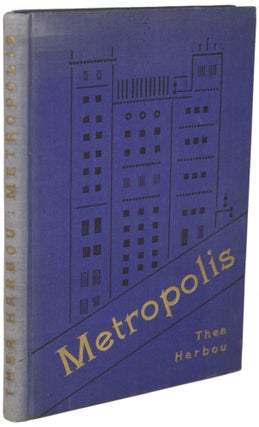
METROPOLIS. ROMÁN ...
Praha: Ustredni Delnicke Knihkupectvi a Nakladatelstvi (A. Sveceny), 1927. Octavo, pp. [1-6] 7-238 [239] [240: blank], sixty-five film stills throughout the text, original blue cloth, front panel stamped in black and gold, spine panel stamped in gold, rear panel stamped in blind, top edge stained blue, decorated endpapers. First printing of this edition. Anti-utopia set in a gigantic city in the year 2000 "where capitalists oppress a mass of proletarian helots." - Fisher, p. 128. A restitution fantasy in which a patriarchal order is ultimately reestablished. The Fritz Lang movie adaptation had a mythic scale that would not be challenged -- "The Shape of Things to Come" aside -- for decades to come. [Reference: Anatomy of Wonder (1976) 3-23; (1981) 2-112; (1987) 2-123; (1995) 2-132; and (2004) II-1197. Bleiler, Science-Fiction: The Early Years 1040. Fisher, Fantasy and Politics: Visions of the Future in the Weimar Republic, pp. 126-37; 139-42. Lewis, Utopian Literature, p. 198. Survey of Science Fiction Literature III, pp. 1383-86. Lexikon 2, pp. 134-6. Bloch (2002) 1370. Nagl, p. 256].
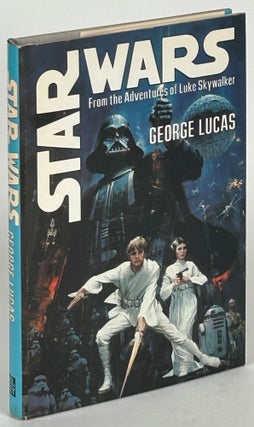
STAR WARS: FROM THE ADVENTURES OF LUKE SKYWALKER.
New York: A Del Rey Book/Ballantine Books, [1977]. Octavo, cover art by John Berkey, boards. First hardcover edition. Issued by the Science Fiction Book Club (precedes the trade hardcover issued later in the year). Novelization of the feature film directed by George Lucas. With still photos from the motion picture.
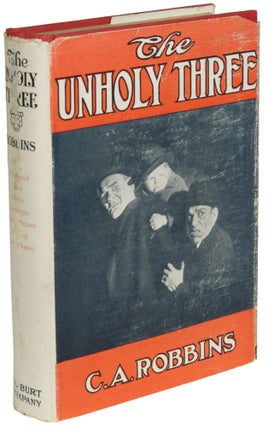
THE UNHOLY THREE.
New York: A. L. Burt Company Publishers, [1930]. Octavo, pp. [1-4] 5-282 [283-288: ads], original red cloth, spine panel stamped in black. Photoplay edition. First printing of the photoplay edition with four stills from the 1930 Metro-Goldwyn Mayer film "The Unholy Three," directed by Jack Conway, starring Lon Chaney, which was based on this macabre mystery novel about three criminous circus misfits, also known as "The Terrible Three" and THE THREE FREAKS. This was Chaney's last film and only talking picture, a remake of Tod Browning's 1925 silent film in which Chaney also starred. [Reference: See Barron (ed), Horror Literature 3-166. Bleiler (1948), p. 236. Hubin (1994), p. 686].
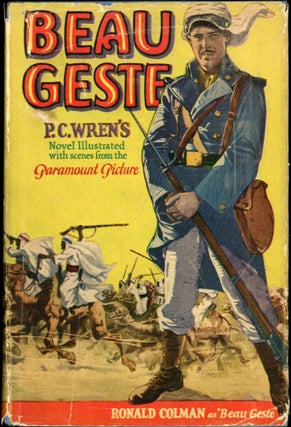
BEAU GESTE.
New York: Grosset & Dunlap Publishers, n.d., [1926]. Octavo, pp. [1-6] [1-2] 3-418 [419-426: ads], four inserted plates from the film, original light blue cloth stamped in black. Later edition. Issued to coincide with the 1926 Paramount film production starring Ronald Coleman. Includes a 6-page afterword by Glendon Allvine about the making of the Paramount film in the Arizona desert.