
Childrens

A COLLECTION OF NOVELS AND TALES OF THE FAIRIES. Written by That Celebrated Wit of France, the Countess d'Anois. In Three Volumes ... The Third Edition. Translated from the Best Edition of Original French, by Several Hands.
London: Printed for J. Brotherton and W. Meadows in Cornhill; R. Ware in Amen Corners; T. Astley in St Paul's Church Yard; and J. Hodges on London Bridge, 1737. Small 12mo, three volumes: pp. x 288; 276; 240, eighteenth-century full brown calf, spine panels ruled and lettered in gold, red morocco title pieces. Third edition. A collection of twenty-six literary fairy tales, of which eleven are by d'Aulnoy (eight tales plus three nouvelles used to frame them), four by the Comtesse de Murat; all those in volume three are by the Comtesse d'Auneuil. In 1785 when Clara Reeve looked back seven or eight decades and recalled Mme d'Aulnoy as "a famous composer of Fairy Tales," she was correct in singling Mme d'Aulnoy out for special attention as an author of CONTES DE FÉES, but she did not know that twenty-eight of the tales which came into England under Mme d'Aulnoy's name were by four other French writers ... Furthermore, the 1699 edition of d'Aulnoy's tales listed by Arundel Esdaile is regarded today as a bibliographical ghost. In other words, except for the English collections of Fénelon's and Charles Perrault's fairy tales, the French fairy tale in England is a subject fraught with bibliographical confusion ... The English vogue for French fairy tales in the late seventeenth and early eighteenth centuries ... was in fact initiated by Mme d'Aulnoy in 1691 with the translation of a fairy tale of hers as THE HISTORY OF ADOLPHUS, which appeared, however, without author's or translator's name and which was regarded until recently as a native English work and not a translation at all. After this beginning and excepting the English versions of fairy tales by Fénelon and Perrault, the French conte de fée as a genre came to England in four collections, all of them said to be Mme d'Aulnoy's work. Only two are completely the work of Mme d'Aulnoy; the other two contain tales by other hands as well as tales by Mme d'Aulnoy. These four collections are Tales of the Fairies (1699); Volume IV of The Diverting Works of the Countess D'Anois, this volume bearing as title Tales of the Fairies in Three Parts Compleat (1707); The History of the Tales of the Fairies (1716); and A Collection of Novels and Tales of the Fairies (Volumes I and II, 1721; Volume III, 1728). Mme d'Aulnoy did indeed dominate the English vogue for the French conte de fée, as Clara Reeve suggested. We know now that eighteen of her tales appeared in English before the nineteenth century -- a larger number than those of any other writer. But we also know now that twenty-eight of the tales formerly attributed to her in England are the products of other writers. Except for the fairy tales of Fénelon and Perrault, there were no other French contes de fées published in England in the early eighteenth century, but two of the collections discussed here did continue to delight English readers throughout the century. The History of the Tales of the Fairies (1716) appeared again in 1749, 1758, and 1781. The Collection of Novels and Tales of the Fairies (all three volumes complete) appeared twice in 1737 and again in 1749 and 1766. In 1817 it even made its way into the era of Jane Austen as Fairy Tales and Novels. "Unlike her contemporary, Charles Perrault (a frequent visitor to her salons), who only occasionally used his fairy tales for purposes of satire, she made that her prime motive, with the result that, unlike Perrault's, her tales were composed primarily for adults -- and were thus among the first literary fairy tales ... Although less known now, her stories contain all the basic plot devices of fantasy, and were highly influential in their day ... Her stories are usually much longer narrative constructions than the fairy tales by Perrault or the Grimm Brothers, and this fact has made them less memorable, despite their position among the earliest original fantasies. It was, however, with the translation of a few of her stories into English as TALES OF THE FAIRIES (1699), that the term 'fairy tales' passed into the language." - Clute and Grant (eds), The Encyclopedia of Fantasy (1997), p. 72. [Reference: ESTC N28398 (Edinburgh University Library, National Library of Wales, Harvard University, New York University)].
PETER PT.
[Philadelphia]: David McKay Company, Publisher, 1944]. Octavo, pictures by Annette Byrne, pictorial boards. First edition. Illustrations by Annette Byrne. The story of Peter, the Patrol Torpedo Boat.

FORTUNATELY THE MILK...
London, New Delhi, New York, Sydney, Bloomsbury, [2013]. Octavo, boards. First edition. Special edition for Foyles Bookshop. Signed on the title page by Gaiman and artist Chris Riddell.
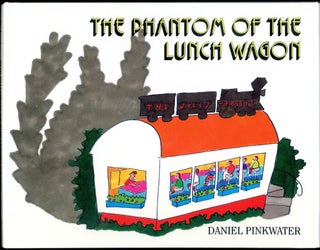
THE PHANTOM OF THE LUNCH WAGON.
New York: Macmillan Publishing Company, [1991]. Octavo, illustrated by Pinkwater, pictorial boards. First edition.
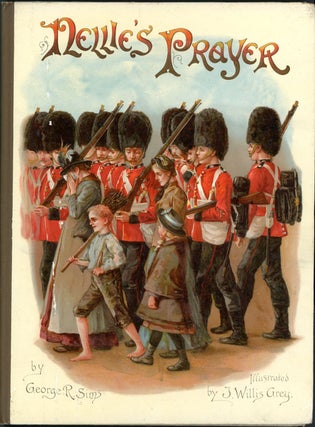
NELLIE'S PRAYER.
London, Paris & New York: Raphael Tuck & Sons, nd [c. 1890-93]. Octavo, [1-24], illustrated by J. Willis Grey, cloth backed boards. A wife gets news her husband is killed in action, delays telling her daughter who prays for his safe return, upon finally telling her the child goes and prays again and her father appears at the door, a mistake being made on the battlefield.
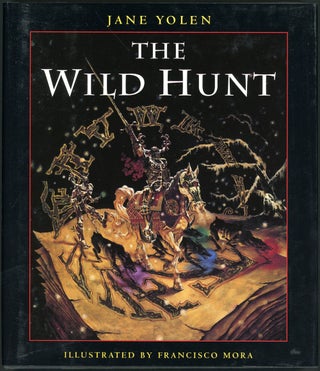
THE WILD HUNT.
San Diego, New York, London: Harcourt Brace & Company, [1995]. Octavo, illustrated by Francisco Mora, cloth backed boards. First edition. Children's fantasy novel. "Thoughtful Jerold and the more reckless, appropriately named Gerund are two boys living in similar houses, somehow in parallel universes, in the dead of winter. As he does every year, Herne the Hunter, Lord of Winter, is battling the Queen of Light, She Who Is Ever, She Whose Word Is Law, she who is also Jerold's and Gerund's house cat. As a blizzard rages, Herne hunts, and Gerund gets himself captured. Jerold must try to be a hero and rescue Gerund." - Publisher's Weekly review.