
Letters and Manuscripts
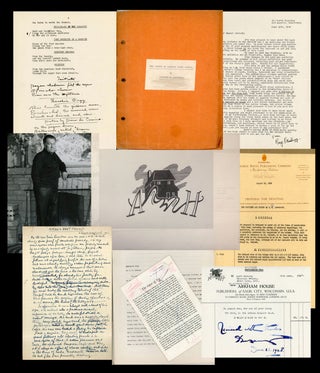
AN ARKHAM HOUSE ARCHIVE: An important archive of material from the from the files of August Derleth, publisher and editor.
In 1939, a promising Midwestern mainstream novelist and a popular Midwestern writer of pulp fiction co-founded a small press to publish a hardbound book to preserve the writing and perpetuate the memory of their dearly departed friend and mentor, Howard Phillips Lovecraft. Arkham House was officially in business when August Derleth and Donald Wandrei signed the George Banta Publishing Company's "Proposal for Printing" THE OUTSIDER AND OTHERS by H. P. Lovecraft, dated 25 August 1939. Thus began of one of America's most important and best known twentieth-century small publishers, Arkham House Publishers (named for the fictional Massachusetts city loosely modeled on Salem, Massachusetts, the setting for many of H. P. Lovecraft's stories) which had an enormous impact on the course and development of the horror fiction genre, particularly in the United States. "Arkham House, founded in 1939, played a crucial role in establishing the importance of the WEIRD TALES school of writers -- including Lovecraft, Clark Ashton Smith, Robert E. Howard, Henry S. Whitehead, and others -- by preserving their pulp fiction in book form for future readers, scholars and writers. Derleth also issued the first books of their immediate successors in the tradition, Robert Bloch, Fritz Leiber, Ray Bradbury and Joseph Payne Brennan. As well, he vigorously championed the British weird fiction tradition, presenting works by Sheridan Le Fanu, William Hope Hodgson, Lord Dunsany, and H. Russell Wakefield to the North American audience, in some cases for the first time" (Penguin Encyclopedia). "August Derleth had almost single-handedly kept weird fiction alive with Arkham House, the grandfather of all specialist science fiction and fantasy small presses ... Arkham House was essentially a book publisher, and Derleth was one of the first to develop original anthologies of weird tales, long before they became popular in the science fiction field. Starting with DARK MIND, DARK HEART (1962), Derleth encouraged a new generation of writers while sustaining the old school of WEIRD TALES contributors" (Mike Ashley). The Arkham House Archive contains over 4000 letters and documents related to publications issued by Arkham House, Mycroft & Moran and Stanton & Lee between 1939 and 1971, as well as correspondence and business papers related to Derleth's activities as writer and editor for other publishers, including his editorial work as an anthologist in the 1940s and 1950s, and as a TV scriptwriter in the 1950s. This archive is a highly important collection of letters and documents. The core of the archive is correspondence, often extensive, from several hundred authors whose work Derleth published under his own imprints or in his highly important non-Arkham House anthologies published in the 1940s and 1950s, as well as manuscripts, mostly typewritten (including fair copies and carbons), submitted by Arkham House authors. The business papers include printers' correspondence, quotes and invoices, beginning with the George Banta Company proposal for printing THE OUTSIDER, 25 August 1939 and the invoice for THE OUTSIDER, 21 November 1939. There is significant business correspondence from Derleth's literary agents: G. Ken Chapman, Robert Goldfarb, Otis Kline Associates, Scott Meredith Literary Agency, Renault and Le Bayon and others, as well as hundreds of letters pertaining to the sale of reprint rights (including audio and film rights) for literary property by Derleth and others. These business papers largely predate the August William Derleth Papers held by the Wisconsin Historical Society, as "most of the pre-1963 materials were destroyed when this collection was originally processed, so substantially complete records survive only for the years between 1963 and 1970." Additionally, the archive includes book production files for some publications, printer's blocks, fair copy typescripts of literary material by various writers made by Arkham House for book production or reference (like typewritten transcriptions of Lovecraft letters), complete and partial book proofs, and photographs of Arkham House authors.

THREE TYPED LETTERS SIGNED (TLsS). Each 1 page, dated 21 July 1962, 23 April 1966 and 25 April 1966, all to "Reg" [Reginald Bretnor], each signed "Isaac."
Three letters to SF writer and critic Reginald Bretnor (1911-1992), the first devoted to Ferdinand Feghoot, a popular intergalactic punster invented by Bretnor, many published under his pseudonym Grendel Briarton in THE MAGAZINE OF FANTASY AND SCIENCE FICTION. (For the uninitiated, Feghoots are short, short joke stories with the punch line a terrible pun.) Asimov sketches out an "idea" for a Feghoot, "without attempting to put it into literary form, so that you can do that part in your own inimitable fashion." Asimov's two other letters concern the reprint fee offered by Doubleday for a short story by Bretnor that Asimov selected for an anthology he is compiling. "As you guessed, Doubleday handled the matter, not I, but as I said in my previous letter, they meant no harm and there was much consternation in the Doubleday offices, partly because they are really a very nice, and very ethical publishing house - honest - and partly because they were afraid I would be upset - and so I was. Anyway, please let me know what you want done, in line with my suggestion in my previous letter (mailed yesterday afternoon)."
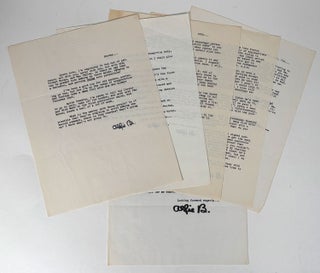
SIX TYPED LETTERS SIGNED (TLsS) and TWO TYPED NOTES SIGNED (TNsS), all undated [circa late 1970s and early 1980s], without salutations [all to Kirby McCauley except one, to Kay McCauley], all signed either "Alfie B." or "Alfie Bester." The notes are on plain postcards, the letters are on letter-size typing paper, three of them with embossed return address (Ottsville, Pa.) at top.
An endearing and amusing file of letters from the author of THE DEMOLISHED MAN (1953) and TIGER! TIGER! (1956), two of the "few genuine classics of genre sf" (Clute and Nicholls, The Encyclopedia of Science Fiction, p. 113). The letters were written towards the end of his career and reveal a man of warmth, generosity, high spirits, quick temper, and, in his persistent refusal to date any of his letters, a rebellion against convention, trivial in itself but perhaps suggestive of a deeper alienation. Bester, a Jewish kid from New York City, went to the University of Pennsylvania and settled in Bucks County. He began writing sf short stories in his twenties, then worked for DC comics, wrote scripts for radio and TV and edited Holiday magazine for many years. Science fiction occupied only part of his literary career and his best work was done in the 1950s and early 1960s, though some of his stories from both before and after this period are among his best, which is to say, among the best that has been done in the genre. He wrote three other sf novels, two of them (THE COMPUTER CONNECTION and GOLEM-100) with glints of the old genius. (1) TNS, postcard, no salutation, undated. Complaining about the lack of progress from Byron Preiss on a project to turn THE STARS MY DESTINATION (the U.S. title of TIGER! TIGER!) into a comic book. "… this Byron Preiss character has sent me nothing on THE STARS, as he promised. Instead he sent me a copy of his version of the Zelazny stories…I don't at all like what he's done with Zelazny; it's cheap and fifth-rate and we would have rejected it at D-C Comics." Closes with, "They're cleaning my hot water coil with HCl. Little else remains to be told." Fine. (2) TNS, postcard, no salutation, undated but postmarked 10 March 1978. Begins, "Kirby, my beauty, do exactly as you think best with TENDER, LOVING RAPE. You must know by now that I have ample reason for trusting your judgment." This mainstream novel, set in the milieu of New York advertising and television in 1959, was written around 1970 and not published until 1991 (posthumously), under the title TENDER LOVING RAGE. Fine. (3) TLS, half-page, no salutation, dated "Monday…" Complaining about delays in the publication of GOLEM-100, the science fiction novel that Bester considered his best. "Kirby, love, I'm beginning to run out of patience; not with you, never with you, but with S&S, Pocket Books, and Mac Talley…. Quite frankly, I'm ready to tell our locals to go to hell, take off for London, and work with Pan and Nick Webb on the first publication which, God knows, needs a hell of a lot of work." The novel was published by Simon & Schuster in 1980. Faint mailing creases, fine. (4) TLS, half-page, no salutation, undated, to Kirby's sister and fellow-agent Kay Kirby. "Enclosed, the lunatic story about the psychiatric hockshop. You'll see that it's the first of a possible series … but it's so wild that I'm scared and beg you both for a frank, honest and, as my dentist used to say, bruteless appraisal." Closes with brief enumeration of some upcoming tasks, "… have my hair cut for Good Friday, and then back to that goddamn Praying Mantis novel. I kiss your libido…" Several creases at edges, short closed tear at top edge, very good. (5) TLS, half-page, no salutation, dated "28th…" Mentions some business details about the manuscript of TENDER, LOVING RAPE (see item #2 above), then kvetches about the creative turmoil attendant on his writing of GOLEM-100. "It's hell when your demon requires you to top yourself constantly. I keep hoping that another eighty pages of knock-outs and the book will award me the decision." Then it's the cold weather. "We're having another Glacial Epoch down here in Bucks and I have a vision of future scientists discovering my Opel GT frozen like a Mastodon in a bog, probably with me inside it, shopping list in hand. '1100110011! 1100001!' they'll exclaim in the language of the future. 'It still runs!' But they'll never be able to decipher my shopping list. Kisses and pinches …" Faint mailing creases, minor creases at edges, a thin irregular strip of faint darkening along upper left margin, very good or better, overall. (6) TLS, 1 page, no salutation, undated, with return address on sticker attached to lower left corner. Another complaint about the lack of progress made by "this Preiss character" on a project to adapt THE STARS MY DESTINATION to comic book (see item #1 above). "He talks real slick and is full of explanations and excuses…He doesn't have a completed script or even a page and panel outline. He doesn't have anything except a vague thirty pages which, apparently, he sold to some publication….I think he's been trying to sell the book before he starts real work on it…. Thirty pages in fourteen months? Jeez! I do thirty pages, including art, in fourteen days." Asks Kirby for advice on how to handle the situation. "Forgive the long letter but I'm so busy with the completion of GOLEM-100 that I didn't have time to write a short one." Faint mailing creases, fine. (7) TLS, half-page, no salutation, dated "Tuesday, Dec. 5th…" Accepting invitation to speak at an upcoming convention. "You must know by now that my attitude toward conventions is to make myself available at all times for all purposes and for all people. I'm no Robert Heinlein, hiding in austere and megalomaniac seclusion. I'm in the entertainment business. Don't worry about money. I'll pay my own way with pleasure. All you'll have to do is reserve real nitzy [ritzy?] accommodations for me and my redhead, and I'll pick up the tab." Announces that GOLEM-100 should be published by the time of the convention, and that Pocket Books wants to title it, "PSYLOCK." Faint mailing creases and several light creases elsewhere, near fine. (8) TLS, top carbon, half-page, no salutation, but with "my dear Mal" in first sentence [probably to UK editor Malcolm Edwards, with this copy to Kirby McCauley], dated "9th…" Concerning plans for an upcoming convention, SEACON '79 (and complaining about a new electric typewriter). "I do not come to a convention for an ego trip; I come to do the damn best P. R. job that I can…. You may count on me for anything; speeches, panels, moderating, last minute off-the-cuff appearances, stand-ins for scheduled people who've dropped out…. I enjoy chatting privately with my colleagues which is why I've asked you to reserve the damn best suite [available] (see item #7 above)…" Doesn't mind giving "a small bash for selected fans … but you guys will have to provide the booze for them." Faint mailing creases, fine. Kirby McCauley was probably the most important literary agent of horror, fantasy and sf writers in the boom years of the 1970s and 1980s.
AUTOGRAPH LETTERS SIGNED (ALS) to Dirk Mosig, 1973-1975. 16 letters, 23 page.
Group of 16 handwritten letters to Dirk Mosig from Bloch dated July 17, 1973 to February 12, 1975. Some are on Bloch's letterhead, some on plain paper. Content includes answers to queries about Lovecraft and his writings, Lovecraft in relation to Bloch (one of Bloch's comments - "I was influenced by HPL, not Dunsany" 7/2/74), Bloch's comments on current events and those who manipulate others, his own writings and more. Dirk Mosig is an important early Lovecraft scholar of the modern period. S. T. Joshi has written, "Dirk Mosig is the key transitional figure in Lovecraft studies; and if the history of this field is ever written, he will have to occupy a central role..."

SIX TYPED LETTERS SIGNED (TLsS). 6 pages, dated variously between 9 June 1978 and 29 November 1978, all to "Dear Kirby" [McCauley], signed "Ramsey."
The letters deal with business details concerning both of Campbell's activities, as an author and an anthologist. Each letter raises a handful of matters, asking for information or action from McCauley, or supplying information. Campbell plows through the matters in pell-mell fashion. The tone is chatty -- neither formal nor intimately emotional. Kirby McCauley was probably the most important literary agent of horror, fantasy and sf writers in the boom years of the 1970s and 1980s.
![Item #27107 THE MESSENGER [Novelette]. Original handwritten manuscript, corrected throughout in...](https://jwkbooks.cdn.bibliopolis.com/pictures/27107.jpg?width=320&height=427&fit=bounds&auto=webp&v=1614540127)
THE MESSENGER [Novelette]. Original handwritten manuscript, corrected throughout in Chambers' hand. 104 pages, written in pencil on the rectos of ruled paper measuring 32x20 cm. Not dated, but written circa 1896-1897.
A tale by Robert W. Chambers (1865-1933) about the Black Priest, branded on the forehead and executed for treason during the Third Crusade and again 1760, whose skull is disinterred in a gravel pit, and who returns again to haunt the Breton countryside. The story was first published in THE MYSTERY OF CHOICE (1897), Chambers' third collection of short fiction. The published version largely follows the final text of the manuscript which has many deletions and revisions by Chambers. THE MYSTERY OF CHOICE "opens with a trilogy of tales sharing the same characters and set in the Breton countryside. They are reminiscent of 'The Demoiselle D'Ys' in mood and setting ... ['The Messenger'] is an effective treatment of a conventional theme" (Lee Weinstein, Bleiler, ed., SUPERNATURAL FICTION WRITERS II, 743). "By far and away the most powerful ... was 'The Messenger.' This is a long, sometimes rambling story that nevertheless guides the reader along to a most eerie conclusion. The setting -- coastal Brittany -- has seldom been used to such effect, and the historical tale behind the story's events has a grotesque ring of truth. This is one of Chambers' best stories, and its use of the traditional cowled figure has never been bettered" (Hugh Lamb, ed., Chambers, OUT OF THE DARK I, pp. xi-xii). "The Messenger" is "a material-horror story, possibly a little unsubtle, but it does have the characteristics of a nightmare with its disruptions of the time-dimension, interlocked identities, and repetitive fate, which are all novel touches for the period" (Bleiler, ed., Chambers, THE KING IN YELLOW AND OTHER HORROR STORIES, p. xi).
![Item #24283 TYPED LETTER SIGNED (TLS). 1 page, dated 1 April [19]73, to "Dear Leo &...](https://jwkbooks.cdn.bibliopolis.com/pictures/24283.jpg?width=320&height=427&fit=bounds&auto=webp&v=1614551310)
TYPED LETTER SIGNED (TLS). 1 page, dated 1 April [19]73, to "Dear Leo & Cylvia" [Leo and Cylvia K. Margulies, editors of Weird Tales Magazine], signed "Harlan." On Ellison's 3484 Coy Drive, Sherman Oaks letterhead.
Cover letter accompanying a short story by Susan Lette which Ellison was recommending for publication in WEIRD TALES. Lette was an amateur writer, but "one of those natural writers whom one spots instantly among the hordes of creative typists and formula hacks who infest out little world." Her first story, Merari," was to be published that summer in COSMOPOLITAN; her second was to be published in Ellison's anthology, LAST DANGEROUS VISIONS. The present story, "Timmy," represented her third. Ellison says reading it raised the nape hairs on the back of his neck and reminded him of Bradbury's "Small Assassin." He notes that she was living in somewhat straitened circumstances and had an autistic child. Leo Margulies was an editor and publisher who had been working in the field since 1932, when he joined the Frank Munsey chain of pulps. Ellison was "... the most controversial and among the finest of those writers associated with sf whose careers began in the 1950s. He was born and raised in Ohio, attending Ohio State University for 18 months before being asked to leave, one of the reasons for his dismissal being rudeness to a creative-writing professor who told him he had no talent." - Clute and Nicholls (eds), The Encyclopedia of Science Fiction (1993), p. 376.
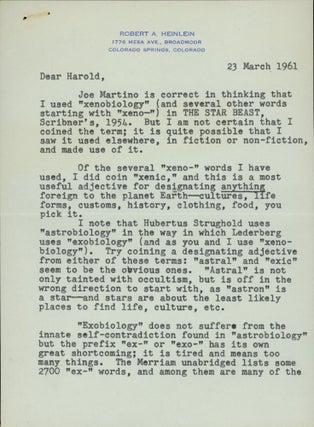
TWO TYPEWRITTEN LETTERS SIGNED (TLsS), two pages, dated 23 March 1961 and one page, dated 26 November 1961, both written on his Colorado Springs, Colorado stationery, from Heinlein to "Dear Harold" [Wooster], both signed "Bob," 1 TYPEWRITTEN LETTER SIGNED (TLS), one page, dated 12 July 1963, on ANALOG letterhead, from Campbell to "Dear Mr. Wooster," signed John W. Campbell, plus carbons of Wooster's letters to Heinlein and Graham DuShane, editor of SCIENCE.
The correspondence relates to an article Dr. Wooster wrote on the coining of the word "xenobiology" (the study of the biology of alien life-forms) generally credited to Heinlein for use in "Star Lummox" (F&SF, May-July 1954; STAR BEAST, Scribner's 1954), which incorporates his correspondence with Heinlein, published in SCIENCE 134: 3473 (July 1961) 223-225. Harold Abbott Wooster (1919-2005) was the chief of the information sciences division of the Air Force Office of Scientific Research in the 1960s, a computer pioneer "whose decades-long career in information science influenced the development of computer technology and medical television ... He left the Air Force's scientific research office, which considered him a pioneer in the information science field, in 1970. From 1970 to 1984, Dr. Wooster worked at the National Library of Medicine's Lister Hill Center for Biomedical Communications. He supervised experiments using television to connect patients in remote areas to doctors" (Washington Post obit 3 June 2005). Dr. Wooster published a single SF story, "Y + Sin X," ASTOUNDING (September 1943). [Reference: See Patterson, William H., Robert A. Heinlein, Volume 2, p. 211].
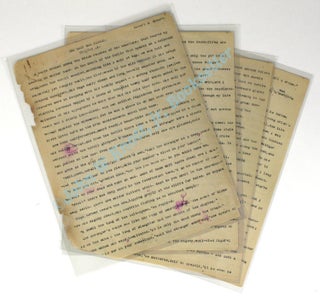
"THE GREY GOD PASSES" TYPED MANUSCRIPT (TMs). 36 leaves. Not dated, circa 1930-31.
Original typed manuscript for the story which was not published during Howard's lifetime. In a letter of provenance from Glenn Lord he states "Originally written as a straight historical entitled "Spears of Clontarf" the story was submitted to Clayton Magazines on June 1, 1930..." Rejected by Clayton, Howard re-wrote the story into its present form and submitted it to Farnsworth Wright at Weird Tales who rejected it in December of 1931. (The rejection letter accompanies the manuscript). It stayed in Howard's files until after his death when August Derleth purchased the rights from literary agent Oscar J. Friend. He published the story in the anthology DARK MIND, DARK HEART (1962). The story occurs during the historical Battle of Clontarf which took place in the early 11th Century involving Brian Boru, High King of Ireland against the Vikings. Howard's main characters are Turlogh Dubh O'Brien and an ex-slave named Conn. "The core of the story, as indicated by the title, is the end of the influence of supernatural beings from our world with the victory of Christian King Brian over the heathen Vikings. Among the Irish dead is a fey prince whose own death will cause the death of his fairy lover, a metaphor for the waning away of all the Sidhe. Odin himself makes an impressive and doomful appearance, making the battle a Götterdämmerung. This is more Wagnerian in tone than the utter end of the world predicted for Ragnarök, though it is indeed the end of a world." - Wikipedia entry.
![Item #34595 A PAIL OF AIR [short story]. Typewritten Manuscript, signed (TMsS). N.d., but 1951....](https://jwkbooks.cdn.bibliopolis.com/pictures/34595.jpg?width=320&height=427&fit=bounds&auto=webp&v=1750079012)
A PAIL OF AIR [short story]. Typewritten Manuscript, signed (TMsS). N.d., but 1951. 20 leaves, 8.5x11 inch plain paper stock. Ribbon copy, corrections and copy edits in pencil throughout. Signed by Leiber on the recto of the first leaf.
First edition. The setting copy. A catastrophe story first published in GALAXY, December 1951. Collected in Leiber's A PAIL OF AIR (1964). The story was dramatized for the radio show X Minus One and broadcast in March 1956.

TYPED LETTER SIGNED (TLS). 1/2 page on a single sheet of letter-size paper, signed "Fritz" in green ink, dated 5 August 1945, to "Dear August" [Derleth].
A businesslike letter to Derleth, as editor of Arkham House, concerning the edition of Leiber's tales that he was preparing. NIGHT'S BLACK AGENTS appeared in 1947, Leiber's first book, and Arkham's 29th. (It was also the first of their titles which went subsequently into a paperback edition, brought out by Ballantine Books in 1961.) In this letter, responding apparently to Derleth's request for blurb material, Leiber refers to a letter he had received from H. P. Lovecraft late in 1936 after sending him the novella, "Adept's Gambit." He points out several sections of the letter, which he had enclosed, that might be suitable for quoting. "... I was delighted to receive a letter from Lovecraft containing not only some general comments, but an unexpected list of detailed criticisms and corrections, which I hastened to make use of in preparing a second writing of the story ... ." The front dust jacket flap did, in fact, wind up using some of this copy. "'Some day I hope the Fafhred Cycle will get into print,' wrote H. P. Lovecraft after reading the manuscript of the novel herewith, 'leading off with Adept's Gambit.'" Bleiler calls NIGHT'S BLACK AGENTS "one of the landmark volumes in modern fantastic fiction" (Bleiler, The Guide to Supernatural Fiction 1002) -- though he didn't care much for the Fafhred/Mouser story, which, in fact, was the only part of NIGHT'S BLACK AGENTS omitted in the Ballantine paperback. The letter links three of the most important figures in mid-twentieth-century American fantastic fiction.

LETTERS FROM H. P. LOVECRAFT TO J. VERNON SHEA, JR. Nine handwritten letters, totaling 84 pages, written between 1931 and 1937, all of which are largely unpublished.
J. Vernon Shea (1912-1981), an aspiring writer whose correspondence with Lovecraft began when Shea was only 19 years old, "soon showed himself to be one of the most astute of Lovecraft's younger correspondents" (Cannon, Lovecraft Remembered, p. 348), not accepting Lovecraft's art-for-art's sake pose without question, and engaging him "in numerous involved (and at times heated) discussions on politics (especially concerning Hitler and the Nazis) and society" (Joshi and Schultz, An H. P. Lovecraft Encyclopedia, p. 240). Shea published a few fantasy and science fiction stories, including several in anthologies edited by August Derleth published by Arkham House. In 1966 Shea published "H. P. Lovecraft: The House and the Shadows," a major critical article on HPL, in THE MAGAZINE OF FANTASY AND SCIENCE FICTION. "Until his death in 1981, Shea remained active on the fringe of Lovecraft fandom as a somewhat lonely and curmudgeonly elder statesman, his intellectual curiosity and sense of humor undimmed" (Cannon). In the 1960s Shea donated what he believed to be all his letters from Lovecraft to the John Hay Library, but nine more letters found after his death were acquired by the Boston Book Annex who offered them for sale in their catalogue number 8 (January 1983). Purchased as a lot and privately held since that time, the nine letters were not available for transcription and publication in Lovecraft's Letters to J. Vernon Shea, Carl F. Strauch, and Lee McBride White, edited by S. T. Joshi and David E. Schultz (Hippocampus Press, New York, 2016) who published brief excerpts made by Shea himself and passed on to August Derleth for inclusion in the Selected Letters project.
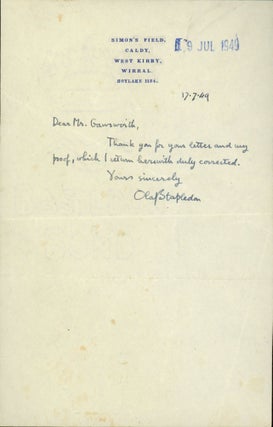
"Conflict of Wisdom." Typed Manuscript (TMs).
10 leaves, plus cover sheet. Corrected throughout in Stapledon's hand with amendments, additions, and strikeouts. At the top edge of the cover sheet Gawsworth has written: "Published by me / when editing ENQUIRY / (1949) / John Gawsworth." Accompanied by a handwritten note (ANS) from Stapledon to Gawsworth dated 17 July 1949 returning a corrected proof of the essay. The essay, published in ENQUIRY, August 1949, addresses the "need both for fidelity to the spirit and agnosticism about the ultimate ends of the universe." - Satty and Smith C190. William Olaf Stapledon (1886-1950) "is best remembered for the extraordinary works of speculative fiction published between 1930 and 1950. As a novelist, he was known as the spokesman for the Age of Einstein and has influenced writers as diverse as Virginia Woolf, Arthur C. Clarke, and Doris Lessing ... Stapledon's novels -- LAST AND FIRST MEN (1930), ODD JOHN (1935), STAR MAKER (1937), and SIRIUS (1944) -- have gathered a passionate following, and they have seldom been out of print in the last twenty-five years ... In his social activism as in his fiction, Stapledon embodied many of the of modern era's anxieties and hopes that allow his works to continue to speak to and for the future." - Robert Crossley.
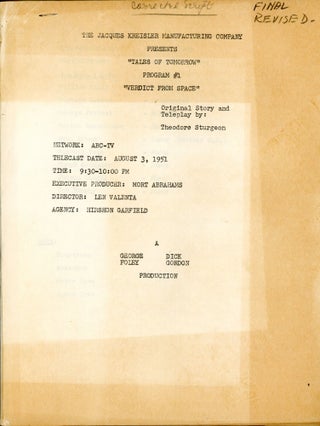
THE JACQUES KREISLER MANUFACTURING COMPANY PRESENTS "TALES OF TOMORROW" PROGRAM #1 "VERDICT FROM SPACE" ORIGINAL STORY AND TELEPLAY BY: THEODORE STURGEON. NETWORK: ABC-TV. TELECAST DATE: AUGUST 3, 1951 ...
[New York]: A George Foley / Dick Gordon Production, 1951. Mimeographed TV script, heavily corrected throughout in pencil. The cover page is marked "Corrected Script" and "FINAL REVISED" in pencil at the top of the sheet. The script is complete and includes cast and crew lists, rehearsal schedule, and inserts on blue paper stock for the commercials that ran during the program. The series, produced by George Foley and Dick Gordon, was performed and broadcast live on ABC-TV from 1951 to 1953. It ran for 85 episodes. The series, originally called Tomorrow is Yours, was developed by Theodore Sturgeon, the series story editor, and Mort Abrahams, the program's executive producer. Tales of Tomorrow was one of the earliest and most successful SF anthology television series. It was ambitious but, like most television of the period, limited by the restrictions imposed by live studio shooting. At a time when most SF on TV was targeted to children, Tales of Tomorrow was intended for adults. It drew its material from a variety of sources, including the SF pulp magazines, as well as using original scripts. "Verdict from Space" is Sturgeon's adaptation of his short story "The Sky Was Full of Ships" which was first published in THRILLING WONDER STORIES, June 1947.
![Item #24339 "THUNDER AND ROSES" [short story]. TYPED MANUSCRIPT, SIGNED (TMsS). 31...](https://jwkbooks.cdn.bibliopolis.com/pictures/24339.jpg?width=320&height=427&fit=bounds&auto=webp&v=1750354521)
"THUNDER AND ROSES" [short story]. TYPED MANUSCRIPT, SIGNED (TMsS). 31 leaves, (first?) carbon copy.
Not dated, but circa 1947. Signed by Sturgeon on the first page. The typescript is incomplete; it ends about three-fourths of the way through the story after the sentence "(She couldn't hear the blood in his ears, the roar of the whirlpool of hate and fear and anguish that spun inside of him.)" This powerful antiwar story was first published in ASTOUNDING SCIENCE FICTION, November 1947. It first appeared in a book in THE ASTOUNDING SCIENCE FICTION ANTHOLOGY, edited by John W. Campbell, Jr. (1952). It was collected, with other stories by Sturgeon, in A WAY HOME (1955). "'Thunder and Roses' is one of Sturgeon's best works of fiction. Written for Campbell the year after 'Memorial,' it is a study of people whose time has run out and an in-depth study of one man, Pete Mawser." - Lucy Menger, Theodore Sturgeon, p. 32.