
California Virtual Book Fair, March 2021

Our selection of books which were exhibited at the recent California Virtual Book Fair.
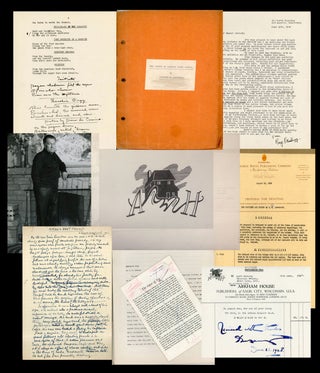
AN ARKHAM HOUSE ARCHIVE: An important archive of material from the from the files of August Derleth, publisher and editor.
In 1939, a promising Midwestern mainstream novelist and a popular Midwestern writer of pulp fiction co-founded a small press to publish a hardbound book to preserve the writing and perpetuate the memory of their dearly departed friend and mentor, Howard Phillips Lovecraft. Arkham House was officially in business when August Derleth and Donald Wandrei signed the George Banta Publishing Company's "Proposal for Printing" THE OUTSIDER AND OTHERS by H. P. Lovecraft, dated 25 August 1939. Thus began of one of America's most important and best known twentieth-century small publishers, Arkham House Publishers (named for the fictional Massachusetts city loosely modeled on Salem, Massachusetts, the setting for many of H. P. Lovecraft's stories) which had an enormous impact on the course and development of the horror fiction genre, particularly in the United States. "Arkham House, founded in 1939, played a crucial role in establishing the importance of the WEIRD TALES school of writers -- including Lovecraft, Clark Ashton Smith, Robert E. Howard, Henry S. Whitehead, and others -- by preserving their pulp fiction in book form for future readers, scholars and writers. Derleth also issued the first books of their immediate successors in the tradition, Robert Bloch, Fritz Leiber, Ray Bradbury and Joseph Payne Brennan. As well, he vigorously championed the British weird fiction tradition, presenting works by Sheridan Le Fanu, William Hope Hodgson, Lord Dunsany, and H. Russell Wakefield to the North American audience, in some cases for the first time" (Penguin Encyclopedia). "August Derleth had almost single-handedly kept weird fiction alive with Arkham House, the grandfather of all specialist science fiction and fantasy small presses ... Arkham House was essentially a book publisher, and Derleth was one of the first to develop original anthologies of weird tales, long before they became popular in the science fiction field. Starting with DARK MIND, DARK HEART (1962), Derleth encouraged a new generation of writers while sustaining the old school of WEIRD TALES contributors" (Mike Ashley). The Arkham House Archive contains over 4000 letters and documents related to publications issued by Arkham House, Mycroft & Moran and Stanton & Lee between 1939 and 1971, as well as correspondence and business papers related to Derleth's activities as writer and editor for other publishers, including his editorial work as an anthologist in the 1940s and 1950s, and as a TV scriptwriter in the 1950s. This archive is a highly important collection of letters and documents. The core of the archive is correspondence, often extensive, from several hundred authors whose work Derleth published under his own imprints or in his highly important non-Arkham House anthologies published in the 1940s and 1950s, as well as manuscripts, mostly typewritten (including fair copies and carbons), submitted by Arkham House authors. The business papers include printers' correspondence, quotes and invoices, beginning with the George Banta Company proposal for printing THE OUTSIDER, 25 August 1939 and the invoice for THE OUTSIDER, 21 November 1939. There is significant business correspondence from Derleth's literary agents: G. Ken Chapman, Robert Goldfarb, Otis Kline Associates, Scott Meredith Literary Agency, Renault and Le Bayon and others, as well as hundreds of letters pertaining to the sale of reprint rights (including audio and film rights) for literary property by Derleth and others. These business papers largely predate the August William Derleth Papers held by the Wisconsin Historical Society, as "most of the pre-1963 materials were destroyed when this collection was originally processed, so substantially complete records survive only for the years between 1963 and 1970." Additionally, the archive includes book production files for some publications, printer's blocks, fair copy typescripts of literary material by various writers made by Arkham House for book production or reference (like typewritten transcriptions of Lovecraft letters), complete and partial book proofs, and photographs of Arkham House authors.
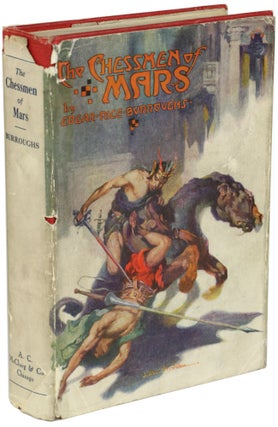
THE CHESSMEN OF MARS.
Chicago: A. C. McClurg & Co., 1922. Octavo, pp. [1-8] 1-375 [376: blank], eight inserted plates with illustrations by J. Allen St. John, eight inserted plates with illustrations by J. Allen St. John, original red cloth, front and spine panels stamped in black. First edition. 12,500 copies printed. Fifth book of the Mars series. [Reference: Bleiler, Science-Fiction: The Early Years 308. Heins CM-1].
![Item #27107 THE MESSENGER [Novelette]. Original handwritten manuscript, corrected throughout in...](https://jwkbooks.cdn.bibliopolis.com/pictures/27107.jpg?width=320&height=427&fit=bounds&auto=webp&v=1614540127)
THE MESSENGER [Novelette]. Original handwritten manuscript, corrected throughout in Chambers' hand. 104 pages, written in pencil on the rectos of ruled paper measuring 32x20 cm. Not dated, but written circa 1896-1897.
A tale by Robert W. Chambers (1865-1933) about the Black Priest, branded on the forehead and executed for treason during the Third Crusade and again 1760, whose skull is disinterred in a gravel pit, and who returns again to haunt the Breton countryside. The story was first published in THE MYSTERY OF CHOICE (1897), Chambers' third collection of short fiction. The published version largely follows the final text of the manuscript which has many deletions and revisions by Chambers. THE MYSTERY OF CHOICE "opens with a trilogy of tales sharing the same characters and set in the Breton countryside. They are reminiscent of 'The Demoiselle D'Ys' in mood and setting ... ['The Messenger'] is an effective treatment of a conventional theme" (Lee Weinstein, Bleiler, ed., SUPERNATURAL FICTION WRITERS II, 743). "By far and away the most powerful ... was 'The Messenger.' This is a long, sometimes rambling story that nevertheless guides the reader along to a most eerie conclusion. The setting -- coastal Brittany -- has seldom been used to such effect, and the historical tale behind the story's events has a grotesque ring of truth. This is one of Chambers' best stories, and its use of the traditional cowled figure has never been bettered" (Hugh Lamb, ed., Chambers, OUT OF THE DARK I, pp. xi-xii). "The Messenger" is "a material-horror story, possibly a little unsubtle, but it does have the characteristics of a nightmare with its disruptions of the time-dimension, interlocked identities, and repetitive fate, which are all novel touches for the period" (Bleiler, ed., Chambers, THE KING IN YELLOW AND OTHER HORROR STORIES, p. xi).

THE QUEEN OF HEARTS ...
London: Hurst & Blackett, Publishers, Successors to Henry Colburn, 13, Great Marlborough Street, 1859. Octavo, three volumes: pp. [1-2] [i] ii-iii [iv] [1] 2-314; [1-2] [1] 2-359 [360: blank]; [1-2] [1] 2-307 [308: blank], original decorated gray green cloth, front and rear panels stamped in blind, spine panels stamped in gold and blind, top edges untrimmed, light yellow coated endpapers. First edition. Collects the title story and "The Ten Days," a group of stories with narrative bridge. "The ten linked stories in THE QUEEN OF HEARTS (1859) show Collins at the height of his powers. Three of the pieces are macabre ['Brother Griffith's Story of Mad Monkton,' 'Brother Morgan's Story of the Dead Hand' and 'Brother Morgan's Story of the Dream Woman'], and two of the three are supernatural." - Bleiler (ed), Supernatural Fiction Writers: Fantasy and Horror, pp. 235-6. These three stories "reveal Collins's technique of grounding his horrors in fact, and domesticating the old ghost-in-a-bedsheet into realistic characters, and the supernatural, or apparently supernatural, elements into everyday phenomena." - Tymn (ed), Horror Literature 2-25. Additionally, the collection includes the classic detective story, "The Biter Bit." [Reference: Bleiler, The Guide to Supernatural Fiction 408. Wilson, Shadows in the Attic, p. 141. See Barron (ed), Horror Literature 2-14. Queen's Quorum 3. Queen, The Detective Short Story, p. 27. Sadleir 603. Wolff 1373].
![Item #24283 TYPED LETTER SIGNED (TLS). 1 page, dated 1 April [19]73, to "Dear Leo & Cylvia" [Leo...](https://jwkbooks.cdn.bibliopolis.com/pictures/24283.jpg?width=320&height=427&fit=bounds&auto=webp&v=1614551310)
TYPED LETTER SIGNED (TLS). 1 page, dated 1 April [19]73, to "Dear Leo & Cylvia" [Leo and Cylvia K. Margulies, editors of Weird Tales Magazine], signed "Harlan." On Ellison's 3484 Coy Drive, Sherman Oaks letterhead.
Cover letter accompanying a short story by Susan Lette which Ellison was recommending for publication in WEIRD TALES. Lette was an amateur writer, but "one of those natural writers whom one spots instantly among the hordes of creative typists and formula hacks who infest out little world." Her first story, Merari," was to be published that summer in COSMOPOLITAN; her second was to be published in Ellison's anthology, LAST DANGEROUS VISIONS. The present story, "Timmy," represented her third. Ellison says reading it raised the nape hairs on the back of his neck and reminded him of Bradbury's "Small Assassin." He notes that she was living in somewhat straitened circumstances and had an autistic child. Leo Margulies was an editor and publisher who had been working in the field since 1932, when he joined the Frank Munsey chain of pulps. Ellison was "... the most controversial and among the finest of those writers associated with sf whose careers began in the 1950s. He was born and raised in Ohio, attending Ohio State University for 18 months before being asked to leave, one of the reasons for his dismissal being rudeness to a creative-writing professor who told him he had no talent." - Clute and Nicholls (eds), The Encyclopedia of Science Fiction (1993), p. 376.
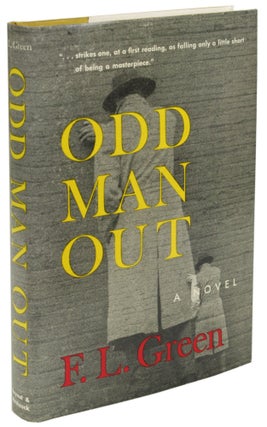
ODD MAN OUT.
New York: Reynal & Hitchcock, [1947]. Octavo, cloth. First U.S. edition. Novel of a wounded IRA man. Filmed in 1947 with James Mason, also released as Gang War. Filmed again in 1969 as The Lost Man with Sidney Poitier.

METROPOLIS. ROMAN.
Berlin: August Scherl G.m.b.H., [1926]. Octavo, pp. [1-8] 9-273 [274] [275: blank] [276-280: ads], three-quarter brick red leather and patterned boards, gilt decorated spine with gilt lettered and ruled tan leather spine label. First edition. Rare publishers deluxe binding. Anti-utopia set in a gigantic city in the year 2000 "where capitalists oppress a mass of proletarian helots." - Fisher, p. 128. A restitution fantasy in which a patriarchal order is ultimately reestablished. The Fritz Lang movie adaptation had a mythic scale that would not be challenged -- "The Shape of Things to Come" aside -- for decades to come. [Reference: Anatomy of Wonder (1976) 3-23; (1981) 2-112; (1987) 2-123; (1995) 2-132; and (2004) II-1197. Bleiler, Science-Fiction: The Early Years 1040. Fisher, Fantasy and Politics: Visions of the Future in the Weimar Republic, pp. 126-37; 139-42. Lewis, Utopian Literature, p. 198. Survey of Science Fiction Literature III, pp. 1383-86. Lexikon 2, pp. 134-6. Bloch (2002) 1370. Nagl, p. 256].
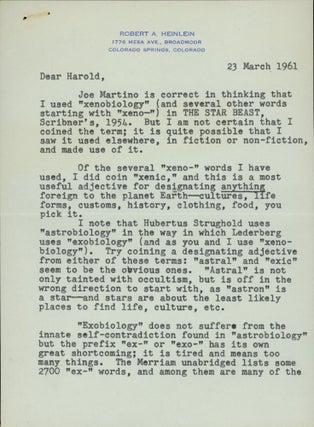
TWO TYPEWRITTEN LETTERS SIGNED (TLsS), two pages, dated 23 March 1961 and one page, dated 26 November 1961, both written on his Colorado Springs, Colorado stationery, from Heinlein to "Dear Harold" [Wooster], both signed "Bob," 1 TYPEWRITTEN LETTER SIGNED (TLS), one page, dated 12 July 1963, on ANALOG letterhead, from Campbell to "Dear Mr. Wooster," signed John W. Campbell, plus carbons of Wooster's letters to Heinlein and Graham DuShane, editor of SCIENCE.
The correspondence relates to an article Dr. Wooster wrote on the coining of the word "xenobiology" (the study of the biology of alien life-forms) generally credited to Heinlein for use in "Star Lummox" (F&SF, May-July 1954; STAR BEAST, Scribner's 1954), which incorporates his correspondence with Heinlein, published in SCIENCE 134: 3473 (July 1961) 223-225. Harold Abbott Wooster (1919-2005) was the chief of the information sciences division of the Air Force Office of Scientific Research in the 1960s, a computer pioneer "whose decades-long career in information science influenced the development of computer technology and medical television ... He left the Air Force's scientific research office, which considered him a pioneer in the information science field, in 1970. From 1970 to 1984, Dr. Wooster worked at the National Library of Medicine's Lister Hill Center for Biomedical Communications. He supervised experiments using television to connect patients in remote areas to doctors" (Washington Post obit 3 June 2005). Dr. Wooster published a single SF story, "Y + Sin X," ASTOUNDING (September 1943). [Reference: See Patterson, William H., Robert A. Heinlein, Volume 2, p. 211].
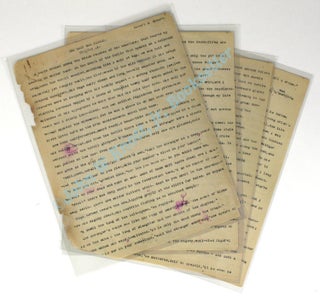
"THE GREY GOD PASSES" TYPED MANUSCRIPT (TMs). 36 leaves. Not dated, circa 1930-31.
Original typed manuscript for the story which was not published during Howard's lifetime. In a letter of provenance from Glenn Lord he states "Originally written as a straight historical entitled "Spears of Clontarf" the story was submitted to Clayton Magazines on June 1, 1930..." Rejected by Clayton, Howard re-wrote the story into its present form and submitted it to Farnsworth Wright at Weird Tales who rejected it in December of 1931. (The rejection letter accompanies the manuscript). It stayed in Howard's files until after his death when August Derleth purchased the rights from literary agent Oscar J. Friend. He published the story in the anthology DARK MIND, DARK HEART (1962). The story occurs during the historical Battle of Clontarf which took place in the early 11th Century involving Brian Boru, High King of Ireland against the Vikings. Howard's main characters are Turlogh Dubh O'Brien and an ex-slave named Conn. "The core of the story, as indicated by the title, is the end of the influence of supernatural beings from our world with the victory of Christian King Brian over the heathen Vikings. Among the Irish dead is a fey prince whose own death will cause the death of his fairy lover, a metaphor for the waning away of all the Sidhe. Odin himself makes an impressive and doomful appearance, making the battle a Götterdämmerung. This is more Wagnerian in tone than the utter end of the world predicted for Ragnarök, though it is indeed the end of a world." - Wikipedia entry.
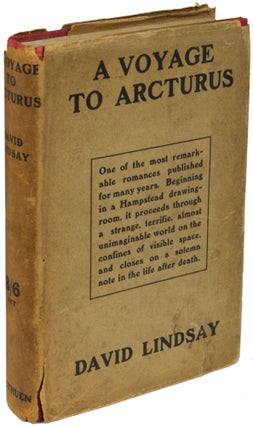
A VOYAGE TO ARCTURUS.
London: Methuen & Co. Ltd., [1920]. Octavo, pp. [1-8] [1] 2-303 [304: printer's imprint]. + 8-page undated publisher's catalogue inserted at rear, original red cloth, spine panel stamped in gold, front cover stamped in blind. First edition. 1250 copies printed of which this is one of 500 to 600 in the first issue binding. Lindsay's masterpiece. "Lindsay's A VOYAGE TO ARCTURUS is one of the most extraordinary works of literature, let alone fantasy, ever written. In form and in some of its symbolic techniques it is highly indebted to the work of George MacDonald: but for sheer inventiveness and intensity of imagination its burns like some literary supernova." - Colin Greenland, Scottish Fantasy Literature, p. 153. "A classic allegorical romance in which the landscapes and inhabitants of the planet Tormance provide an externalization of the moral and metaphysical questions that preoccupied the author. Its incarnate theological system influenced Lewis's OUT OF THE SILENT PLANET (1938), and it also bears some similarity to George Macdonald's LILITH (1895), although it is very much a work sui generis." - Anatomy of Wonder (1995) 2-72. "Some of the imagery is borrowed from Norse mythology (Surtur and Muspel) but the metaphysics that is gradually elaborated is basically a transformed evolutionary theory that applies a harsh metaphorical Darwinism to the business of personal intellectual development. A masterpiece, unparalleled in its graphic imagery and in its ambition." - Barron (ed), Fantasy and Horror (1999) 5-184. "VOYAGE ... has become one of the most widely discussed and debated fantasies of the twentieth century, and it is well on its way to becoming one of the most influential." - Survey of Modern Fantasy Literature IV, pp. 2039-45. [Reference: Anatomy of Wonder (1987) 2-63 and (2004) II-673. Barron (ed), Fantasy Literature 3-221. Bleiler, The Guide to Supernatural Fiction 1019. Cawthorn and Moorcock, Fantasy: The 100 Best Books 31. Clareson, Science Fiction in America, 1870s-1930s 509. Locke, A Spectrum of Fantasy, p. 140. Negley, Utopian Literature: A Bibliography 693. Schlobin, The Literature of Fantasy 666. Survey of Science Fiction Literature V, pp. 2383-88. Tymn (ed), Fantasy Literature, p. 127. Bleiler (1978), p. 124. Reginald 09074].

THE QUAKER CITY; OR, THE MONKS OF MONK-HALL. A ROMANCE OF PHILADELPHIA LIFE, MYSTERY AND CRIME ...
Philadelphia: Published by the Author, and for Sale by All Booksellers, 1845. Small quarto, pp. [1] 2-494 [note: pages 5-314 are printed in double columns; pages 315-494 printed in a single column], inserted engraved frontispiece and engraved title leaf, mid-nineteenth century three-quarter pebbled calf and marbled boards, spine panel titled and ruled in gold, all edges marbled. First complete edition. A bibliographically complex book. Supposedly first published in ten paper-covered parts, but no complete set of parts published by G. B. Zieber exists. Examples of seven parts do exist. They are printed in double columns and paginated consecutively up to page 314. The following 180 pages of the published complete book are set in a single column and apparently had no previous parts publication. The edition in parts is dated 1844 on the title page, but a contract dated 31 March 1845 between Lippard and publisher G. B. Zieber indicates that Lippard was still writing the book. Before 5 May 1845 (the date of Lippard's introduction to this edition, which is also is copyright 1845), Lippard bought the existing plates and copyrights and commenced to reprint the book under his own name. According to Lippard, this edition was published in ten paper-covered parts and this copy appears to be bound from parts (evidence includes a bit of a blue wrapper adhered to the blind side of the frontispiece). Several one and two volume reprint editions were published by Lippard before Peterson of Philadelphia began publishing and reprinting his works in the 1840s. "... a handbook for Gothicism in all its most exaggerated forms." - Tymn (ed), Horror Literature 2-66. "Sensational expose novel in the manner of the French feuillleton novels (Sue and Hugo) and British counterparts. Crime and supernaturalism in early 19th century Philadelphia." - Bleiler, Guide to Supernatural Fiction 1027. "Lippard's sensational Philadelphia Gothic was first serialized in 1844-1845 and stands as a lurid example of the American Gothic spirit of the 1840s. Lippard allures and holds his readers by every repulsive means available. The result is a Gothic farrago of the Philadelphia underworld comparable to Victorian pulp Gothics. Monk Hall itself is an updated version of the infernal subterranean of the castle or abbey. Teeming with malicious creatures of every type and presided over by a crippled monster called Devilbug. Monk Hall also has a Gothic maiden-in-residence, Mabel Pyne. The plottings of Devilbug provide the occasion for live burials, necrophiliac love affairs, necromancy, satanic ritual, and other depravities embellished with nauseating scenes of Lippard's own. E. F. Bleiler's comment on the American Gothic extravaganza is severe but accurate: the novel is 'amusing in small doses, disgusting in large.' This judgment applies equally to Lippard's other Gothic endeavors, THE LADYE ANABEL; OR, THE DOOM OF THE POISONER (1844) and THE ENTRANCED; OR, THE WANDERER OF EIGHTEEN CENTURIES (1849)." - Frederick S. Frank, Barron (ed), Fantasy and Horror (1999) 1-95. [Reference: Wright (I) 1689. BAL 11773. Roger Butterfield, "Lippard and His Secret Brotherhood," The Pennsylvania Magazine of History and Biography, July 1955, pp. 285-309].
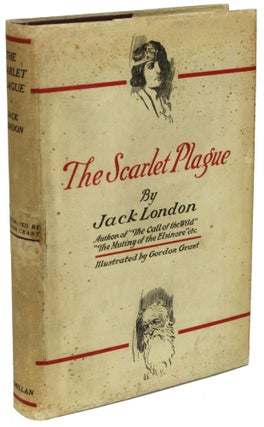
THE SCARLET PLAGUE ...
New York: The Macmillan Company, 1915. Octavo, pp. [1-8] 9 [10] 11-181 [182: blank] [183-188: ads] [189-192: blank] [note: last two leaves are blanks], illustrations by Gordon Grant, original pictorial red-brown cloth, front panel stamped in orange and yellow, spine panel stamped in orange, yellow and gold, fore and bottom edges rough trimmed, decorated endpapers. First published edition, preceded by a copyright printing. A world catastrophe novel in the tradition of Mary Shelley's THE LAST MAN (1826) and M. P. Shiel's THE PURPLE CLOUD (1901). "Undoubtedly London's best fantastic story, told with considerable artistry and with less tub-thumping and breast-beating than usual." - Bleiler, Science-Fiction: The Early Years 1358. [Reference: Anatomy of Wonder (1976) 2-109; (1981) 1-118; (1887) 1-60; (1995) 1-60. Clareson, Science Fiction in America, 1870s-1930s 517. Locke, A Spectrum of Fantasy, p. 142. Bleiler (1978), p. 126. Reginald 09150. BAL 11960. Baird and Greenwood, An Annotated Bibliography of California Fiction 1664-1970 1543].

THE HOUNDS OF TINDALOS.
Sauk City, Wisconsin: Arkham House, 1946. Octavo, cloth. First edition. 2602 copies printed. Signed on the front free endpaper by Long. The author's first book of fiction. Twenty-one stories, most first published in WEIRD TALES, UNKNOWN WORLDS and other pulps between 1924 and 1944. [Reference: Barron (ed), Horror Literature 3-131. Bleiler, The Guide to Supernatural Fiction 1034. Tymn (ed), Horror Literature 4-154].
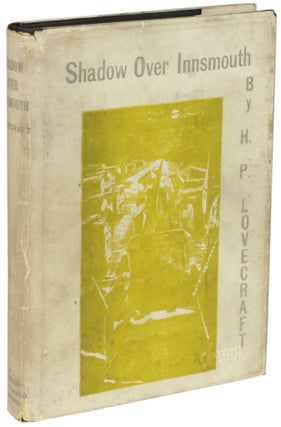
THE SHADOW OVER INNSMOUTH ...
Everett, Pennsylvania: Visionary Publishing Co., 1936. Octavo, pp. [1-16: blank] [1-12] 13-158 [159-176: blank] [note: first and last leaves are used as front and rear paste-downs], illustrations by Frank A. Utpatel, original black cloth, front and spine panels stamped in silver. First edition. An early copy with four leaves in signature 3 reversed and bound out of sequence: 69-72; 45-68; 41-44. As these books were bound by hand, this is probably a binding error, not a printing error. Of two known bindings, this copy has title on front panel stamped in upper and lower case letters. Lovecraft's first published book, preceded by THE SHUNNED HOUSE (1928) that was printed, but not circulated beyond a tiny circle of Lovecraft's friends. Publisher William H. Crawford has stated that approximately 400 copies were printed, of which about 200 were bound, the remainder supposedly destroyed at a later date. Binding and typography were wretched and a handful of the earliest copies had corrections in Lovecraft's hand. The errata leaf and printed dust jacket, prepared after publication according to Crawford, accompany this copy. The errata leaf has numerous additions in Lovecraft's hand. The dust jacket is Currey's variant 2 (no priority established) with lettering in silver and yellow-green illustration. "A fine story of supernatural adventure and discovery, despite the unfortunate surprise ending which does much to spoil what went on before." - Bleiler, The Guide to Supernatural Fiction 1039. [Reference: Sullivan (ed), The Penguin Encyclopedia of Horror and the Supernatural, p. 272. Survey of Modern Fantasy Literature IV, pp. 1624-26. In 333. See Barron (ed), Horror Literature 3-132. See Tymn (ed), Horror Literature 4-160. Bleiler (1978), p. 127. Reginald 09259. Joshi I-A-11].
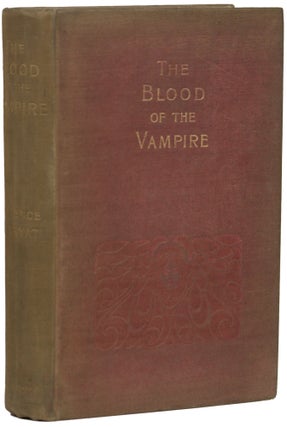
THE BLOOD OF THE VAMPIRE.
London: Hutchinson & Co., 1897. Octavo, pp. [1-4] 1-345 [346-348: ads], publisher's pictorial reddish brown cloth, front panel stamped in gold and blind, spine panel stamped in gold. First edition. The alleged vampire is 21-year-old Harriet Brandt. The 'blood' of the title is metonomous for 'heredity,' and refers to the rumor that Harriet’s grandmother, a Jamaican slave, was bitten by a vampire bat while pregnant with Harriet’s mother. Thus, the novel takes on as its central theme the power of heredity versus that of later nurturing and free will. It poses the question: is Harriet, despite her many charms and good intentions, tainted irredeemably with the blood of the vampire? She inherits bad blood also from her father, an Englishman who had been kicked out of medical school in Switzerland for unauthorized and deadly experiments in vivisection. He moved to Jamaica, a wealthy and unscrupulous man, and continued his experiments on animals - and on the slaves, as well. He impregnated, but did not marry, a sadistic and gluttonous half-caste who practiced obeah, according to the slaves. Harriet does indeed seem to be a psychic vampire, though against her own will. People who get close to her die, including children and her husband, and she eventually commits suicide in despair. A sophisticated variation on traditional vampire motifs, which found expression that same year, more famously, in DRACULA." [Reference: Bleiler (1978), p. 133. Reginald 09684. Not in Locke, A Spectrum of Fantasy I-III. Not in the Eaton catalogue].
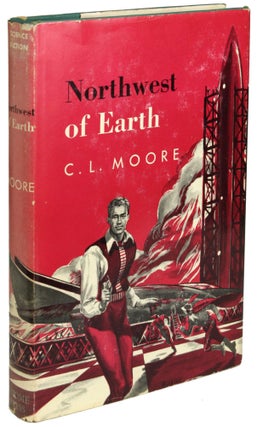
NORTHWEST OF EARTH.
New York: Gnome Press, Inc., Publishers, [1954]. Octavo, boards. First edition. Presentation copy with signed inscription by Moore on front free endpaper: "For Jean & Julie Schwartz / with the best wishes of / C.L. Moore." Very nice association from a fine writer to an important editor, agent and fan in the field of science fiction. Julie Schwartz was a fanzine publisher (along with close friend Mort Weisinger), opened the first literary agency to specialize in SF authors (also with Weisinger) and later became an editor at DC comics and played a major role in the revival of their super-hero line in the late 1950s. Collects seven stories, five featuring Northwest Smith and two with Jirel of Joiry. All first published in Weird Tales magazine. The Jirel stories are notable as being pulp fiction's first sword-and-sorcery Amazonian warrior. [Reference: Bleiler, The Guide to Supernatural Fiction 1191. Schlobin, The Literature of Fantasy 793].

THE NARRATIVE OF ARTHUR GORDON PYM. OF NANTUCKET ...
New-York: Harper & Brothers, 1838. Octavo, pp. [1]-2 [leaf of ads dated "May, 1838"] [iii-v] vi-vii [viii] [9] 10-201 [202: blank] [1]-14 [ads], fly leaf at front, original pebble grain blue muslin, printed paper label affixed to spine panel, untrimmed. First edition. Poe's first prose book and his only book-length work of fiction, one of the nineteenth century's most fantastic short novels. "A novel of horrendous sea adventure, followed by extraordinary experiences in the Antarctic ... Critically, Pym has generally been held in low esteem, but this is probably because of the full-blown sensation approach of the first part of the novel, which retails more horrors in one short voyage than would have taken place in a sailor's lifetime or more. But considered within the aesthetics of BLACKWOOD'S, it is a fine achievement. As for the second, puzzle section, it remains successfully puzzling after a century and a half." - Bleiler, Science-Fiction: The Early Years 1784. "Clearly, THE NARRATIVE OF ARTHUR GORDON PYM has exerted a powerful influence on its readers, and its entrancing ending in particular has aroused considerable interest. The novel has become a frequent subject for scholarly debate and a rich source for numerous literary and artistic endeavors, and in the last twenty-five years, it has come to be recognized as a masterpiece." - Survey of Modern Fantasy Literature III, pp. 1092-95. [Reference: Anatomy of Wonder (1976) 1-41; (1981) 1-138; (1987) 1-74; (1995) 1-74: and (2004) II-857. Bailey, Pilgrims Through Space and Time, pp. 43-4. Barron (ed), Horror Literature 2-76. Bleiler, The Guide to Supernatural Fiction 1313. Bleiler (ed), Science Fiction Writers, pp. 15-7. Survey of Science Fiction Literature III, pp. 1480-87. Tymn (ed), Horror Literature 2-78. Bleiler (1978), p. 159. Reginald 11610. BAL 16128. Wright (I) 2052. Heartman and Canny, pp. 38-40].
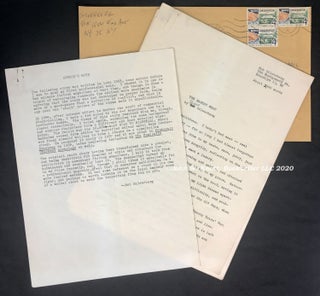
"The Rarest Meat." Typed manuscript (TMs).
9 leaves, plus cover sheet headed "Author's Note." An early unpublished short story by Silverberg that was the basis for "Road to Nightfall." According to Silverberg, this "story was written in late 1953, some months before I was to make my first professional sale. I showed it to one or two science fiction magazines at that time, and though it drew a couple of encouraging comments the editors were unanimous in agreeing that the story was not developed in proper form, being more of a mood-piece than a narrative of conflict, and that in any case the 'shock' nature of the theme made it unpublishable. In 1954, after intense effort to master the craft of commercial storytelling, I made a few sales to the SF magazines and to a hardcover house. The theme of this story remained with me, though, almost obsessively. I tried again, examining the same background and similar characters from a different and more detailed viewpoint. The result was the 10,000-word "Road to Nightfall," which wandered around from editor to horrified editor until Hans Santesson found himself willing to take a chance on a cannibalism story. He accepted it early in 1957 and it saw print in FANTASTIC UNIVERSE in 1958 ..." "Road to Nightfall," written as early as 1954 but not published until 1958, depicts a ruined America where survivors are reduced to cannibalism. It is "an important early example of the dark vision the permeated Silverberg's later fiction" (Clareson, Robert Silverberg, pp. 15-6).
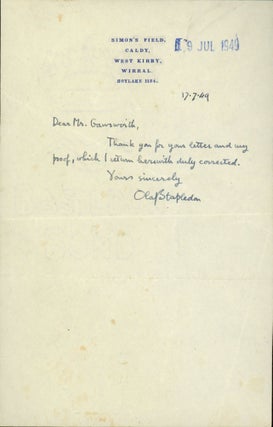
"Conflict of Wisdom." Typed Manuscript (TMs).
10 leaves, plus cover sheet. Corrected throughout in Stapledon's hand with amendments, additions, and strikeouts. At the top edge of the cover sheet Gawsworth has written: "Published by me / when editing ENQUIRY / (1949) / John Gawsworth." Accompanied by a handwritten note (ANS) from Stapledon to Gawsworth dated 17 July 1949 returning a corrected proof of the essay. The essay, published in ENQUIRY, August 1949, addresses the "need both for fidelity to the spirit and agnosticism about the ultimate ends of the universe." - Satty and Smith C190. William Olaf Stapledon (1886-1950) "is best remembered for the extraordinary works of speculative fiction published between 1930 and 1950. As a novelist, he was known as the spokesman for the Age of Einstein and has influenced writers as diverse as Virginia Woolf, Arthur C. Clarke, and Doris Lessing ... Stapledon's novels -- LAST AND FIRST MEN (1930), ODD JOHN (1935), STAR MAKER (1937), and SIRIUS (1944) -- have gathered a passionate following, and they have seldom been out of print in the last twenty-five years ... In his social activism as in his fiction, Stapledon embodied many of the of modern era's anxieties and hopes that allow his works to continue to speak to and for the future." - Robert Crossley.
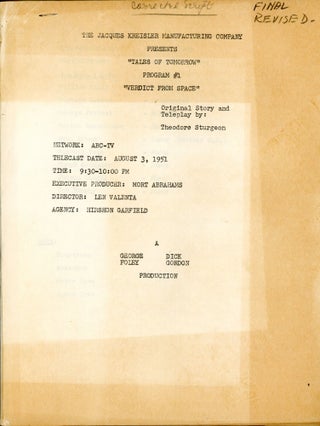
THE JACQUES KREISLER MANUFACTURING COMPANY PRESENTS "TALES OF TOMORROW" PROGRAM #1 "VERDICT FROM SPACE" ORIGINAL STORY AND TELEPLAY BY: THEODORE STURGEON. NETWORK: ABC-TV. TELECAST DATE: AUGUST 3, 1951 ...
[New York]: A George Foley / Dick Gordon Production, 1951. Mimeographed TV script, heavily corrected throughout in pencil. The cover page is marked "Corrected Script" and "FINAL REVISED" in pencil at the top of the sheet. The script is complete and includes cast and crew lists, rehearsal schedule, and inserts on blue paper stock for the commercials that ran during the program. The series, produced by George Foley and Dick Gordon, was performed and broadcast live on ABC-TV from 1951 to 1953. It ran for 85 episodes. The series, originally called Tomorrow is Yours, was developed by Theodore Sturgeon, the series story editor, and Mort Abrahams, the program's executive producer. Tales of Tomorrow was one of the earliest and most successful SF anthology television series. It was ambitious but, like most television of the period, limited by the restrictions imposed by live studio shooting. At a time when most SF on TV was targeted to children, Tales of Tomorrow was intended for adults. It drew its material from a variety of sources, including the SF pulp magazines, as well as using original scripts. "Verdict from Space" is Sturgeon's adaptation of his short story "The Sky Was Full of Ships" which was first published in THRILLING WONDER STORIES, June 1947.

THE FOUR STRENGTHS OF SHADOW.
Money Creek [MN]: Sutton Hoo Press, 2013. Octavo, light blue cloth with three quarter marble board front cover, fore and bottom edge uncut, top edge rough cut. First edition. Signed by Weighell. This book was limited to one hundred copies, however only fifty copies of the sheets were actually bound by the publisher, of which only 22 were made available for public sale. An antiquarian ghost story written specifically for this publisher. Summers, a scholar, comes to Venice to research the life of Sigisomondo Mortensa, the 16th-century architect who designed the Church of Saint Bartholomew. As he studies the marginalia in various books in Mortensa’s library, Summers uncovers the horrific truth about Mortensa’s relationship with Antonio Borsini, a young apprentice who vanished mysteriously during the church's construction after being publicly denounced for his participation in blasphemous activities.
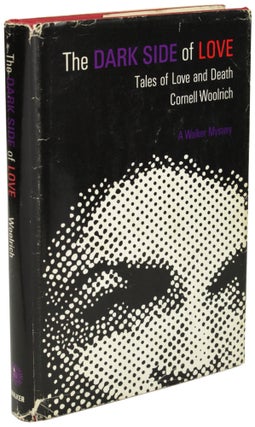
THE DARK SIDE OF LOVE: TALES OF LOVE AND DEATH.
New York: Walker and Company, [1965]. Octavo, boards. First edition. Signed inscription by Woolrich on the front end paper: "To Ethel & Karl Paley / Sincerely, / Cornell Woolrich." As with all Woolrich books, scarce signed, especially so as the author was quite reclusive and this title is one of the last two published during his lifetime (he died in 1968).
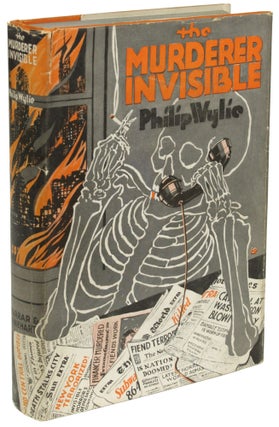
THE MURDERER INVISIBLE.
New York: Farrar & Rinehart Incorporated, Publishers, [1931]. Octavo, pp. [1-6] [1-2] 3-314, original orange cloth stamped in dark blue. First edition. Mystery and science fiction novel of a man who can turn himself invisible and seeks to rule the world. Wylie freely admits indebtedness to Wells' novel The Invisible Man (which Wylie, unaccredited, helped write the screenplay for the 1933 film). [Reference: Clareson, Science Fiction in America, 1870s-1930s 835. In 333. Bleiler (1978), p. 213. Reginald 15693. Hubin (1994) p. 882].