
Selections for RBMS June, 2025
RBMS conference June, 2025
A focus on popular fiction with selection of interesting material relating to our areas of focus. Included in the list are a number of bound sets of pulp magazines, several that would be ideal for institutions. The first three which Weird Tales, Strange Tales and Strange Stories represent the major portion of weird fiction published in magazine format before the end of World War II, with Weird Tales extend a number of years beyond. Major genre authors contributed here, H. P. Lovecraft, Clark Ashton Smith, Robert E. Howard, Robert Bloch, Ray Bradbury, Fritz Leiber, C. L. Moore, Edmond Hamilton and many others. We also have a complete file of Doc Savage in bound volumes. Also featuring a wide range of pulp magazine, books, and amateur magazines.
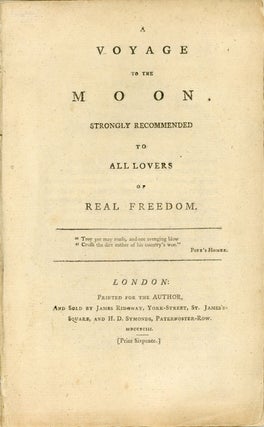
A VOYAGE TO THE MOON, STRONGLY RECOMMENDED TO ALL LOVERS OF REAL FREEDOM ...
London: Printed for the Author, and Sold by James Ridgway, York-Street, St. James-Square, and H. D. Symonds, Paternoster-Row, 1793. Octavo, pp. [1-4] [1] 2-39 [40: blank], disbound. First edition. A voyage by Balloon to the Moon. "Dystopia on the Moon -- allegory about contemporary England." - Sargent, British and American Utopian Literature, 1516-1985 (1988), p. 31. [Reference: Howgego, Encyclopedia of Exploration: Invented and Apocryphal Narratives of Travel A19. Locke, Voyages in Space (2011) V91. Negley, Utopian Literature 1153. Bleiler (1978), p. 9. Reginald 00468. Not in Locke, Spectrum I-III].
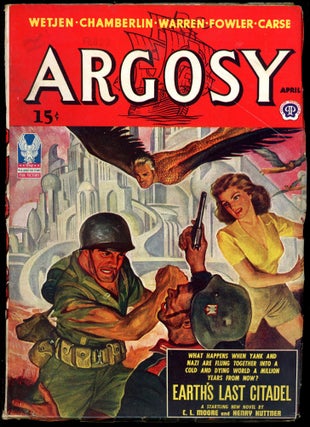
ARGOSY.
Chicago: Popular Publications, 1943. Octavo, single issue, cover by Rafael DeSoto, pictorial wrappers. Pulp Magazine. Includes part one of "Earth's Last Citadel" by C. L. Moore and Henry Kuttner. Interior illustration by Virgil Finlay.

THREE TYPED LETTERS SIGNED (TLsS). Each 1 page, dated 21 July 1962, 23 April 1966 and 25 April 1966, all to "Reg" [Reginald Bretnor], each signed "Isaac."
Three letters to SF writer and critic Reginald Bretnor (1911-1992), the first devoted to Ferdinand Feghoot, a popular intergalactic punster invented by Bretnor, many published under his pseudonym Grendel Briarton in THE MAGAZINE OF FANTASY AND SCIENCE FICTION. (For the uninitiated, Feghoots are short, short joke stories with the punch line a terrible pun.) Asimov sketches out an "idea" for a Feghoot, "without attempting to put it into literary form, so that you can do that part in your own inimitable fashion." Asimov's two other letters concern the reprint fee offered by Doubleday for a short story by Bretnor that Asimov selected for an anthology he is compiling. "As you guessed, Doubleday handled the matter, not I, but as I said in my previous letter, they meant no harm and there was much consternation in the Doubleday offices, partly because they are really a very nice, and very ethical publishing house - honest - and partly because they were afraid I would be upset - and so I was. Anyway, please let me know what you want done, in line with my suggestion in my previous letter (mailed yesterday afternoon)."
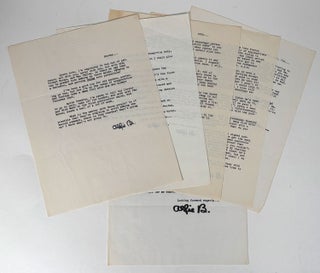
SIX TYPED LETTERS SIGNED (TLsS) and TWO TYPED NOTES SIGNED (TNsS), all undated [circa late 1970s and early 1980s], without salutations [all to Kirby McCauley except one, to Kay McCauley], all signed either "Alfie B." or "Alfie Bester." The notes are on plain postcards, the letters are on letter-size typing paper, three of them with embossed return address (Ottsville, Pa.) at top.
An endearing and amusing file of letters from the author of THE DEMOLISHED MAN (1953) and TIGER! TIGER! (1956), two of the "few genuine classics of genre sf" (Clute and Nicholls, The Encyclopedia of Science Fiction, p. 113). The letters were written towards the end of his career and reveal a man of warmth, generosity, high spirits, quick temper, and, in his persistent refusal to date any of his letters, a rebellion against convention, trivial in itself but perhaps suggestive of a deeper alienation. Bester, a Jewish kid from New York City, went to the University of Pennsylvania and settled in Bucks County. He began writing sf short stories in his twenties, then worked for DC comics, wrote scripts for radio and TV and edited Holiday magazine for many years. Science fiction occupied only part of his literary career and his best work was done in the 1950s and early 1960s, though some of his stories from both before and after this period are among his best, which is to say, among the best that has been done in the genre. He wrote three other sf novels, two of them (THE COMPUTER CONNECTION and GOLEM-100) with glints of the old genius. (1) TNS, postcard, no salutation, undated. Complaining about the lack of progress from Byron Preiss on a project to turn THE STARS MY DESTINATION (the U.S. title of TIGER! TIGER!) into a comic book. "… this Byron Preiss character has sent me nothing on THE STARS, as he promised. Instead he sent me a copy of his version of the Zelazny stories…I don't at all like what he's done with Zelazny; it's cheap and fifth-rate and we would have rejected it at D-C Comics." Closes with, "They're cleaning my hot water coil with HCl. Little else remains to be told." Fine. (2) TNS, postcard, no salutation, undated but postmarked 10 March 1978. Begins, "Kirby, my beauty, do exactly as you think best with TENDER, LOVING RAPE. You must know by now that I have ample reason for trusting your judgment." This mainstream novel, set in the milieu of New York advertising and television in 1959, was written around 1970 and not published until 1991 (posthumously), under the title TENDER LOVING RAGE. Fine. (3) TLS, half-page, no salutation, dated "Monday…" Complaining about delays in the publication of GOLEM-100, the science fiction novel that Bester considered his best. "Kirby, love, I'm beginning to run out of patience; not with you, never with you, but with S&S, Pocket Books, and Mac Talley…. Quite frankly, I'm ready to tell our locals to go to hell, take off for London, and work with Pan and Nick Webb on the first publication which, God knows, needs a hell of a lot of work." The novel was published by Simon & Schuster in 1980. Faint mailing creases, fine. (4) TLS, half-page, no salutation, undated, to Kirby's sister and fellow-agent Kay Kirby. "Enclosed, the lunatic story about the psychiatric hockshop. You'll see that it's the first of a possible series … but it's so wild that I'm scared and beg you both for a frank, honest and, as my dentist used to say, bruteless appraisal." Closes with brief enumeration of some upcoming tasks, "… have my hair cut for Good Friday, and then back to that goddamn Praying Mantis novel. I kiss your libido…" Several creases at edges, short closed tear at top edge, very good. (5) TLS, half-page, no salutation, dated "28th…" Mentions some business details about the manuscript of TENDER, LOVING RAPE (see item #2 above), then kvetches about the creative turmoil attendant on his writing of GOLEM-100. "It's hell when your demon requires you to top yourself constantly. I keep hoping that another eighty pages of knock-outs and the book will award me the decision." Then it's the cold weather. "We're having another Glacial Epoch down here in Bucks and I have a vision of future scientists discovering my Opel GT frozen like a Mastodon in a bog, probably with me inside it, shopping list in hand. '1100110011! 1100001!' they'll exclaim in the language of the future. 'It still runs!' But they'll never be able to decipher my shopping list. Kisses and pinches …" Faint mailing creases, minor creases at edges, a thin irregular strip of faint darkening along upper left margin, very good or better, overall. (6) TLS, 1 page, no salutation, undated, with return address on sticker attached to lower left corner. Another complaint about the lack of progress made by "this Preiss character" on a project to adapt THE STARS MY DESTINATION to comic book (see item #1 above). "He talks real slick and is full of explanations and excuses…He doesn't have a completed script or even a page and panel outline. He doesn't have anything except a vague thirty pages which, apparently, he sold to some publication….I think he's been trying to sell the book before he starts real work on it…. Thirty pages in fourteen months? Jeez! I do thirty pages, including art, in fourteen days." Asks Kirby for advice on how to handle the situation. "Forgive the long letter but I'm so busy with the completion of GOLEM-100 that I didn't have time to write a short one." Faint mailing creases, fine. (7) TLS, half-page, no salutation, dated "Tuesday, Dec. 5th…" Accepting invitation to speak at an upcoming convention. "You must know by now that my attitude toward conventions is to make myself available at all times for all purposes and for all people. I'm no Robert Heinlein, hiding in austere and megalomaniac seclusion. I'm in the entertainment business. Don't worry about money. I'll pay my own way with pleasure. All you'll have to do is reserve real nitzy [ritzy?] accommodations for me and my redhead, and I'll pick up the tab." Announces that GOLEM-100 should be published by the time of the convention, and that Pocket Books wants to title it, "PSYLOCK." Faint mailing creases and several light creases elsewhere, near fine. (8) TLS, top carbon, half-page, no salutation, but with "my dear Mal" in first sentence [probably to UK editor Malcolm Edwards, with this copy to Kirby McCauley], dated "9th…" Concerning plans for an upcoming convention, SEACON '79 (and complaining about a new electric typewriter). "I do not come to a convention for an ego trip; I come to do the damn best P. R. job that I can…. You may count on me for anything; speeches, panels, moderating, last minute off-the-cuff appearances, stand-ins for scheduled people who've dropped out…. I enjoy chatting privately with my colleagues which is why I've asked you to reserve the damn best suite [available] (see item #7 above)…" Doesn't mind giving "a small bash for selected fans … but you guys will have to provide the booze for them." Faint mailing creases, fine. Kirby McCauley was probably the most important literary agent of horror, fantasy and sf writers in the boom years of the 1970s and 1980s.
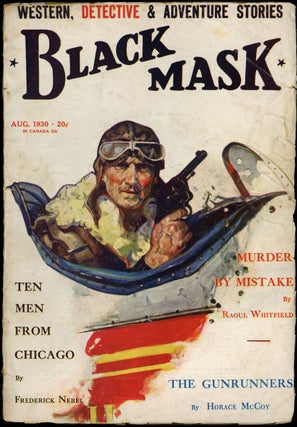
BLACK MASK.
New York: Pro-Distributors Publishing Company, Inc., 1930. Octavo, single issue, cover by Schlaikjer, pictorial wrappers. Pulp magazine. Includes Raoul Whitfield, Horace McCoy, Frederick Nebel, Carroll John Daly and others. [Reference: Cook, Mystery, Detective and Espionage Magazine, pp. 62-68].
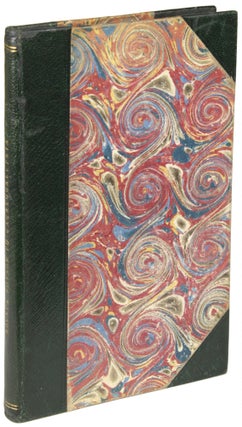
A VOYAGE TO CACKLOGALLINIA: WITH A DESCRIPTION OF THE RELIGION, POLICY, CUSTOMS AND MANNERS OF THAT COUNTRY ...
London: Printed by J. Watson in Black-Fryers, and sold by the Booksellers of London and Westminster, 1727. Octavo, pp. [1-2] [1] 2-167 [168: blank], engraved frontispiece, engraved tailpiece on page 121, later three-quarter green pebbled morocco and marbled boards, titled on spine in gold. First edition. Satire in the manner of Swift's GULLIVER'S TRAVELS in which the narrator finds himself shipwrecked in a land populated by a society of fowls. "A VOYAGE TO CACKLOGALLINIA, written by Captain Samuel Brunt and printed at London London in 1727, is one of the most imaginative, thoughtful, and subtly satirical works in the imaginary voyages genre. The author is a slave-trader who at the start of his narrative is captured on Jamaica by runaway slaves under their leader, a certain Captain Thomas. His shipmates having been decapitated, Brunt is taken to the slaves' village in the mountains and treated with kindness and hospitality. When the village is raided by the English and most of its population murdered, Brunt escapes with a friendly slave in a commandeered fishing vessel with the intention of reaching Cuba or Hispaniola. En route the vessel is captured by pirates, but, after further adventures, the pirate sloop breaks up in a storm and Brunt finds himself shipwrecked on an unknown island, Cacklogallinia, populated by a community of talking chickens. Its capital is Ludbitallya, and the island is ruled by the Emperor Hippomina Connuferento. Although at first regarded as a curiosity, Brunt (or Probusomo as he comes to be called) is befriended by the chief minister and rises to the rank of 'castleairiano, or, 'examiner of projects to raise taxes.' Brunt's description of the community is a fairly conventional satire on English life and Walpole's government, but the author enhances this with a parody of the South Sea Bubble, the speculative trading venture that burst in 1721, by involving Brunt in a project to finance a Cacklogallinian expedition to the Moon. Borrowing from Godwin's THE MAN IN THE MOONE, the hero is projected skyward in a palanquin borne by several of the flying chickens. However, rather than finding a trading paradise on the Moon, the Cacklogallinians discover a peaceful world populated by the souls of humans with a disregard for wealth and power, causing Brunt and his chicken entourage to reflect on the folly of their own societies. Anxious to return to his home country, and with the aid of a compass, Brunt descends from the Moon directly into the Blue Mountains of Jamaica, makes his way to Kingston, and there acquires a free passage to England." - Howgego, Encyclopedia of Exploration: Invented and Apocryphal Narratives of Travel B60. "Nearly a hundred years elapsed between Godwin's THE MAN IN THE MOONE and the only other full-length English moon voyage to use the device of 'harnessing of birds' ... On the one hand this is a 'Robinsonade,' on the other an obvious imitation of the fourth book of GULLIVER'S TRAVELS which had been published a year before Brunt's lesser work appeared ... The originality of A VOYAGE TO CACKLOGALLINIA does not arise from its science ... It comes from the fact that this is the first moon voyage, the inspiration for which is to be found primarily in economics ... This is a satire upon that great orgy of speculation, the South Sea Bubble ... From this background, so poignantly in the minds of his contemporaries, Captain Samuel Brunt drew the materials for his satire." - Nicolson, Voyages to the Moon, pp. 98-108. [Reference: Anatomy of Wonder (1976) 1-8 and (1981) 1-28. Bleiler, Science-Fiction: The Early Years 286. Gove, The Imaginary Voyage in Prose Fiction, pp. 259-61. Lewis, Utopian Literature, p. 30. Locke, A Spectrum of Fantasy, p. 42. Locke, Voyages in Space (2011) V153. Negley, Utopian Literature: A Bibliography 159. Sargent, British and American Utopian Literature, 1516-1985, pp. 20-1. Bleiler (1978), p. 33. Reginald 02080].

SIX TYPED LETTERS SIGNED (TLsS). 6 pages, dated variously between 9 June 1978 and 29 November 1978, all to "Dear Kirby" [McCauley], signed "Ramsey."
The letters deal with business details concerning both of Campbell's activities, as an author and an anthologist. Each letter raises a handful of matters, asking for information or action from McCauley, or supplying information. Campbell plows through the matters in pell-mell fashion. The tone is chatty -- neither formal nor intimately emotional. Kirby McCauley was probably the most important literary agent of horror, fantasy and sf writers in the boom years of the 1970s and 1980s.

TOP-NOTCH MAGAZINE.
Gardenvale, Quebec: Street & Smith Publications, Inc., 1933. Octavo, single issue, cover by Coughlin, pictorial wrappers. Pulp magazine. Includes fiction by J. Allan Dunn and others.
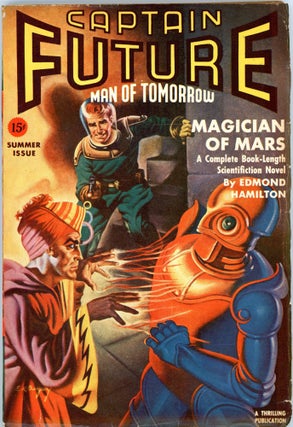
CAPTAIN FUTURE.
New York: Better Publications, Inc., 1941. Octavo, single issue, cover by Earle Bergey, pictorial wrappers. Pulp magazine. "Magician of Mars" by Edmond Hamilton. The only hero pulp magazine solely within the science fiction genre. [Reference: Tymm and Ashley, Science Fiction, Fantasy, and Weird Fiction Magazines, pp. 155-157].

THE DEATH GUARD.
London: Hutchinson & Company, n.d., [1939]. Octavo, pp. [1-4] 5 [6] 7-8 [9-10] 11-431 [432: blank] + 52-page undated publisher's catalogue inserted at rear, original black cloth, front and spine panels stamped in gold. First edition. The author's first and only novel. The novel is narrated by Gregory Beldite, the current owner of Dax-Beldite, a biological research and engineering firm, The Death Guard details the creation and demise of the Flesh Guard, synthetic life forms without thought or emotion designed to replace human beings as soldiers during times of war. Although Dax-Beldite’s operations are secretly funded by the British government, the rest of the world learns of the Flesh Guard’s existence when a small contingent accidentally slaughters an entire village near a research compound in the Congo. Fearing eventual world domination, all the major European nations invade England a pre-emptive measure. The resulting holocaust and carnage caused by the invasion and the defensive deployment of the Flesh Guard is witnessed firsthand by Beldite both on and off the battlefield. Because the Flesh Guard cannot be destroyed by conventional means, the units that are incapacitated or blown to pieces during combat devolve into a self-replicating oviplasm that spawns deformed, mutated organisms that devastate England. Although not published until 1939, The Death Guard, according to Chadwick’s preface was written immediately after World War I. The novel, however, clearly reflects the political climate of the late 1930s. Covering a span of time up to the early 1970s, Chadwick’s novel depicts England as a fascist dictatorship, and Beldite references Hitler as one of the great villains of the recent past. As a future war novel, The Death Guard is ahead of its time, predicting not only nuclear weapons and genetic engineering but also radar tracking systems and remote-controlled unmanned drones. Chadwick’s account of Europe engaged in an arms race that consists of covert weapons development, industrial profiteering, and broken peace treaties anticipates the actual Cold War as series of complex chess moves designed to maintain a delicate balance of power. Well-written and thought-provoking, The Death Guard is a seminal work of science fiction on par with H. G. Wells’ The War of the Worlds. Chadwick’s vision of England as a wasteland overrun by biological horrors recalls the work of William Hope Hodgson, and his critique of the socio-political forces that underlie warfare establishes his novel firmly in the tradition of later classics such as Joe Haldeman’s The Forever War. Despite its rarity and relatively unknown status even today, The Death Guard deserves to be widely acknowledged as a foundational work in the development of science fiction. - Boyd White. "The most horrific of all the future war novels published in the run-up to World War II ... Copies of the original edition are extremely rare, most of the print run having mysteriously vanished when hostilities actually broke out (possibly because the horrific text was considered a threat to morale) ..." - Anatomy of Wonder (1995) 2-18. [Reference: Anatomy of Wonder (2004) II-227. Clarke, Tale of the Future (1978), p. 74. Locke, A Spectrum of Fantasy, p. 49. Sargent, British and American Utopian Literature, 1516-1985, Additions. Bleiler (1948), p.74; (1978), p. 41. Reginald 02793].

THE KING IN YELLOW ...
Chicago: Neely, 1895. Small octavo, pp. [1-2] [1-9] 10-316 [317: ad] [318: blank], original pictorial green cloth, front and spine panels stamped in brown, top edge gilt, other edges untrimmed. First edition. Of the three printings with title pages dated 1895, this one is generally accepted as the first. There is no inserted frontispiece, page [318] is blank, lizard design is on the front cover, and sheets bulk 1.5 cm. The author's second book and first collection of short stories. "One of the most important works of supernatural horror between Edgar Allan Poe and modern horror fiction." - Bleiler (ed), Supernatural Fiction Writers: Fantasy and Horror, p. 739. "Surprisingly vital stories, undoubtedly the best work that Chambers did. A landmark book in abandoning the ghosts of Victorian literary tradition and concentrating on the nightmare." - Bleiler, The Guide to Supernatural Fiction 364. "... one of the basic documents in the history of fantastic fiction." - Bleiler, Science-Fiction: The Early Years 396. [Reference: Bleiler, The Guide to Supernatural Fiction 364. Survey of Modern Fantasy Literature II, pp. 844-47. Barron (ed), Horror Literature 2-12. Sargent, British and American Utopian Literature, 1516-1985, Additions. Tymn (ed), Horror Literature 3-49].
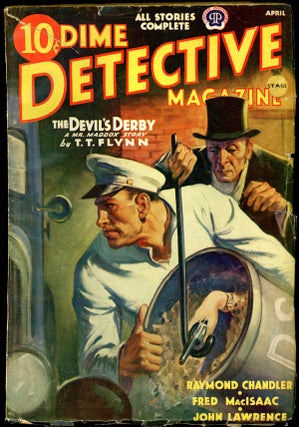
DIME DETECTIVE MAGAZINE.
Chicago: Popular Publications, 1939. Octavo, single issue, pictorial wrappers. Pulp magazine. Features the Raymond Chandler story, "Pearls are a Nuisance". [Reference: Cook, Mystery, Detective and Espionage Magazine, pp. 168-170].

INTERPLANETARY FLIGHT: AN INTRODUCTION TO ASTRONAUTICS ...
London: Temple Press Limited, [1950]. Octavo, cloth. First edition. Clarke's first book. Great associational copy with signatures of many post war science fiction authors, editors and fans. Signed by Clarke and; Walter Gillings, Ted Carnell, John Beynon Harris, C. S. Youd (John Christopher), Eric Williams, William F. Temple, Fred[erick] C. Brown, M. E. Allen, John Frederick Burke, J[ohn] Newman, and one unidentified. All were active in British fandom which met at the White Horse pub in London and all the signatories with the exception of one are on a known list of attendees at the 1948 Whitcon, the first post-war British science fiction convention. "The best modern semi-technical work on astronautics" (Humphries). [Reference: Ciancone 45. Humphries, Rockets and Guided Missiles 21. Ley, Rockets, Missiles, and Space Travel, revised edition, 1957, p. 490].

COSMOS (SERIAL NOVEL).
[Jamaica, New York: Conrad H. Ruppert, 1933-1935.]. Octavo, seventeen parts plus preliminaries, the parts and the two preliminary leaves professionally bound in black cloth. First edition. COSMOS, a legendary collaborative novel by eighteen authors, was published in seventeen parts as supplements to SCIENCE FICTION DIGEST (later FANTASY MAGAZINE), July 1933–January 1935. In order of appearance, contributors were Ralph Milne Farley, David G. Keller, Arthur J. Burks, Bob Olsen, Frances Flagg, John W. Campbell, Rae Winters, Otis Adelbert Kline and E. Hoffmann Price, Abner J. Gelula, Raymond A. Palmer, A. Merritt, J. Harvey Haggard, Edward E. Smith, P. Schuyler Miller, Lloyd A. Eshbach, Eando Binder, and Edmond Hamilton. The title page (designed by Hannes Bok) and table of contents were printed with the final issue. In 1946 Sam Moskowitz estimated that only thirty complete sets of COSMOS existed. [Reference: Moskowitz, The Immortal Storm (1974), p. 16. Pavlat and Evans, Fanzine Index (1965), p. 19].

DOC SAVAGE MAGAZINE.
New York: Street & Smith Publications, Inc., 1933-1949. Octavo, thirty-two volumes, pictorial wrappers uniformly bound in green cloth. A complete file of 181 issues in bound volumes. Doc Savage was a precursor to the modern super hero. Clark "Doc" Savage, Jr. was trained from birth with a rigorous regimen resulting in extraordinary strength and intelligence. He never killed unless necessary, he had scientific gadgets, a headquarters and a secret base (a fortress of solitude). The stories combined mystery, adventure and some science fiction. He also had a team of five experts in various fields to assist in his adventures. His stories were extremely popular during the pulp era and then found a new audience in the 1960s-70s when the series was reprinted in paperback. The novels were written using the house pseudonym of Kenneth Robeson, the main author was Lester Dent who wrote nearly 80% of the novels. Other author contributors as Robeson included William Bogart, Alan Hathway, Harold Davis, Laurence Donovan and W. Ryerson Johnson. There were many excellent contributors to the short stories which rounded out the magazine with authors such as Steve Fisher, E. Hoffman Price, Q. Patrick, John D. MacDonald, Bruno Fischer, Frank Herbert, William Lindsay Gresham, to name a few. Street and Smith publishing executive Henry Ralston and editor John Nanovic established the initial idea for Clark "Doc" Savage, Jr. - ...a brawny 'superman,' a master of many fields-surgeon, mineralogist, engineer, inventor, linguist. His skin was a glowing bronze...his hair was a matching hue, and so too his eyes, resembling gold flake. He would be known as the Man of Bronze."- Server, Encyclopedia of Pulp Fiction Writers, p.81. "Doc Savage was intended to be an adventure character, but under Lester Dent's imaginative manipulations he became something more - the first superhero and an inspiration for countless pulp, comic-book, and television characters." - Cook, Mystery, Detective and Espionage Magazines, pp. 521-527. "The enormously wealthy Doc Savage – headquartered in a fantasticated New York with his five sidekicks, who specialize in various crafts and sciences at the borderline of sf – devotes his life to combating criminal conspiracies, almost all masterminded by the kind of charismatic villain later given definitive form by Ian Fleming in the James Bond books. Doc Savage himself clearly influenced the creation of Superman." - SFE online. A note on artists, Walter Baumhofer contributed the initial look to the character with his striking cover painting through late 1936. Other artists include R[obert] G[eorge] Harris, Emery Clarke, Modest Stein, and George Rozen. An ideal collection for an institution. [Reference: Tymm and Ashley, Science Fiction, Fantasy, and Weird Fiction Magazines, pp. 183-185].
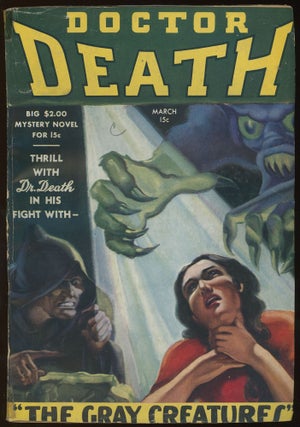
DOCTOR DEATH.
New York: Dell Publishing Co., Inc., 1935. Octavo, single issue, cover by Rudolph Zirm, pictorial wrappers. Pulp magazine. Series character first appeared in All-Detective Magazine. "The Gray Creatures" by Harold Ward writing as "Zorro." [Reference: Tymn and Ashley (eds), Science Fiction, Fantasy, and Weird Fiction Magazines, pp. 186-87].
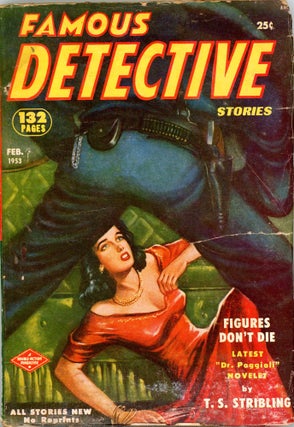
FAMOUS DETECTIVE.
Holyoke, MA: Columbia Publications, Inc., 1953. Octavo, single issue, pictorial wrappers. First edition. Pulp magazine. Fiction by Carroll John Daly, Frank Kane, Philip St. John (Lester del Rey), T. S. Stribling (A Dr. Poggiolo story), and others. [Reference: Cook, Mystery, Detective and Espionage Magazines, pp. 108-111].
![Item #34265 FANTASY: A MAGAZINE OF THRILLING SCIENCE-FICTION. [3 issues, all published]. FANTASY:...](https://jwkbooks.cdn.bibliopolis.com/pictures/34265.jpg?width=320&height=427&fit=bounds&auto=webp&v=1748291944)
FANTASY: A MAGAZINE OF THRILLING SCIENCE-FICTION. [3 issues, all published].
London: Published by George Newnes Ltd., 1938-1939. Octavo, three issues, all covers by S. R. Drigin, pictorial wrappers. Fantasy magazine was a combination of reprints and new materials as well as factual articles. Authors included John Beynon, John Russell Fearn, Eric Frank Russell and others. The magazine was canceled due to the war. "Fantasy 's lifetime was too short to make a value judgment on its position in SF, but there is not denying that Sprigg had considerable editorial acumen and that Fantasy would no doubt have developed into a major magazine" - Tymn and Ashley (eds), Science Fiction, Fantasy, and Weird Fiction Magazines, pp. 254-56.

KILLERS' CARNIVAL.
New York: Farrar & Rinehart Incorporated Publishers, [1932]. Octavo, pp. [1-10] 1-274 [275-278: blank], publisher's red cloth stamped in black, top edge stained gray, other edges rough trimmed. First edition. The dedication is one of the best in hard-boiled fiction: "This book is warningly dedicated to all them fellers whose rackets are so tough they figure guns are sweeter things to pack around then umbrellas." A violent tough guy novel of murder and revenge on the mean streets of New York City. Published in Black Mask in six parts. [Reference: Hubin, p. 282].
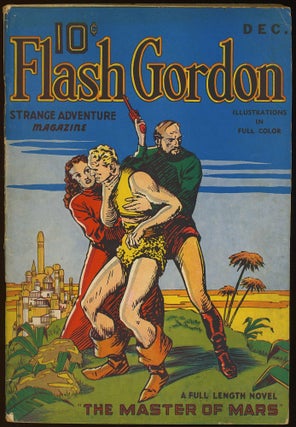
FLASH GORDON STRANGE ADVENTURE MAGAZINE.
New York: C.J.H. Publications, Inc., 1936. Large octavo, single issue, illustrations by Fred Meagher, pictorial wrappers saddle stapled. Pulp magazine. The only issue, which includes eight full page color illustrations. An attempt to blend the comic strip and pulp field which did not find the right audience. Includes the lead story which stars Flash Gordon and three other SF stories. [Reference: Tymm and Ashley, Science Fiction, Fantasy, and Weird Fiction Magazines, pp. 273-274].

BY ROCKET TO THE MOON: THE STORY OF HANS HARDT'S MIRACULOUS FLIGHT.
New York: Sears Publishing Company, Inc., [1931]. Octavo, pp. [1-2] [i-iv] v-vii [viii] ix-xi [xii] 1-303 [304-306] [note: first and last leaves are blanks], eight inserted plates with illustrations by R. V. Grunberg, original pictorial black cloth, front and spine panels stamped in red, top edge stained red, other edges untrimmed. First edition in English. "Boys' book, fairly realistic in its description of the first flight into space ... Despite Atlantis and life on the moon, the author has very carefully used the best scientific and technological data of his day, and much of what he says seems very modern. Successful as a boys' book." - Bleiler, Science-Fiction: The Early Years 829. [Reference: Locke, A Spectrum of Fantasy, p. 88. Bleiler (1978), p. 78. Reginald 05703. Lexikon 2, pp. 117-8. See Bloch (2002) 1090].
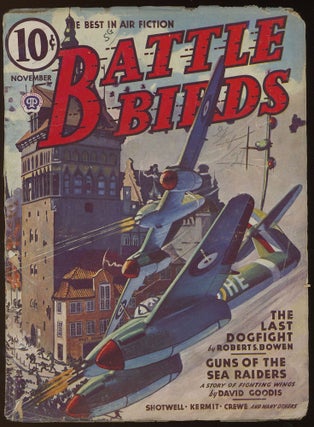
BATTLE BIRDS.
Chicago: Fictioneers, Inc., 1943. Octavo, single issue, pictorial wrappers. Pulp magazine. Air stories. Includes "Guns of the Sea Raiders" by David Goodis. Other fiction by Lance Kermit, Ray P. Shotwell, Robert Sidney Bowen and others.
![Item #30707 THE WOMAN IN BLACK A NOVEL by M. Y. Halidom [pseudonym]. M. Y. Halidom, Alexander Huth](https://jwkbooks.cdn.bibliopolis.com/pictures/30707.jpg?width=320&height=427&fit=bounds&auto=webp&v=1702415373)
THE WOMAN IN BLACK A NOVEL by M. Y. Halidom [pseudonym] ...
London: Greening & Co., Ltd., 1906. Octavo, pp. [i-vii] viii [1] 2-320, original pictorial gray cloth, front panel stamped in yellow and black, spine panel stamped in black and gold. First edition. "Returning to his country home from the Boer War, Ashley Carruthers finds himself a victim of the mysterious Woman in Black who has been terrorizing the village of Abbotswood for over a century. Carruthers soon discovers that the Woman in Black is Mrs. Aubrey de Vere, a seemingly ageless widow, with pointed ears, pronounced canine teeth, and talon-like finger nails, whose breath smells 'like a charnel house.' In addition to her hypnotic sexuality, de Vere is able to project her astral self in the form of a large vampire bat and disappear into thin air at will. De Vere is actually an ancient Egyptian sorceress whose supernatural powers and ability to prolong her life by drinking human blood are granted to her by a magic ring she stole from the mummy of a high priest during the reign of Amenhotep III. The structure of Halidom's novel and its central conceits involve elements cobbled together from VARNEY THE VAMPIRE (1847), DRACULA (1897), and THE BEETLE (1897). While THE WOMAN IN BLACK is not nearly as good as other rare vampire novels like IN THE DWELLINGS OF THE WILDERNESS (1904) or THE MARK OF THE BAT (1928), it is a well-written, highly entertaining read with a number of effective macabre sequences. The novel is also notable for the role that Nurse Everett, a young woman with psychic gifts, plays in the final confrontation with the vampire." (Boyd White). [Reference: Locke, A Spectrum of Fantasy , p. 103].
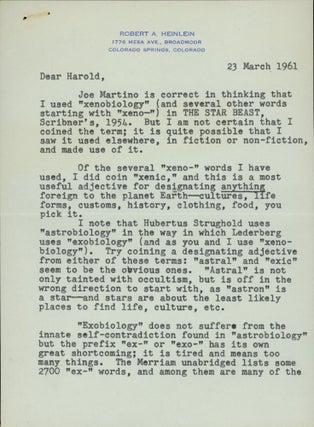
TWO TYPEWRITTEN LETTERS SIGNED (TLsS), two pages, dated 23 March 1961 and one page, dated 26 November 1961, both written on his Colorado Springs, Colorado stationery, from Heinlein to "Dear Harold" [Wooster], both signed "Bob," 1 TYPEWRITTEN LETTER SIGNED (TLS), one page, dated 12 July 1963, on ANALOG letterhead, from Campbell to "Dear Mr. Wooster," signed John W. Campbell, plus carbons of Wooster's letters to Heinlein and Graham DuShane, editor of SCIENCE.
The correspondence relates to an article Dr. Wooster wrote on the coining of the word "xenobiology" (the study of the biology of alien life-forms) generally credited to Heinlein for use in "Star Lummox" (F&SF, May-July 1954; STAR BEAST, Scribner's 1954), which incorporates his correspondence with Heinlein, published in SCIENCE 134: 3473 (July 1961) 223-225. Harold Abbott Wooster (1919-2005) was the chief of the information sciences division of the Air Force Office of Scientific Research in the 1960s, a computer pioneer "whose decades-long career in information science influenced the development of computer technology and medical television ... He left the Air Force's scientific research office, which considered him a pioneer in the information science field, in 1970. From 1970 to 1984, Dr. Wooster worked at the National Library of Medicine's Lister Hill Center for Biomedical Communications. He supervised experiments using television to connect patients in remote areas to doctors" (Washington Post obit 3 June 2005). Dr. Wooster published a single SF story, "Y + Sin X," ASTOUNDING (September 1943). [Reference: See Patterson, William H., Robert A. Heinlein, Volume 2, p. 211].

DUNE serialized in ANALOG SCIENCE FICTION/SCIENCE FACT (eight issues).
New York: Conde Nast Publications, 1963-1965. Large and small octavo, eight issues, pictorial wrappers. Eight issues of Analog with the two serials "Dune World" (December 1963-February 1964) and "The Prophet of Dune" (January-May 1965), revised as the fixup novel DUNE (1965). Themes of intergalactic politics, religion, feudal societies, messiah, and perhaps most important-ecology. Basis for two feature films.